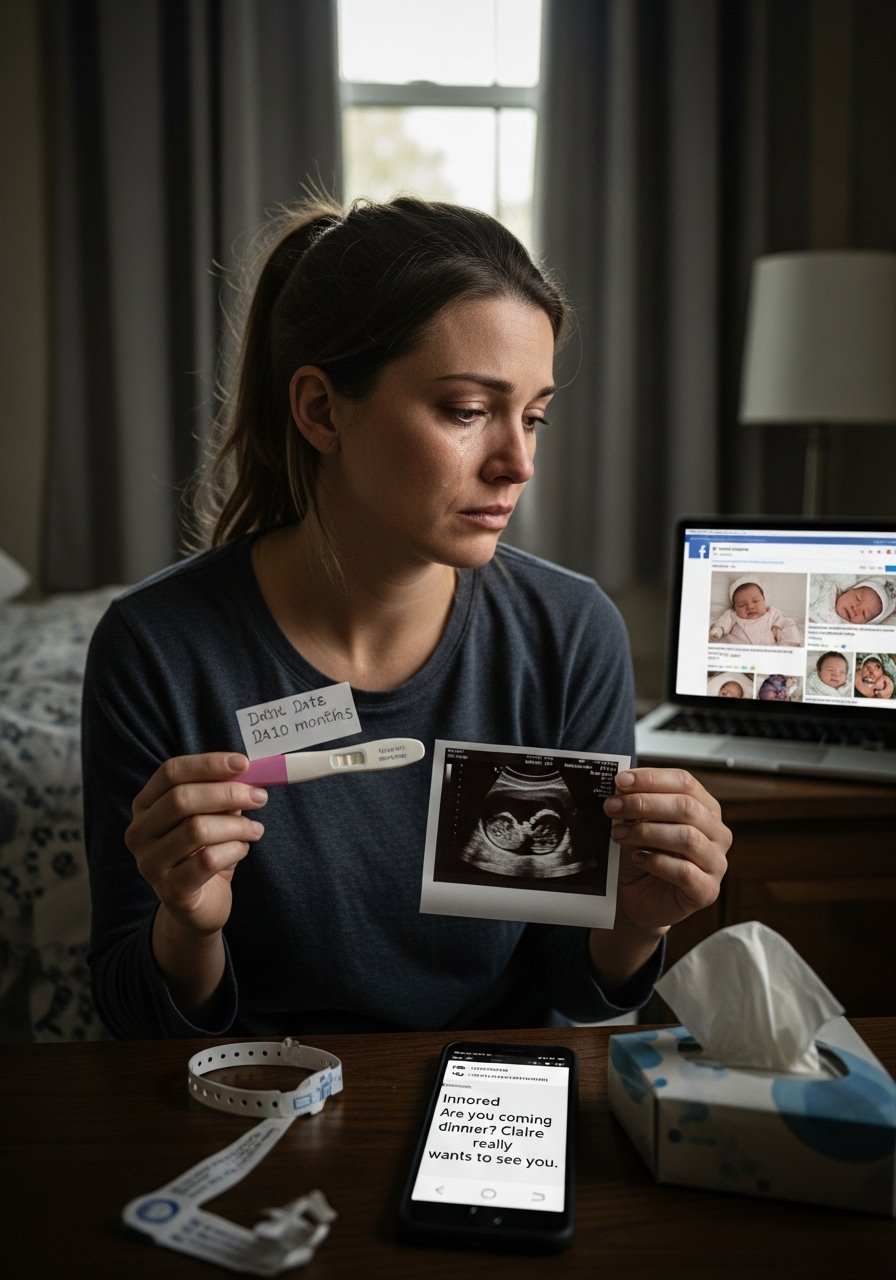
I had a miscarriage six weeks ago. It was my second one this year. I’m devastated, heartbroken, and grieving. But I haven’t told my family.
Not because I don’t need support. Not because I’m ashamed. But because my sister “Claire” is seven months pregnant, and if I tell anyone in my family about my loss, she will somehow make it about her. She will turn my grief into her drama. She will use my miscarriage as an opportunity to center herself and demand attention.
And I just… I can’t. Not this time.
So I’ve been suffering in silence, lying to my family about why I’m “not feeling well,” and avoiding all baby-related conversations. My husband thinks I should tell them. My therapist thinks I’m protecting myself in an unhealthy way. But I know my sister. And I know what will happen if I tell the truth.
Now my family is starting to ask questions. They think I’m pulling away for no reason. They think I’m jealous of Claire’s pregnancy. And I’m wondering: Am I wrong for keeping this secret? Or am I finally learning to protect myself from my narcissistic sister?
The Sister Dynamic
I’m 32. Claire is 29. We’ve never been close, but it took me years to understand why.
Claire is what my therapist calls a “vulnerable narcissist.” Everything is about her—her feelings, her struggles, her triumphs. But unlike the stereotypical loud, boastful narcissist, Claire plays the victim. She’s fragile. She’s sensitive. She’s always suffering more than anyone else.
Some examples from our lives:
When I graduated college (summa cum laude): Claire announced at my graduation dinner that she was thinking about dropping out because school was “too hard” and she “wasn’t smart like me.” The entire dinner became about reassuring Claire that she was intelligent and capable. My graduation was barely mentioned.
When I got engaged: Claire called crying the same day because she’d broken up with her boyfriend and was “going to die alone.” When I tried to tell her about my proposal, she said, “That’s great, but can we talk about my breakup? I really need you right now.”
When I got my dream job: Claire had a meltdown because she’d been rejected from a job she’d applied to. At my celebration dinner, she spent the entire time crying about her rejection while my parents comforted her. When I tried to talk about my new position, my mom said, “Not now, honey. Can’t you see your sister is upset?”
When I bought my first house: Claire announced she was broke and might be evicted. My parents immediately offered to help her with rent. When I asked them to help me with my down payment (they’d promised to), they said the money was “tied up” helping Claire. Spoiler: She wasn’t actually being evicted. She just wanted to move to a nicer apartment.
This pattern has repeated for thirty years. Every milestone I achieve, every happy moment I have, Claire finds a way to eclipse it with her crisis.
And my parents enable it. Always have.
The Pregnancy Announcement
Two years ago, my husband “David” and I decided to start trying for a baby. We were excited, hopeful, ready.
It took us eight months to conceive the first time. When I got pregnant, I was overjoyed. We waited until I was twelve weeks to tell anyone—safely out of the first trimester, or so I thought.
I planned a cute announcement for family dinner. I was going to give my parents a gift box with baby shoes and a note saying “Coming Soon: Your First Grandchild.”
The morning of the dinner, I woke up bleeding.
We rushed to the ER. The ultrasound confirmed what I already knew: I’d lost the baby. I was 13 weeks along. The doctor said it was a missed miscarriage—the baby had stopped developing at 9 weeks, but my body hadn’t recognized it yet.
I was devastated. David was devastated. We went home and cried for hours.
My parents called to ask why we’d cancelled dinner. David said I was sick. We didn’t tell them the truth yet—we needed time to process.
Two days later, while I was still bleeding and grieving, Claire announced on Facebook that SHE was pregnant.
The family group chat exploded with excitement. Congratulations poured in. My mom called Claire crying with joy. My dad posted on Facebook about becoming a grandfather. Claire posted daily bump updates, registry links, and constant commentary about her symptoms.
And I just… watched. Silent. Bleeding. Grieving the baby no one knew I’d lost.
The First Miscarriage Reveal
I waited two weeks before telling my family about my miscarriage. I needed time to grieve privately before dealing with their reactions.
When I finally told them—in person, just my parents—they were sympathetic for about five minutes.
“Oh honey, I’m so sorry,” my mom said, hugging me.
“These things happen,” my dad said awkwardly. “You’re young. You’ll get pregnant again.”
Then my mom’s phone buzzed. Claire was texting.
“Oh, Claire’s having morning sickness again,” my mom said, reading her texts. “Poor thing, she can barely keep anything down. Did I tell you she’s been throwing up six times a day?”
I stared at her. “Mom, I just told you I had a miscarriage.”
“I know, honey, and I’m very sorry. But that’s in the past now. Claire needs support right now—morning sickness is awful.”
That’s when I realized: my grief would never matter as much as Claire’s pregnancy.
Over the next few weeks, every conversation with my family somehow circled back to Claire:
Me: “I’m really struggling with the loss.” Mom: “I understand. You know, Claire is struggling too. She’s so tired and nauseous all the time.”
Me: “David and I are thinking about seeing a fertility specialist.” Dad: “That’s good. Hey, did you see Claire’s ultrasound photos? We’re having a grandson!”
Me: “I’m not sure I can come to Claire’s baby shower. It’s still too painful.” Mom: “You have to come. You’re her sister. Don’t make this about you.”
Don’t make this about ME? My miscarriage, and I wasn’t allowed to make it about me?
Claire’s Behavior
But the worst part was Claire herself.
She called me a week after I told my parents about my miscarriage. I thought maybe she’d finally show some empathy.
“Hey, so Mom told me about your miscarriage,” she said. “I’m sorry.”
“Thanks, Claire. I’m—”
“I’ve been so scared that the same thing will happen to me. Every time I don’t feel the baby move, I panic. Did you have any warning signs? What symptoms did you have before you lost it? I need to know what to watch for.”
She spent forty-five minutes asking me detailed questions about my miscarriage—not because she cared about me, but because she wanted to make sure it wouldn’t happen to HER.
When I finally said I was too upset to keep talking about it, she said, “Oh, I’m sorry. I’m just so anxious about my pregnancy. This is such a scary time for me.”
MY miscarriage was a scary time for HER.
A few weeks later, she posted on Facebook: “Pregnancy after hearing about pregnancy loss is so terrifying. Every day I’m grateful this baby is healthy. Sending love to all the angel mamas out there 💕👼”
She tagged me.
In the comments, people asked who had experienced loss. Claire responded: “My sister recently lost her baby at 13 weeks. It’s made me so much more aware of how precious life is.”
She’d taken my private grief and used it for Facebook sympathy points.
When I texted her asking her to remove the post, she said: “I was trying to honor your loss and raise awareness. Why are you being so sensitive?”
The Baby Shower
Claire’s baby shower was four months after my miscarriage. My mom pressured me relentlessly to attend.
“You need to support your sister.”
“You can’t let your grief stop you from being there for family.”
“What will people think if you don’t come?”
I went. It was torture.
I watched Claire open gifts for the baby I didn’t have. I smiled through games about baby names and parenting advice. I ate cake decorated with a stork and blue booties.
And then Claire gave a speech.
“Thank you all so much for being here. This pregnancy hasn’t been easy—” (She had a completely normal, healthy pregnancy) “—and I’ve been so scared something would go wrong, especially after what happened to my sister.”
Everyone turned to look at me.
“But this baby is strong and healthy, and I’m just so blessed. Some people aren’t as lucky, and I think about that every day.”
She was using my miscarriage in her baby shower speech. To highlight how “blessed” she was.
I left early. My mom followed me outside.
“Where are you going? You’re being so rude!”
“Mom, Claire just used my miscarriage to make herself look grateful in front of her friends.”
“She was being sensitive! She was acknowledging your loss!”
“She was centering herself in MY grief!”
“Everything isn’t always about you!”
I drove home and cried for three hours.
The Second Pregnancy
After months of trying and fertility treatments, I got pregnant again this past summer. I was cautiously optimistic but terrified.
I didn’t tell anyone except David. Not at 6 weeks. Not at 8 weeks. Not at 10 weeks.
I wanted to get past the first trimester. I wanted to feel safe.
Meanwhile, Claire had her baby—a healthy boy. My parents are obsessed. They go over to her house constantly. They post 500 photos a week on Facebook. They text me daily about what their grandson did.
“He smiled today!” “He grabbed my finger!” “He’s the most beautiful baby in the world!”
I’m happy for them. Genuinely. But it’s also painful. Every baby milestone is a reminder of what I’ve lost.
I made it to 11 weeks with my second pregnancy. I was starting to hope. Starting to believe maybe this time would be different.
Then I started bleeding.
The Second Miscarriage
The second miscarriage was worse than the first. Maybe because I’d let myself hope. Maybe because it was my second loss. Maybe because I was just tired of grieving.
The ER confirmed it. Another missed miscarriage. Baby stopped developing at 8 weeks.
I had to have a D&C this time. The recovery was physical and emotional.
David took time off work to take care of me. We grieved together. We held each other and cried.
And we decided: we’re not telling my family.
Not yet. Maybe not ever.
Because I knew exactly what would happen.
What Would Happen If I Told Them
I can predict it with perfect accuracy:
- Initial sympathy from my parents: “Oh honey, we’re so sorry.” (30 seconds)
- Immediate pivot to Claire: “This is going to be so hard for Claire to hear. She’s going to be so upset for you. Should we tell her gently?”
- Claire’s reaction: She’ll call crying. Not for me—about how scared she was during her pregnancy, how she can’t imagine what I’m going through, how grateful she is for her baby, how guilty she feels that her pregnancy worked out and mine didn’t.
- Claire makes it about her: She’ll post on social media about “supporting loved ones through loss” and “being there for family.” She’ll probably share articles about miscarriage (tagging me) and talk about how “hard it is to be happy about your own baby when someone you love is suffering.”
- My parents’ divided attention: Every time I need support, they’ll also be supporting Claire through HER feelings about MY miscarriage.
- Family events become about my loss: Every gathering will feature awkward conversations. People will ask if I’m “okay” while simultaneously cooing over Claire’s baby. Claire will make sure to be extra affectionate with her son in front of me to show how “blessed” she is.
- I become the sad sister: Forever defined by my losses while Claire is defined by her beautiful motherhood.
I cannot do that again. I will not survive that again.
So David and I decided: we keep it secret.
Living the Lie
For six weeks, I’ve been lying to my family.
When they invite me to Sunday dinners, I say I’m not feeling well.
When they ask me to come meet Claire’s baby for the tenth time, I say I’m busy with work.
When my mom calls asking why I seem distant, I say I’m just tired.
My mom thinks I’m being antisocial. My dad thinks I’m jealous of Claire. Claire thinks I’m bitter about her having a baby when I don’t.
Let them think whatever they want. It’s better than the alternative.
David has been incredible. He supports my decision completely. “Your mental health comes first,” he says. “If keeping this private protects you, then that’s what we do.”
But it’s lonely. I’m grieving alone (except for David). I can’t talk about my loss with anyone who knows my family. I can’t post on social media. I can’t accept support from the people who are supposed to love me.
And I’m angry. I’m angry that my sister’s narcissism has robbed me of the ability to grieve openly. I’m angry that my parents enable her. I’m angry that I have to hide my pain to protect myself.
The Questions Start
Last week, my mom confronted me.
“What is going on with you? You’ve been avoiding family for over a month. You won’t come see your nephew. You barely return my calls. Are you upset about something?”
“I’m just dealing with some stuff,” I said vaguely.
“What stuff?”
“Personal stuff.”
“Is it about Claire? Are you jealous that she has a baby?”
“No, Mom. I’m not jealous.”
“Then what is it? Because Claire is really hurt that you haven’t been around. She thinks you don’t care about your nephew.”
“I care about him. I’m just… going through something right now.”
“Well, whatever it is, you need to get over it. Family is important. Claire needs you. The baby needs his aunt.”
I wanted to scream. I wanted to tell her everything. I wanted to say: “I had a miscarriage six weeks ago and I’m barely holding it together, but I can’t tell you because Claire will make it about herself and I cannot handle that right now.”
But I didn’t. I just said I’d try to come to the next family dinner.
Claire’s “Concern”
Yesterday, Claire texted me:
“Hey, I’m worried about you. Mom says you’re pulling away from the family. Is everything okay? Are you mad at me for some reason?”
I didn’t respond immediately. I needed to think about what to say.
She texted again: “I know it must be hard seeing me with a baby when you’ve had losses. But you can’t let that come between us. We’re sisters. And my son needs his aunt in his life. You’re missing out on so much.”
There it was. She’d made my absence about her. About what I’m missing. About what her son needs.
Not “are you okay?” Not “do you need support?” But “you’re hurting my feelings by not being present for MY baby.”
I texted back: “I’m going through something personal. It has nothing to do with you.”
She responded immediately: “Well, it affects me when my sister disappears from my life right after I have a baby. People are starting to ask questions. It makes me look bad, like I did something wrong.”
“This isn’t about you, Claire.”
“Everything you do affects me. We’re family. If you’re struggling with something, you should tell me so I can help.”
I didn’t respond. Because I know exactly what would happen if I told her.
My Therapist’s Take
I’ve been seeing a therapist for three years (partly because of my family dynamics, partly for infertility grief). She knows all about Claire.
When I told her I was keeping the second miscarriage secret, she had mixed feelings.
“I understand why you’re doing it,” she said. “Your sister has a pattern of making your pain about her, and your parents enable it. You’re protecting yourself.”
“But?”
“But keeping secrets takes energy. You’re spending emotional resources maintaining a lie instead of grieving openly. And you deserve support.”
“I can’t get support from my family. Not without it becoming about Claire.”
“What about friends? Other relatives? A support group?”
“I have David. That’s enough.”
She looked skeptical. “Is it?”
Honestly? I don’t know. Some days I feel fine keeping this private. Other days I feel so alone I can barely breathe.
But I still think it’s better than the alternative.
David’s Perspective
David completely supports my decision, but he’s also worried about me.
“I hate that you’re going through this alone,” he said last night. “I hate that your family is so dysfunctional that you can’t even tell them you had a miscarriage.”
“I’m not alone. I have you.”
“I know. But you should be able to tell your mom. You should be able to cry with your sister. This is fucked up.”
“It is fucked up. But it’s reality. And I’m making the choice that protects me.”
“I support you. But I also think… maybe you need to consider going low contact with your family. At least with Claire. This dynamic isn’t healthy.”
He’s probably right. But the idea of distancing myself from my family feels like failure. Like Claire wins.
Though maybe she’s already won. Maybe she won years ago, and I’m just finally recognizing it.
The Upcoming Holiday
Thanksgiving is in two weeks. My family always does a big dinner at my parents’ house. Claire will be there with her baby.
My mom has already called three times asking if I’m coming.
“Of course you’re coming. It’s Thanksgiving. It’s tradition.”
“I’ll let you know.”
“What do you mean you’ll let me know? It’s family. You come to family Thanksgiving.”
“I might not be up for it this year.”
“Because of Claire? Because you’re jealous?”
“I’m not jealous, Mom.”
“Then what is it? Because Claire is really hurt by your behavior. She thinks you hate her baby.”
“I don’t hate her baby.”
“Then prove it. Come to Thanksgiving. Be a good sister and a good aunt.”
David says we should skip it. “Let’s go away for Thanksgiving. Just us. We’ll go somewhere quiet and grieve and start healing.”
That sounds amazing. But it also sounds like giving up. Like letting Claire drive me away from my own family.
I don’t know what to do.
The Moral Dilemma
Here’s what I keep wrestling with:
Am I wrong for keeping this secret?
Part of me says yes. Keeping secrets is generally unhealthy. I’m depriving myself of potential support. I’m lying to my family. I’m letting them think I’m jealous or petty when really I’m grieving.
But another part of me says no. I’m protecting myself from predictable emotional harm. I’m choosing my mental health over my family’s expectations. I’m setting a boundary—even if it’s an invisible one.
Am I being unfair to Claire?
She doesn’t know I had a miscarriage. She doesn’t know why I’m distant. She thinks I’m mad at her or jealous of her.
In some ways, I’m judging her for behavior she hasn’t even done yet. I’m preemptively punishing her for what I know she’ll do.
But is that unfair? Or is it learning from thirty years of experience?
Am I enabling the dysfunction?
My therapist asked me this: “By keeping the secret, are you allowing the dysfunctional pattern to continue? If you never confront Claire’s behavior, how will it ever change?”
Good question. But also: it’s not my job to fix Claire. It’s not my responsibility to teach her empathy through my pain.
What do I owe my family?
Do I owe them the truth? Do I owe them access to my grief? Do I owe them the opportunity to support me, even if I know they’ll fail?
Or do I owe myself protection first?
The Breaking Point
This morning, my mom called again.
“I need to know what’s going on with you. Your father and I are worried. Your sister is hurt. This has gone on long enough.”
“Mom, I’m going through something personal.”
“What personal thing? What’s so personal you can’t tell your own mother?”
I felt something snap inside me.
“I had a miscarriage,” I said. “Six weeks ago. My second one this year. That’s why I’ve been distant. That’s why I haven’t been around. I’m grieving.”
Silence.
Then: “Oh honey. Oh no. I’m so sorry.”
“Thank you.”
“Why didn’t you tell us?”
“Because I knew what would happen.”
“What do you mean?”
“I mean that Claire would make it about her. Just like she did with my first miscarriage. Just like she does with everything.”
“That’s not fair—”
“Mom, last time I had a miscarriage, you told me I couldn’t make it ‘about me’ and that I needed to support Claire through her pregnancy. Claire used my loss in her baby shower speech. She posted about it on Facebook without my permission. She called me to ask about my symptoms because she was worried about HER pregnancy. Do you really not see the pattern?”
More silence.
“I think you’re being very unfair to your sister. She was trying to be supportive.”
And there it was. Exactly what I knew would happen.
“Mom, I have to go.”
“Wait—does Claire know? Should I tell her?”
“No. Do not tell Claire.”
“But she’s your sister—”
“Mom, I’m asking you not to tell her. Please respect that.”
“I… okay. But we need to talk about this more. And you should really tell her yourself. She’d want to support you.”
I hung up.
The Aftermath of Telling
It’s been six hours since I told my mom. Here’s what’s happened:
- My dad called. “Your mother told me. I’m sorry for your loss. Let us know if you need anything.” (Most normal response so far.)
- My mom texted: “I’ve been thinking about what you said about Claire. I think you’re wrong, but I won’t tell her if you don’t want me to. But I do think you’re being unfair to her.”
- My mom texted again: “Also, Claire mentioned yesterday that she’s struggling with postpartum anxiety. She’s having a really hard time. I think she could really use her sister right now.”
There it is. I tell my mom I had a miscarriage, and within hours she’s telling me that Claire needs support.
The Question
So here’s what I need to know: Am I the asshole for keeping my miscarriage secret from my family because I knew my narcissistic sister would make it about herself?
People who think I’m wrong:
- I deprived myself of support by keeping secrets
- I judged Claire unfairly for something she hadn’t done yet
- I let my past experiences prevent possible growth
- I should have given my family a chance
- Keeping secrets is unhealthy
- I’m being unfair to Claire by assuming the worst
People who think I’m right:
- I protected myself from predictable emotional harm
- Past behavior is the best predictor of future behavior
- I don’t owe anyone access to my grief
- My mental health comes first
- I set a boundary, even if invisibly
- Claire has never shown evidence of change
I’m exhausted. I’m grieving. I’m angry. And I don’t know if I did the right thing.
What would you have done?
UPDATE (3 days later):
My mom told Claire. Despite me explicitly asking her not to.
Claire called me crying. “Why didn’t you tell me? I’m your sister! I could have been there for you!”
“Claire, I needed space to grieve privately.”
“But I went through pregnancy! I understand how scary it is! I could have helped!”
“I didn’t need help. I needed space.”
“This makes me feel terrible. Like you don’t trust me. Like you think I’m a bad sister.”
And there it is. My miscarriage is now about Claire’s hurt feelings.
I’m done. I’m going low contact with my entire family. David and I are spending Thanksgiving alone.
I’m grieving my babies. And I’m grieving the family I wish I had.