When grandparents undermine parenting rules in the name of Christmas generosity, one mother’s response sparked a family war that’s still raging.
Christmas morning is supposed to be magical. The excitement in children’s eyes, the joy of giving, the warmth of family traditions. For most parents, it’s a day they spend months planning and anticipating.
For 32-year-old Emma Richardson, this Christmas morning turned into a nightmare that would fracture her family for months to come.
The presents were under the tree. Her two children—ages 6 and 4—were buzzing with excitement. Her husband was making coffee. Everything seemed perfect until Emma started reading the gift tags.
“From Santa,” they read. All twelve of them. Twelve expensive presents from “Santa” that violated the one clear, repeatedly communicated boundary Emma and her husband had set with family: a four-gift limit per child.
What happened next has divided her entire extended family, led to accusations of cruelty and control, and raised fundamental questions about grandparents’ rights, parental authority, and whether Emma’s response was justified or extreme.
Because Emma didn’t just return the gifts. She didn’t just have a conversation with her in-laws.
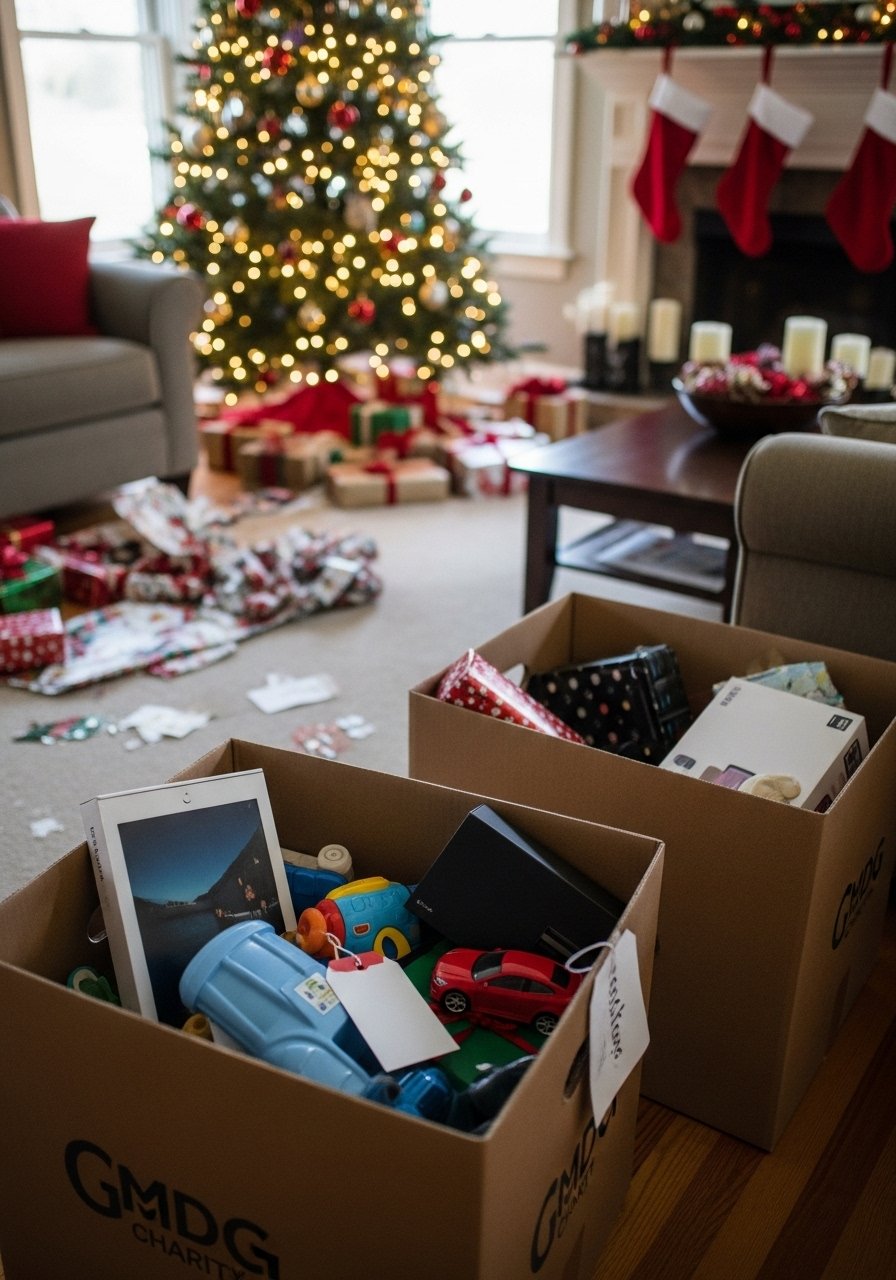
She donated every single present to a local children’s charity while her kids were napping. All twelve of them. Gone.
Now, three weeks later, her mother-in-law isn’t speaking to her, her husband is sleeping in the guest room, and half the family is calling her a monster who “ruined Christmas” for her own children.
But Emma says she’d do it again.
The Four-Gift Rule
To understand Emma’s reaction, you need to understand the rule—and why it existed in the first place.
Emma and her husband, David, established what they call the “Four-Gift Rule” when their oldest child turned three. Each child would receive four gifts at Christmas: Something they want, something they need, something to wear, and something to read.
“It wasn’t about being cheap or depriving our kids,” Emma explains. “It was about teaching them that Christmas isn’t just about getting a mountain of stuff. It was about intention, gratitude, and not raising spoiled children who expect everything they see.”
The rule extended to extended family as well. Grandparents, aunts, uncles—everyone was asked to stick to one meaningful gift per child, or to contribute to experiences like zoo memberships or savings accounts for college.
“We explained this to everyone multiple times,” Emma says. “We sent an email two years ago when we implemented it. We reminded people before birthdays and holidays. This wasn’t sprung on anyone.”
David’s parents—Joyce and Richard—had always struggled with the boundary.
“My mother-in-law thinks love equals stuff,” Emma says. “The more presents, the more love you’re showing. She sees our rule as us being controlling and depriving her grandchildren.”
Previous holidays had featured “discussions”—Joyce would show up with extra gifts, Emma and David would pull her aside, and eventually the extras would be returned or saved for later. It was an ongoing tension, but it had never exploded quite like this.
Until Joyce decided to invoke Santa.
Christmas Eve: The Setup
David’s family has a tradition of gathering on Christmas Eve. Everyone exchanges gifts, eats dinner, and the kids get to open one present before bed.
This year, Joyce and Richard arrived with their usual wrapped gifts—one per child, as requested. The kids opened them: a craft kit for the oldest, a puzzle for the youngest. Age-appropriate, thoughtful gifts. Emma breathed a sigh of relief.
“I actually thanked her,” Emma recalls. “I told her the gifts were perfect. I thought we’d finally gotten through to her.”
What Emma didn’t know was that Joyce had a plan.
“She asked if the kids had put out cookies for Santa yet,” Emma says. “She made a big deal about it, helped them arrange everything. She was so enthusiastic. I thought she was just being a sweet grandmother.”
After David’s family left, Emma and David did their usual Christmas Eve routine: baths, pajamas, reading ‘Twas the Night Before Christmas, tucking the kids in with reminders that Santa was coming.
Then Emma and David brought out the four gifts they’d carefully chosen for each child. They arranged them under the tree, ate the cookies “Santa” left behind, and went to bed feeling like everything was perfect.
Christmas Morning: The Discovery
Emma woke up at 6 AM to excited children bouncing on her bed. “Santa came! Santa came!”
She and David stumbled downstairs, coffee-deprived but happy, ready to watch their kids’ faces light up as they opened their eight carefully chosen presents.
Instead, they found twenty presents under the tree.
“My stomach dropped,” Emma says. “I counted them three times. We’d put out eight. There were twenty.”
Twelve additional presents, all labeled “From Santa,” had appeared overnight.
David was confused. Emma was immediately suspicious. She checked the front door—locked. She checked the back door—locked. The only people with a key to their house were David’s parents.
“I knew immediately what had happened,” Emma says. “Joyce had asked about Santa cookies to find out our routine. She waited until she knew we’d be asleep, then she let herself in and put all those presents under our tree.”
Emma woke David up fully and showed him the presents. He was shocked but tried to downplay it.
“He said maybe we should just let it go this one time, that it was Christmas morning, that the kids were excited,” Emma recalls. “But I was furious. This wasn’t just breaking our rule. This was sneaking into our house, undermining our parenting, and using Santa—something our kids believe in—to do it.”
The Unwrapping Reveals the Scale
As the kids started opening presents, the full scope of Joyce’s gift-giving became clear.
The additional presents included:
- An expensive electronic tablet for the 6-year-old (something Emma and David had explicitly said they weren’t ready for)
- A motorized ride-on car for the 4-year-old (something they’d said no to because they had no space for it)
- Designer clothes (multiple outfits per child)
- High-end toys (several trending items from this year’s commercials)
- Art supplies and games (duplicates of things the kids already had)
Emma estimates the value at over $800.
“These weren’t thoughtful gifts,” Emma says. “These were expensive status items. The tablet especially—we’d told her multiple times we weren’t doing screens for our oldest yet. She bought it anyway and disguised it as coming from Santa so we couldn’t say no without looking like the bad guys.”
David tried calling his mother. No answer. He texted. No response.
The kids were in heaven, surrounded by more presents than they’d ever seen. They didn’t understand why their mother looked angry instead of happy.
“That’s what killed me,” Emma says. “They were so excited. But this wasn’t about making them happy. This was about Joyce proving she could override our rules. She used Santa—something sacred to our kids—as a weapon against our parenting.”
The Decision
While David tried to reach his parents, Emma made a decision.
“I told him I was donating everything that wasn’t from us,” she says. “He thought I was joking. I wasn’t.”
She told the kids that Santa had made a mistake and delivered presents meant for children who didn’t have any toys to a wrong house by accident, and that they needed to help fix Santa’s error by making sure those presents got to the right children.
“I framed it as them being Santa’s helpers,” Emma explains. “I told them they were doing something very kind and that Santa would be proud of them for making sure other kids had a good Christmas too.”
Her oldest asked if they could keep one of the extra presents. Emma said no—Santa had already brought them their four perfect presents, and these other presents belonged to children who hadn’t gotten anything.
To her surprise, the kids accepted this explanation without much protest.
“They were disappointed for about five minutes,” Emma says. “Then they got interested in playing with the gifts they actually were supposed to get. Four-year-olds have short attention spans, thankfully.”
While the kids played with their actual presents, Emma loaded all twelve of Joyce’s gifts into her car. She drove to a local charity that provides Christmas gifts to families in need and donated everything.
She took photos as proof. She got a receipt. She sent both to her mother-in-law with a message:
“You broke into our home. You violated our clearly stated boundaries. You used our children’s belief in Santa to undermine our parenting. These gifts have been donated to children who actually need them. Do not ever enter our home without permission again. We will be changing the locks.”
Then she blocked her mother-in-law’s number and went back inside to make Christmas breakfast.
The Explosion
Joyce’s response came through David’s phone: over a dozen text messages, multiple missed calls, and eventually a voicemail that David described as “unhinged.”
According to David, his mother was:
- Sobbing hysterically
- Calling Emma cruel and heartless
- Claiming Emma had “robbed” her grandchildren
- Insisting she had a right to spoil her grandchildren
- Threatening to call Child Protective Services for “emotional abuse”
- Demanding David “control his wife”
Richard, David’s father, sent his own message calling Emma “vindictive and unstable” and saying they would be consulting a lawyer about “grandparents’ rights.”
David’s brother called him, furious, saying Emma had “gone too far” and that their mother was “devastated.”
David’s sister sent a long message about how Emma was “punishing children to make a point” and that the whole family thought she’d overreacted.
Family members Emma had never even met started commenting on Facebook about the situation (Joyce had posted her version of events to a grandmother support group, which had then been shared publicly).
Within 24 hours, Emma had been labeled a narcissist, an abuser, mentally unstable, and cruel. Multiple people suggested David should divorce her for the sake of the children.
“It was insane,” Emma says. “According to his family, I’m the problem. Not the woman who broke into our house to override our parenting. Not the woman who tried to use Santa as a manipulation tool. Me, for setting a boundary.”
David’s Position
Perhaps most painfully, David didn’t fully support Emma’s decision.
“He agrees his mother was wrong,” Emma says. “He agrees she crossed a line. But he thinks I went nuclear when we could have handled it differently.”
David’s preferred approach would have been:
- Let the kids keep the presents for Christmas Day
- Have a serious conversation with his parents afterward
- Return the presents later, out of the kids’ sight
- Issue a final warning about future boundaries
“He thinks I traumatized our kids by taking away their presents on Christmas morning,” Emma says. “He thinks I could have made my point without being so extreme.”
This disagreement has created a rift in Emma and David’s marriage. He’s been sleeping in the guest room since December 26th. They’re barely speaking except about logistics with the kids.
“He’s mad at both me and his mother,” Emma explains. “But he’s taking it out on me because I’m here. He keeps saying I’ve made everything worse, that now we’ll never have peace with his family.”
David has refused to change the locks, saying it’s “too inflammatory.” He’s been taking the kids to visit his parents at their house, without Emma.
“He says the kids shouldn’t be punished for adult drama,” Emma says. “I say I’m not comfortable with unsupervised visits with someone who has proven she’ll undermine our rules and has threatened to call CPS on us.”
The Children’s Response
Interestingly, Emma and David’s children seem largely unaffected by the incident.
“They ask about Grandma Joyce sometimes,” Emma says. “But they’re not traumatized. They’re not sitting around crying about lost presents. They played with their four gifts all day Christmas and have barely mentioned the other presents since.”
Emma’s oldest did ask once why Grandma couldn’t visit anymore.
“I told her Grandma made some choices that broke our family rules, and that grown-ups need time to talk about it,” Emma explains. “She said ‘okay’ and went back to playing with her craft kit.”
Child psychologist Dr. Patricia Chen says this response is actually quite normal.
“Children are remarkably resilient, especially young children,” Dr. Chen explains. “The idea that they’re traumatized by not receiving excessive gifts is usually projection from adults who are uncomfortable with the boundary-setting. Most children are perfectly content with a few meaningful gifts and actually struggle with the overwhelm of receiving too much.”
Dr. Chen adds: “The concern isn’t about the gifts. The concern is about the child being used as a pawn in adult conflict. In this case, that happened when the grandmother used ‘Santa’ to override the parents’ rules, not when the mother enforced the boundary.”
The Grandparents’ Rights Claim
Joyce and Richard’s threat to pursue “grandparents’ rights” has added another layer of stress.
In most states, grandparents’ rights are extremely limited and typically only apply in cases of:
- Death of a parent
- Divorce or separation
- Existing custody arrangement being disrupted
- Evidence of parental unfitness
“My kids have two living, married parents with no history of abuse or neglect,” Emma says. “A lawyer I consulted laughed at the idea that they’d have any case. But the threat alone is stressful.”
The grandparents’ rights movement has become increasingly vocal in recent years, with some grandparents arguing they should have legally protected access to grandchildren regardless of parents’ wishes.
Family law attorney Michael Torres says these cases rarely succeed unless there are extenuating circumstances.
“Courts overwhelmingly favor parental rights,” Torres explains. “Unless there’s evidence that cutting off grandparent contact is actively harming the child, or unless the grandparents can demonstrate an existing legal relationship that gives them standing, these cases don’t go anywhere.”
He adds: “In this case, the grandparents broke into the home and violated clearly established boundaries. A judge would not look favorably on that.”
The Extended Family Fallout
The conflict has fractured David’s entire extended family.
David’s brother and sister are firmly on Joyce’s side. They’ve told David he needs to “rein in” his wife and that Emma is destroying the family.
Several cousins have taken Emma’s side, privately messaging her support and sharing their own stories of Joyce’s boundary violations over the years.
David’s aunt sent a message calling both Emma and Joyce “wrong” and begging everyone to just “let it go and move forward.”
Family group chats have become war zones. The family’s annual New Year’s gathering was cancelled because half the family refused to attend if Emma was invited, and the other half refused to attend if she wasn’t.
“I feel terrible that David’s losing his family over this,” Emma says. “But I also can’t bring myself to apologize for setting a boundary. What message does that send to our kids? That they should accept boundary violations to keep the peace?”
The Online Reaction
When Joyce posted about the situation in her grandmother support group, the responses were divided but passionate.
One camp agreed with Joyce:
- “Grandparents should be able to spoil their grandchildren”
- “This mother is controlling and abusive”
- “Those poor children lost all their presents on Christmas!”
- “One day she’ll need those grandparents for help and they’ll remember this”
The other camp supported Emma:
- “Parents set the rules, period”
- “Breaking into someone’s house is never okay”
- “This wasn’t about the kids, it was about the grandmother’s ego”
- “Good for this mom for standing firm on her boundaries”
The post was eventually shared to Reddit, where it gained over 15,000 comments in various parenting forums.
The Reddit response was overwhelmingly supportive of Emma, with many commenters sharing similar stories of grandparents who used gifts to undermine parental authority.
Common themes in supportive comments included:
- Recognition that this was about control, not generosity
- Acknowledgment that breaking into the home was a serious violation
- Agreement that using Santa to override parents was manipulative
- Support for enforcing consequences when boundaries are crossed
However, even among Emma’s supporters, many thought the timing was harsh.
“I agree with what you did but maybe not when you did it,” one commenter wrote. “Could you have waited until the 26th to donate the gifts?”
Emma’s response: “No. Because then the kids would have played with them, bonded with them, and removing them later would have actually been traumatic. It had to be immediate.”
The Question of Proportionality
The central debate around Emma’s response comes down to one question: Was the punishment proportional to the crime?
Critics argue:
- The presents were given with good intentions, even if misguided
- Emma could have made her point without involving the children
- Donating gifts on Christmas morning was cruel
- Emma prioritized being “right” over her children’s happiness
- There were other ways to enforce boundaries
Supporters counter:
- Joyce’s actions were premeditated and manipulative
- Allowing the boundary violation to stand would have encouraged future violations
- The children were fine and Emma handled it age-appropriately
- Sometimes consequences need to be immediate and clear
- Emma’s first priority is raising her children according to her values
Family therapist Dr. Lisa Morton says both perspectives have merit.
“Emma’s boundary was reasonable, and Joyce’s violation was serious,” Dr. Morton explains. “Breaking into someone’s home to override their parenting decisions is concerning behavior. Emma had a right to respond firmly.”
However, Dr. Morton adds: “The question is whether this response will actually achieve Emma’s goals. If the goal is to maintain a relationship with extended family while enforcing boundaries, this approach may have been counterproductive. If the goal is to send an unmistakable message that boundaries are non-negotiable, it succeeded.”
What Emma Could Have Done Differently
Looking back, Emma acknowledges there might have been other approaches:
Option 1: Delay the donation Let the kids play with the gifts on Christmas, then quietly donate them over the following days, framing it as “making room for new toys” or “helping other children.”
Option 2: Return instead of donate Take the gifts back to the store and use the money for the kids’ college funds, showing them the account growth as a “different kind of present.”
Option 3: Controlled access Keep the gifts but only allow access to them at specific times, as a way of teaching delayed gratification and limiting the “avalanche” effect.
Option 4: Third-party storage Store the gifts at a neutral location (a friend’s house) while she and David decided how to handle it together.
“Maybe those options would have worked,” Emma says. “But they all involve compromising on my boundary. They all involve letting Joyce’s violation partially succeed. And I wasn’t willing to do that.”
The Bigger Issue: Weaponized Generosity
Beyond this specific incident, Emma’s story highlights a larger problem: grandparents who use gift-giving as a way to undermine parental authority.
Dr. Chen calls this “weaponized generosity.”
“It’s when gifts become a tool of control rather than an expression of love,” she explains. “The gift-giver creates a situation where refusing the gift makes you look ungrateful or mean, even when accepting it violates your values or boundaries.”
Signs of weaponized generosity include:
- Giving gifts that explicitly violate stated rules
- Giving in secret or behind parents’ backs
- Using gifts to compete with parents for children’s affection
- Claiming gifts are “for the children” when they’re really about the giver’s feelings
- Responding to gift refusal with emotional manipulation
- Characterizing boundary enforcement as “depriving” children
“This isn’t about whether grandparents should be allowed to give gifts,” Dr. Chen says. “It’s about whether they should be allowed to override parents’ decisions by using gifts as leverage.”
The Santa Complication
Joyce’s decision to label the gifts as being from Santa added another layer to the violation.
Child development experts generally agree that Santa should be used to support family values, not undermine them.
“When children believe in Santa, they believe he knows if they’ve been naughty or nice, that he brings gifts based on that assessment,” explains Dr. Raymond Hughes, a child psychologist. “Using Santa to deliver gifts that violate family rules sends confusing messages about authority and values.”
In this case, Joyce effectively told Emma’s children that Santa:
- Overrides their parents’ rules
- Values quantity of gifts over quality
- Rewards them regardless of family values about materialism
“It’s one thing for a grandparent to give an extra present openly,” Dr. Hughes says. “It’s another to use Santa as a cover for undermining the parents. That’s not just about the gift—it’s about manipulating the child’s understanding of authority and truth.”
Where Things Stand Now
Three weeks after Christmas, the Richardson family remains fractured.
Emma and David are in marriage counseling, trying to navigate their different perspectives on the incident and its aftermath.
Emma has had no contact with Joyce or Richard and has no plans to resume contact unless they acknowledge their violation and agree to respect future boundaries.
David continues to take the children to visit his parents on weekends. Joyce has reportedly been instructed by David not to discuss the incident with the kids and not to give them any gifts.
David’s siblings are not speaking to Emma. Several extended family members have taken sides, creating rifts throughout the family.
The kids, according to Emma, are thriving and seem unbothered by the drama.
“They ask about Grandma sometimes,” Emma says. “But they’re resilient. They have grandparents on my side who respect our parenting. They have friends, activities, stability at home. They’re okay.”
As for whether Emma regrets her response, she’s unequivocal.
“I don’t regret it at all,” she says. “I regret that it was necessary. I regret that my mother-in-law pushed things to this point. But I don’t regret standing up for my family’s values and protecting my authority as a parent.”
She adds: “My kids will grow up knowing that their parents’ rules matter. That boundaries are real and have consequences. That love doesn’t mean letting people disrespect you. Those are lessons worth teaching, even if they come with a cost.”
The Path Forward
For families wondering how to prevent similar conflicts, experts offer several suggestions:
For Parents:
- Communicate boundaries clearly and in writing
- Have conversations early, before conflicts arise
- Be consistent in enforcing boundaries
- Don’t make exceptions “just this once”
- United front between partners is essential
- Be willing to accept the consequences of boundary enforcement
For Grandparents:
- Listen when parents set rules, even if you disagree
- Remember that parenting styles may differ from your own
- Channel generosity into parent-approved avenues
- Ask before giving, especially for big-ticket items
- Accept that your role is to support, not override
- Focus on relationship, not competition
For Extended Family:
- Don’t take sides publicly in family conflicts
- Offer support without judgment
- Respect both parties’ perspectives
- Avoid gossip and social media warfare
- Remember that children’s wellbeing comes first
Dr. Morton emphasizes that repair is possible, but requires genuine acknowledgment from Joyce.
“For this family to heal, the grandmother needs to take accountability for the violation,” Dr. Morton says. “Not just apologize for ‘upsetting’ Emma, but genuinely acknowledge that breaking into their home and undermining their parenting was wrong. Without that, any reconciliation will be superficial.”
The Unanswered Questions
As Emma’s story continues to circulate online, it raises questions that don’t have easy answers:
- Where’s the line between grandparental generosity and parental authority?
- How much control should parents have over gifts given to their children?
- What makes a consequence “appropriate” versus “excessive”?
- How do you balance family harmony with boundary enforcement?
- Should children ever be involved in adult conflict resolution?
- What obligations do we have to maintain relationships with family members who disrespect us?
These are questions every family must answer for themselves, based on their own values, dynamics, and priorities.
Final Thoughts
Emma Richardson’s Christmas morning decision has become a lightning rod for debates about parenting, boundaries, and family dynamics.
To some, she’s a hero—a mother who refused to be steamrolled and taught her children that values matter more than stuff.
To others, she’s a villain—a controlling parent who prioritized making a point over her children’s happiness on Christmas morning.
The truth, as is often the case, is probably more complex than either narrative.
What’s clear is that Emma’s story resonates because it touches on universal tensions: the struggle between generations, the challenge of setting boundaries with people we love, the difficulty of standing firm when everyone around you says you’re wrong.
“I know a lot of people think I’m terrible,” Emma says. “That’s okay. I’m not parenting by popular vote. I’m parenting according to the values my husband and I chose for our family. And if that makes me the villain in some people’s stories, I can live with that.”
She pauses, then adds: “My kids won’t remember the presents they didn’t get. But they will remember growing up in a home where their parents’ word mattered, where boundaries were real, and where love wasn’t measured in stuff. That’s the legacy I’m choosing.”
Whether you agree with Emma’s methods or not, one thing is certain: her Christmas morning decision will be talked about in her family for years to come—a moment when one mother drew a line in the sand and refused to cross it, no matter the cost.
What do you think? Was Emma’s response justified or too extreme? Share your thoughts in the comments below.