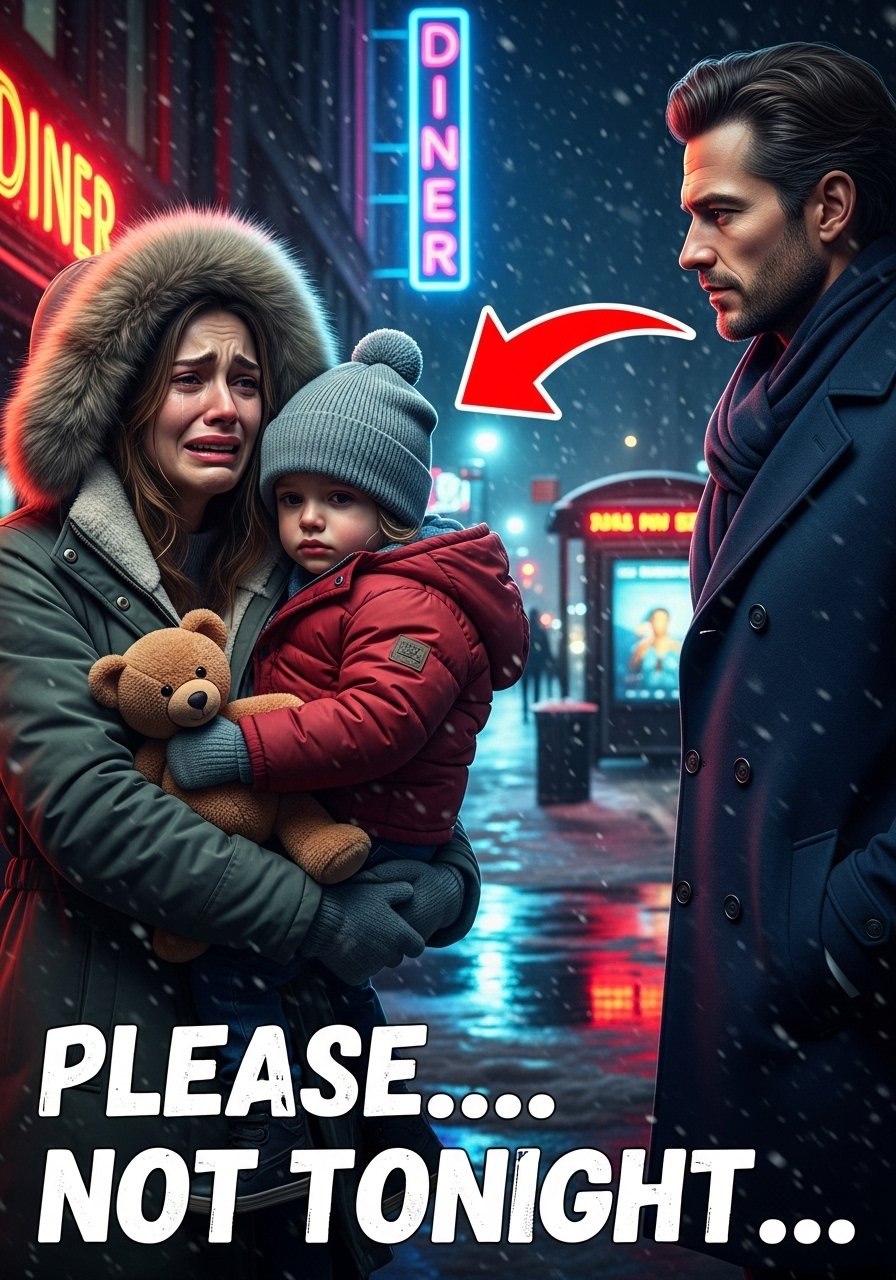
The cold in Minneapolis doesn’t just chill your skin; it reaches for your bones and tries to snap them. It was 11:42 PM on a Tuesday, and I was standing under the flickering neon sign of a closed gas station, holding my three-year-old son, Toby.
He was wrapped in three layers of mismatched sweaters, his small face tucked into my neck. I could feel his shivering starting to slow down, which terrified me more than the shaking. That’s when the hypothermia starts to win.
The Fall from Grace
Six months ago, I was a paralegal with a steady paycheck and a two-bedroom apartment. But life has a way of pulling the rug out from under you when you least expect it. A medical emergency led to a mountain of debt, which led to a missed rent payment, which led to an eviction notice. My “support system”—the friends who liked my photos on Instagram and the family who promised to “always be there”—vanished the moment I actually needed a place to sleep.
My mother told me she couldn’t “risk her lease” by letting us stay. My ex-husband had changed his number a year ago. I was alone.
By that Tuesday night, I was down to my last $4.00. I had spent the day being shuttled from one overcrowded shelter to another, only to be told the same thing: “We’re at capacity. Try the church on 5th.” But the church on 5th was dark.
I stood in the falling snow, the silence of the city feeling like a physical weight. I felt invisible. I watched cars drive by, their headlights momentarily illuminating my desperation before disappearing into the dark. I was a ghost in my own city.
I leaned my forehead against the cold glass of the gas station door and whispered into Toby’s hair, my voice a broken rasp:
“I’m so sorry, baby. We have nowhere to go…”
The Stranger
“The heater in my shop is running full blast, and the soup is just sitting on the stove.”
I jumped, clutching Toby tighter. A man was standing a few feet away. He was wearing a grease-stained jumpsuit and a heavy Carhartt jacket. He looked like he had just finished a sixteen-hour shift under a car. He wasn’t a knight in shining armor; he was a man who looked tired, but his eyes were the kindest thing I had seen in years.
I wiped a frozen tear from my cheek. “I’m sorry, I was just leaving. I don’t want any trouble.”
“I didn’t ask if you wanted trouble,” he said, his voice steady. “I heard you tell the little guy you had nowhere to go.”
He stepped back and gestured toward a small independent auto-body shop across the street. A warm, orange glow spilled out from the office window.
“My name is Elias,” he said. “I’m staying late to finish a transmission, but the office is warm, there’s a couch, and the door locks from the inside. You can stay there tonight.”
I hesitated. We are taught from birth to fear strangers, especially as women. But then I felt Toby’s hand—it was like ice. I looked at Elias and saw no pity, only a quiet recognition.
“But we don’t have anywhere to go,” I repeated, as if he hadn’t understood the gravity of my situation.
He looked at me, a small, sad smile touching his lips.
“You do now.”
The Turning Point
Elias didn’t just give us a floor to sleep on. He gave us back our humanity. He brought us two plastic bowls of thick beef stew and a stack of clean shop towels to use as blankets. He didn’t ask me for my “story.” He didn’t make me feel like a failure. He treated me like a guest.
As I watched Toby fall into a deep, warm sleep on that cracked leather sofa, I realized that the “High Stakes” of my life weren’t just about money or housing. It was about whether or not the world still cared if I existed.
The next morning, Elias didn’t just kick us out. He made a call to his sister, who worked at a local non-profit. He told her he had a “friend” who needed a hand up.
Where We Are Now
That was two years ago. Today, Toby is in preschool, and I’m working as an office manager—for Elias.
Every morning when I walk into the shop, I see that office door. I remember the feeling of the snow on my neck and the crushing weight of being “nowhere.” And I remember the man who didn’t offer a lecture or a handout, but a home for the night.
In a world that loves to share “AITA” stories about family betrayals and people cutting each other off, we forget that the most dramatic thing you can do is be kind. We forget that a four-word sentence—“You do now”—can be the difference between a tragedy and a second chance.
If you’re reading this and you feel invisible: Hang on. Someone is coming with a key.