I live my life by the “bottom line.” As the CFO of a national retail chain, my world is built on spreadsheets, profit margins, and the cold, hard logic of fiscal responsibility. I have a penthouse in the city, a car that costs more than most people’s homes, and a profound, aching loneliness that no amount of year-end bonuses can fill.
Last Tuesday, I was doing a “floor walk” at one of our suburban locations—incognito, in a plain hoodie—when I saw her.
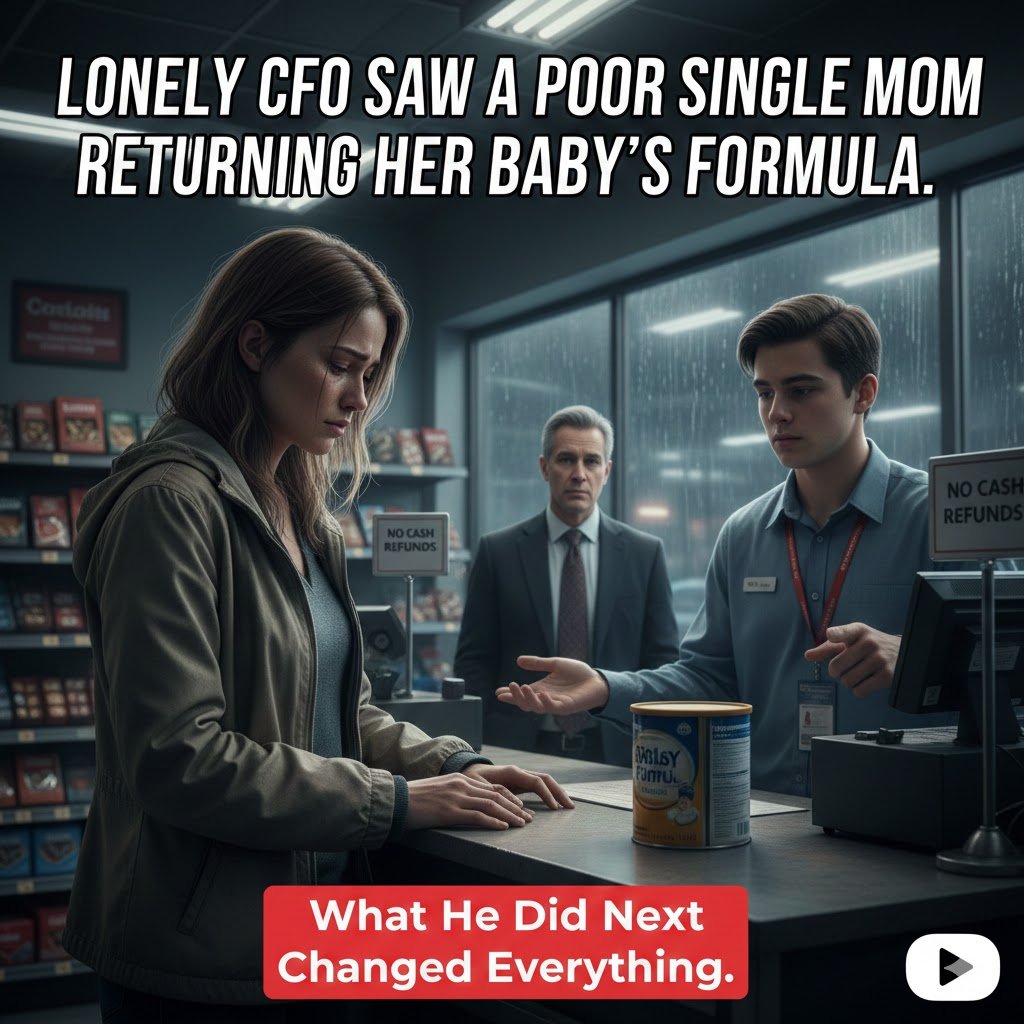
She was standing at the customer service desk, clutching a single can of premium infant formula. She couldn’t have been more than twenty-two. Her coat was thin, ill-fitting for the December chill, and her hands were shaking.
“I… I need to return this,” she whispered to the clerk. “I haven’t opened it. I have the receipt.”
The clerk, a teenager who looked like he’d rather be anywhere else, scanned the receipt. “Store credit only without the original card, ma’am.”
The woman looked like she’d been punched. “I don’t need credit. I need the cash. I need to buy gas to get to my shift tonight.”
“Policy is policy,” the kid muttered.
I watched from behind a display of holiday chocolates. She didn’t argue. She didn’t scream. She just let out a long, shuddering breath, took the store credit voucher, and walked out into the freezing rain. She left the formula on the counter. She had just traded her baby’s food for a few gallons of gas.
For the first time in my career, the “policy” I helped write felt like a death sentence.
I did something then that my legal team would have hated. I grabbed the formula, paid for it out of my own pocket, and followed her. I watched her get into a rusted 2005 sedan that groaned as it started. I followed her at a distance, through the grey, industrial outskirts of the city, until she pulled into a trailer park that looked like it had been forgotten by time.
I pulled up behind her just as she was stepping out. She froze, her eyes wide with terror as a stranger in a luxury SUV approached her.
“Wait!” I called out, holding the can of formula like a white flag. “You forgot this.”
She looked at the can, then at me. “I… I returned that. I can’t take it.”
“I bought it,” I said, my voice cracking in a way that surprised me. “And I noticed you didn’t have a diaper bag in the car. Is there anything else you’re ‘returning’ just to survive?”
She broke then. The “tough single mom” facade crumbled, and she leaned against her car and sobbed. Her name was Elena. She had been working two jobs since her husband passed away six months ago, but with the cost of childcare, she was effectively paying to work. She was $400 short on rent, her electricity was scheduled for shut-off, and she was skipping meals so her seven-month-old, Leo, wouldn’t have to.
I sat in her cramped, freezing kitchen and listened to the “data” of her life. It wasn’t a spreadsheet; it was a tragedy. She wasn’t a “demographic” or a “consumer segment.” She was a person drowning in a system I had optimized for profit.
That night, I didn’t just give her money. I called the utility company and paid her balance. I called a local non-profit I’d donated to for tax breaks and actually used my influence to get her a spot in their subsidized childcare program.
But the real change happened on Wednesday morning.
I walked into the boardroom for our quarterly earnings call. My CEO started talking about “minimizing shrinkage” and “tightening return policies” to boost the Q4 dividends.
I stood up. I didn’t show them the slides about revenue growth. I showed them a photo I’d taken of Elena’s empty refrigerator.
“We’re worried about 2% shrinkage,” I told the room of stunned executives. “But we’re ignoring the 100% loss of humanity in our stores. If a mother has to choose between gas and formula, we haven’t built a business; we’ve built a trap.”
I resigned as CFO that day. I didn’t leave because I was “rich enough to quit.” I left because I realized that the “bottom line” is a lie if it doesn’t include the people at the bottom.
Today, I run a foundation that partners with retailers to turn “unsellable” near-expiry baby products into a direct-aid network for single parents. I still have a nice car, but the passenger seat is usually filled with crates of formula.
I used to be a man who knew the price of everything and the value of nothing. It took a $30 can of milk and a mother’s tears to finally make me rich.