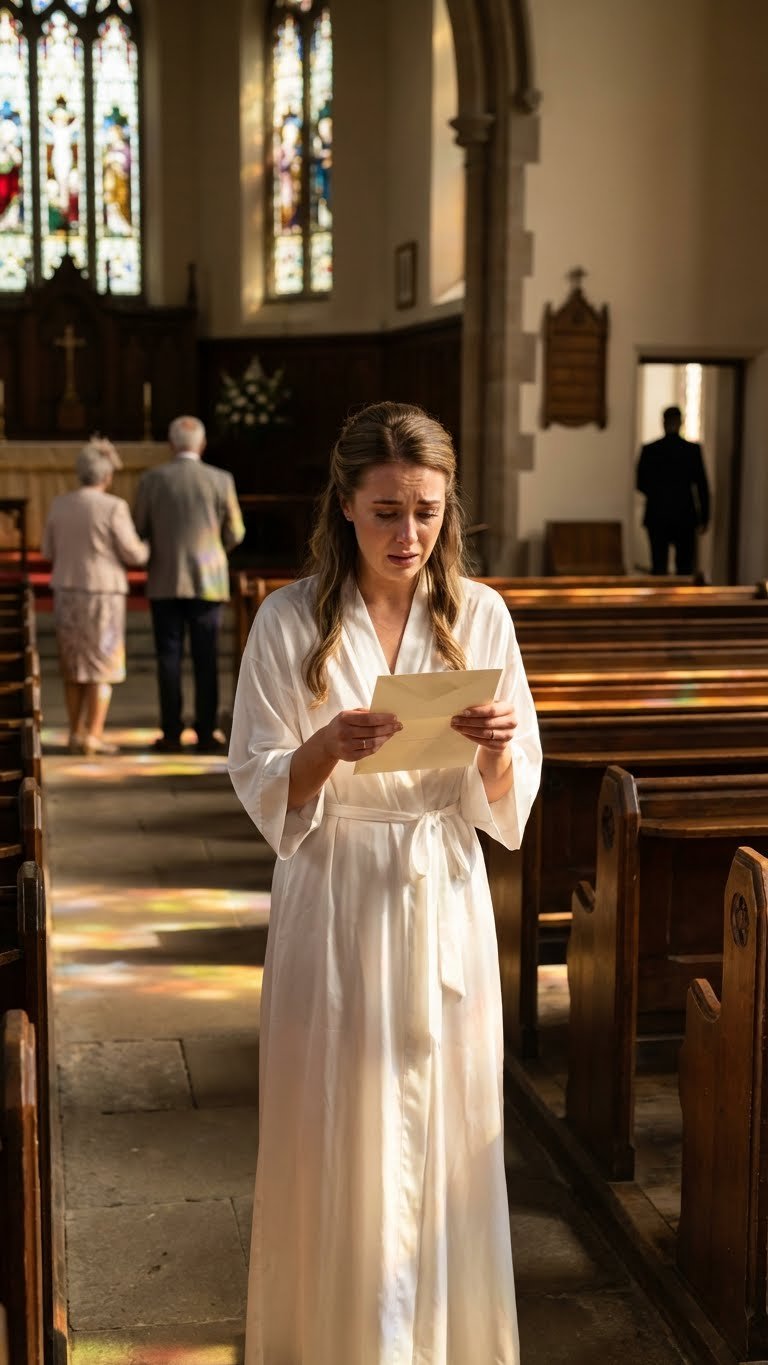
She was standing in the back of the church during our rehearsal. I didn’t recognize her at first. It had been twelve years. But my mother’s face went completely white when she saw her, and that’s when I knew.
My sister Rachel. The one we didn’t talk about. The one whose pictures had been removed from the house when I was sixteen. The one whose name made conversations stop mid-sentence.
She looked older. Thinner. Her hair was shorter and darker than I remembered. She was wearing a simple black dress and holding a small purse with both hands like she wasn’t sure what to do with them. Our eyes met across the church. She smiled. It was tentative and sad and it made my chest hurt.
My mother grabbed my father’s arm. “Get her out of here,” she hissed. But my father didn’t move. He just stared at Rachel like he was seeing a ghost.
I walked down the aisle toward her. My fiancé called my name behind me but I didn’t stop. When I reached Rachel she looked like she might cry.
“Hi, Jamie,” she said. Her voice was exactly the same. “I’m sorry. I know I shouldn’t have come.”
“Why are you here?” I asked. I didn’t mean it to sound harsh but it did.
“I heard you were getting married. I just wanted to see you. I won’t stay. I just—I needed to see you.”
My mother was suddenly beside me. “You need to leave. Right now.”
Rachel looked at her. There was something in that look I didn’t understand. Not anger. Something else. Something like pity.
“I’m leaving,” Rachel said quietly. “I just wanted to give Jamie something.” She reached into her purse and pulled out an envelope. “You don’t have to open it now. Or ever. But it’s yours if you want it.”
She handed me the envelope and walked out of the church before I could respond. My mother tried to take the envelope from my hands but I held on to it.
“What is that?” she demanded.
“I don’t know.”
“Give it to me.”
“No.”
We stood there in the church with my entire wedding party watching. My fiancé came down the aisle and put his arm around me. “What’s going on?” he asked.
“That was my sister,” I said.
He looked confused. I’d told him I was an only child. Because that’s what my parents had told me to say. That’s what I’d been saying for twelve years.
That night in our hotel room I opened the envelope. Inside was a letter. Four pages. Front and back. Rachel’s handwriting. And a photograph.
The photograph showed Rachel when she was younger. Maybe nineteen or twenty. She was holding a baby. A little girl with dark curls. On the back of the photo, in Rachel’s handwriting: “Sophia. Born March 15th, 2013.”
I read the letter twice. Then I sat on the edge of the hotel bed and tried to breathe.
Rachel had gotten pregnant when she was nineteen. The father was someone our parents didn’t approve of. Someone older. Someone who wasn’t from our church community. When she told our parents, they gave her an ultimatum: end the pregnancy or leave the family.
She chose to leave.
She’d been living two hours away for the past twelve years. Working as a dental hygienist. Raising her daughter alone. She’d tried to reach out to me over the years but our parents had blocked her number. They’d returned her letters unopened. They’d told everyone in our family and community that Rachel had made choices that meant she was no longer part of our lives.
The letter didn’t ask for anything. It just explained. It told me about Sophia. About how she was ten now and loved reading and wanted to be a veterinarian. It told me about Rachel’s life. The apartment they lived in. The small church they attended that didn’t judge her. How hard it had been. How lonely.
At the end she wrote: “I don’t expect you to forgive me for leaving you. You were only sixteen. I know that was selfish. But I couldn’t stay and I couldn’t take you with me. I’ve thought about you every single day. I hope you’re happy. I hope your life is everything you wanted. You don’t have to contact me. I just wanted you to know the truth before you started your own family.”
I didn’t sleep that night. I kept reading the letter. Looking at the photo. Thinking about everything I’d been told.
My parents had said Rachel left because she’d rejected our family values. That she’d chosen a destructive lifestyle. That she’d broken their hearts and refused to come back. They made it sound like she was on drugs or involved in something dangerous. They never mentioned a baby. They never mentioned a granddaughter.
I confronted them the next morning. My wedding was in six hours. I went to their hotel room before breakfast and I brought the letter.
My mother’s face went hard when she saw it. “She had no right to give you that.”
“She had every right. She’s my sister.”
“She made her choice.”
“You gave her an impossible choice,” I said. “She was nineteen.”
“She was pregnant with that man’s baby. He was thirty-five years old. He was taking advantage of her. We were trying to protect her.”
“By kicking her out?”
“We didn’t kick her out. We gave her options. She chose to leave.”
My father hadn’t said anything. He was sitting in the chair by the window looking older than I’d ever seen him look.
“Did you know about the baby?” I asked him. “About Sophia?”
He nodded slowly.
“You have a granddaughter and you’ve never met her.”
“It was your mother’s decision,” he said quietly.
“It was our decision,” my mother corrected. “We couldn’t have someone like that in our lives. We couldn’t expose you to that situation. We did what we thought was right.”
“You lied to me for twelve years.”
“We protected you.”
I left their hotel room. I went back to mine and told my fiancé everything. He listened without interrupting. When I finished he said, “What do you want to do?”
“I want to meet my niece,” I said.
“Okay.”
“I want Rachel at my wedding.”
“Then invite her.”
“My parents will lose their minds.”
“It’s your wedding,” he said. “Not theirs.”
I called the number on Rachel’s letter. She answered on the third ring. When I told her I wanted her there she started crying. She said she couldn’t. She said she didn’t want to cause problems. I told her she was my sister and I wanted her there and that was final.
She came. She brought Sophia. My niece was small and quiet and had Rachel’s eyes. She wore a purple dress and sat in the back row during the ceremony. My parents sat in the front row and didn’t turn around once.
After the ceremony, during the reception, Sophia came up to me shyly. “You’re my aunt,” she said.
“I am.”
“You’re really pretty.”
“So are you.”
“My mom talks about you a lot. She says you used to play games together when you were little.”
“We did.”
“Can I hug you?”
I knelt down and she hugged me. She smelled like children’s shampoo and something sweet. When I stood up Rachel was there. We looked at each other for a long moment.
“Thank you for coming,” I said.
“Thank you for inviting me.”
We didn’t talk much that night. There was too much to say and a wedding reception wasn’t the place. But before she left she gave me her address and made me promise to visit.
My parents left the reception early. They didn’t say goodbye. They sent a text later saying they were disappointed in my choices. That I was breaking their hearts. That they’d raised me better than this.
I didn’t respond.
Two weeks after the wedding, my husband and I drove to Rachel’s apartment. It was small but clean and decorated with children’s artwork. Sophia showed us her room. Her collection of stuffed animals. Her bookshelf full of chapter books. She was smart and funny and completely unaware of the family drama that had kept us apart.
Rachel made coffee. We sat at her kitchen table. She told me everything. Not just what was in the letter. Everything.
The father of her baby had been her manager at the restaurant where she worked. She thought they were in love. When she got pregnant he disappeared. Changed jobs. Blocked her number. She never heard from him again. Our parents had been right that he was bad news. But their solution had been to force her to choose between her family and her child.
She’d chosen her child. She’d moved in with a friend. Worked two jobs through her pregnancy. Had Sophia alone in the hospital with a nurse holding her hand. Raised her daughter with help from a church community that actually lived the values they preached.
“I tried so many times to reach you,” she said. “I sent letters. I called. I even came to the house once but Mom threatened to call the police.”
“I didn’t know. They told me you didn’t want contact.”
“I never stopped wanting contact.”
We talked for three hours. About the years we’d missed. About Sophia’s childhood. About my life. My career. My wedding. Everything.
When we were leaving, Sophia hugged me again. “Can you come back?” she asked.
“Yes,” I said. “We’ll come back.”
In the car on the way home my husband asked if I was okay.
“No,” I said. “But I will be.”
My parents called a week later. My father. He asked if we could talk. We met at a diner halfway between our houses. Neutral ground.
He looked tired. “Your mother is very upset,” he said.
“I know.”
“She thinks you’re making a mistake.”
“I’m getting to know my sister. That’s not a mistake.”
“Rachel made choices—”
“Rachel was a teenager who got pregnant. You made it impossible for her to stay. That was your choice. Not hers.”
He was quiet for a long time. Then he said, “I’ve thought about reaching out. Over the years. Your mother wouldn’t allow it.”
“You’re an adult. You could have made your own decision.”
“Marriage is complicated.”
“That’s not an excuse.”
He nodded. Like he knew. Like he’d been telling himself that for years.
“I’d like to meet Sophia,” he said quietly.
“Talk to Rachel. Not me. This isn’t my decision to make.”
I don’t know if he ever did. Rachel hasn’t mentioned it. We see each other every few weeks now. Sophia calls me Aunt Jamie. We’re building something. It’s slow and careful but it’s real.
My mother hasn’t spoken to me since the wedding. She sends messages through my father sometimes. Asking when I’m going to stop this. When I’m going to come to my senses. I don’t respond.
Last week Sophia asked me why Grandma and Grandpa don’t come to visit. Rachel tried to change the subject but Sophia persisted. She’s ten. She’s old enough to notice what’s missing.
“It’s complicated,” Rachel told her.
“Did I do something wrong?”
“No, baby. You didn’t do anything wrong.”
After Sophia went to bed Rachel and I sat on her couch drinking wine. She was quiet for a while. Then she said, “I used to think about crashing your high school graduation. Your college graduation. Every major event. I wanted to be there so badly.”
“Why didn’t you?”
“I was afraid I’d make things worse for you. I was afraid you’d hate me.”
“I could never hate you.”
“You didn’t know me anymore.”
“I know you now.”
She started crying. Not dramatic crying. Just tears running down her face while she smiled. “I can’t believe you invited me to your wedding. I can’t believe you wanted me there.”
“You’re my sister. Where else would you be?”
But that’s the thing I keep coming back to. For twelve years she wasn’t at anything. She missed my entire young adult life. I missed Sophia’s entire childhood. We lost years we can’t get back because our parents decided their pride was more important than their family.
I’ve been thinking about what I’ll say if I ever have children. How I’ll explain why they have only one grandmother who visits. How I’ll tell them about the aunt and cousin who were kept secret. How I’ll make sure they understand that love isn’t conditional. That family doesn’t come with ultimatums.
Rachel says she forgave our parents a long time ago. That holding onto anger was only hurting her. But I don’t know if I can forgive them. Not yet. Maybe not ever.
Last month Rachel showed me a box of letters she’d written to me over the years. Letters she’d sent that were returned. Letters she’d kept meaning to send but didn’t. Hundreds of them. Twelve years of one-sided conversations with the sister she’d lost.
I asked if I could read them. She said yes. I’ve been reading one or two a week. They’re chronological. They start when I was sixteen and she was nineteen. The early ones are full of apologies and explanations. The middle ones are updates about Sophia. About life. About holidays we weren’t spending together. The recent ones are shorter. Sadder. More resigned.
There’s one from my college graduation. She wrote about watching my Facebook photos from the ceremony. About how proud she was. About how much she wished she could have been there. At the end she wrote: “I wonder if you ever think about me. I wonder if you hate me or if you just don’t remember me anymore. I wonder if Mom and Dad told you I’m dead. I wouldn’t put it past them.”
I never thought she was dead. But I did stop thinking about her as much after a few years. She became this abstract concept. The sister who left. The family mystery we didn’t discuss. I was busy with college and friends and building a life. It was easier not to think about the gap she’d left.
Now I can’t stop thinking about it. About all the years we lost. About Sophia growing up without knowing she had family beyond her mother. About my parents sitting in church every Sunday preaching about love and forgiveness while refusing to acknowledge their own granddaughter.
My husband says I need to decide what kind of relationship I want with my parents going forward. If I want one at all. He says it’s okay to be angry. It’s okay to set boundaries. It’s okay to choose Rachel and Sophia over people who would make me choose at all.
I don’t have an answer yet. I just know that everything I thought I understood about my family was wrong. And I’m still trying to figure out what the truth means for who I am now.
Rachel asked me last week if I regret finding out. If I wish I’d thrown away that envelope and gotten married without knowing any of this. I told her no. I told her I regret not finding out sooner.
But there’s a part of me that wonders what else I don’t know. What other secrets are buried in my family’s past. What other truths my parents decided I couldn’t handle.
And I wonder if I’ll ever be able to look at them the same way again.