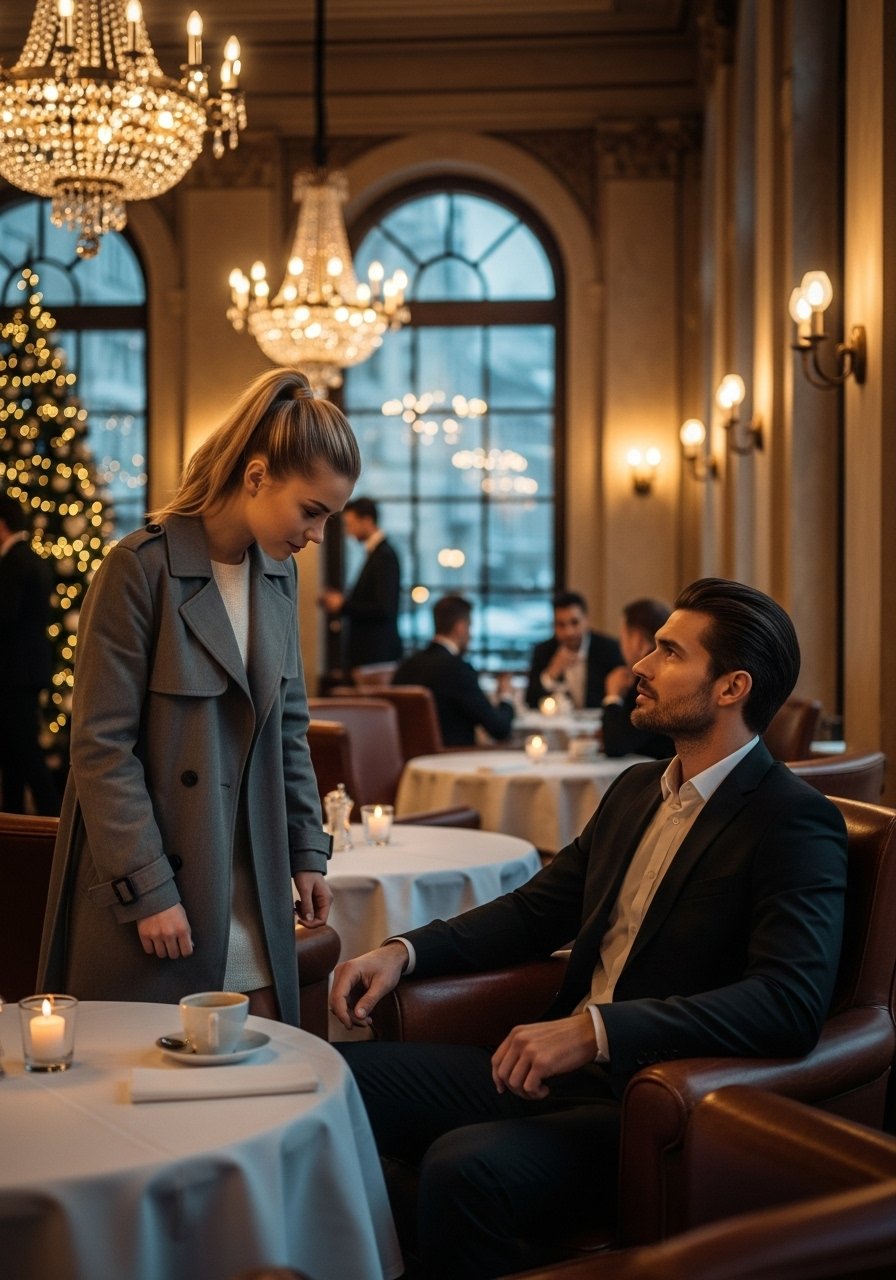
I almost didn’t hear her.
The café was loud in that particular Christmas way—bells chiming when the door opened, a low hum of conversation, holiday music playing just loudly enough to be noticed. The place was packed with people escaping the cold, clutching paper cups and shopping bags, faces flushed from the December air.
I was sitting alone at a small table near the window.
It was intentional.
I’d chosen the café because it was anonymous. No reservations. No private rooms. Just a warm place to sit and think without being recognized. I was wearing a plain coat, no watch, nothing that suggested who I was or what I did for a living.
That’s when I heard her voice.
“Um… excuse me.”
I looked up.
She couldn’t have been older than nineteen or twenty. Thin jacket. Worn sneakers. A scarf that looked like it had seen better winters. Her hands were red from the cold, fingers wrapped tightly around a small paper cup—empty, or close to it.
She gestured awkwardly toward the chair across from me.
“Is this seat only for the rich?”
A few people nearby went quiet. Not dramatically—but enough that I felt the shift.
I blinked, genuinely confused.
“I’m sorry?” I asked.
She flushed immediately, clearly regretting speaking.
“I just—I’ve been standing for a while,” she said quickly. “And there’s nowhere else to sit. But everyone here looks like they belong. I didn’t want to… you know.”
She trailed off, already preparing for rejection.
I looked around. She wasn’t wrong. The café wasn’t expensive, but it wasn’t cheap either. It was the kind of place people lingered, not rushed. And she didn’t fit the picture.
I pulled the chair back with my foot.
“Please,” I said. “It’s just a seat.”
She hesitated, then sat—perching on the edge like she expected to be asked to leave at any moment.
We sat in silence for a few seconds.
I noticed how carefully she held herself. How she kept her eyes down. How she kept glancing at the counter like she was calculating how long she could stay before someone told her she needed to buy something.
Finally, she laughed nervously.
“I’m sorry. That was a stupid question.”
“No,” I said. “It wasn’t.”
She looked surprised.
“My name’s Emma,” she said after a moment. “I’m just trying to warm up before my bus comes.”
I introduced myself—just my first name. No titles. No explanations.
She asked what I did.
“I work a lot,” I said truthfully.
She smiled at that. “Same. Just… for not much.”
That’s when she told me her story.
She’d moved to the city three months earlier. A job that fell through. A roommate who disappeared with the deposit. Shifts at a diner that barely covered food, let alone rent. She was staying wherever she could—friends’ couches, a shelter when she had to.
“I’ll figure it out,” she said quickly, like she was used to reassuring other people. “I always do.”
Her phone buzzed. She checked it and sighed.
“Bus is delayed,” she muttered.
Without thinking, I stood and went to the counter.
When I came back, I set a hot drink and a sandwich in front of her.
Her eyes widened. “Oh—I can’t—”
“It’s Christmas,” I said. “And I ordered too much.”
She stared at the food like it might disappear if she blinked.
“Thank you,” she said quietly.
We talked for nearly an hour.
Not about money. Not about success. About books she liked. About the little town she came from. About how she used to think adulthood would feel more stable than this.
At some point, she asked why I was alone on Christmas week.
I thought about lying.
Instead, I said, “Because being surrounded by people doesn’t always mean you’re not lonely.”
She nodded like she understood exactly what I meant.
When her bus finally arrived, she stood, slinging her bag over her shoulder.
“Thank you for letting me sit,” she said. “And for not making me feel… small.”
She paused, then added, “I hope you have a good Christmas.”
After she left, I sat there for a long time.
I thought about the meetings I’d rushed through that morning. The emails waiting on my phone. The decisions I’d made that affected thousands of people I’d never meet.
And I realized something uncomfortable.
In all my success, I’d insulated myself so completely that a simple question—Is this seat only for the rich?—felt like a quiet indictment of the world I helped build.
I don’t know where Emma is now.
But I think about her every Christmas.
And I always make sure the seat across from me stays empty—just in case someone needs it.