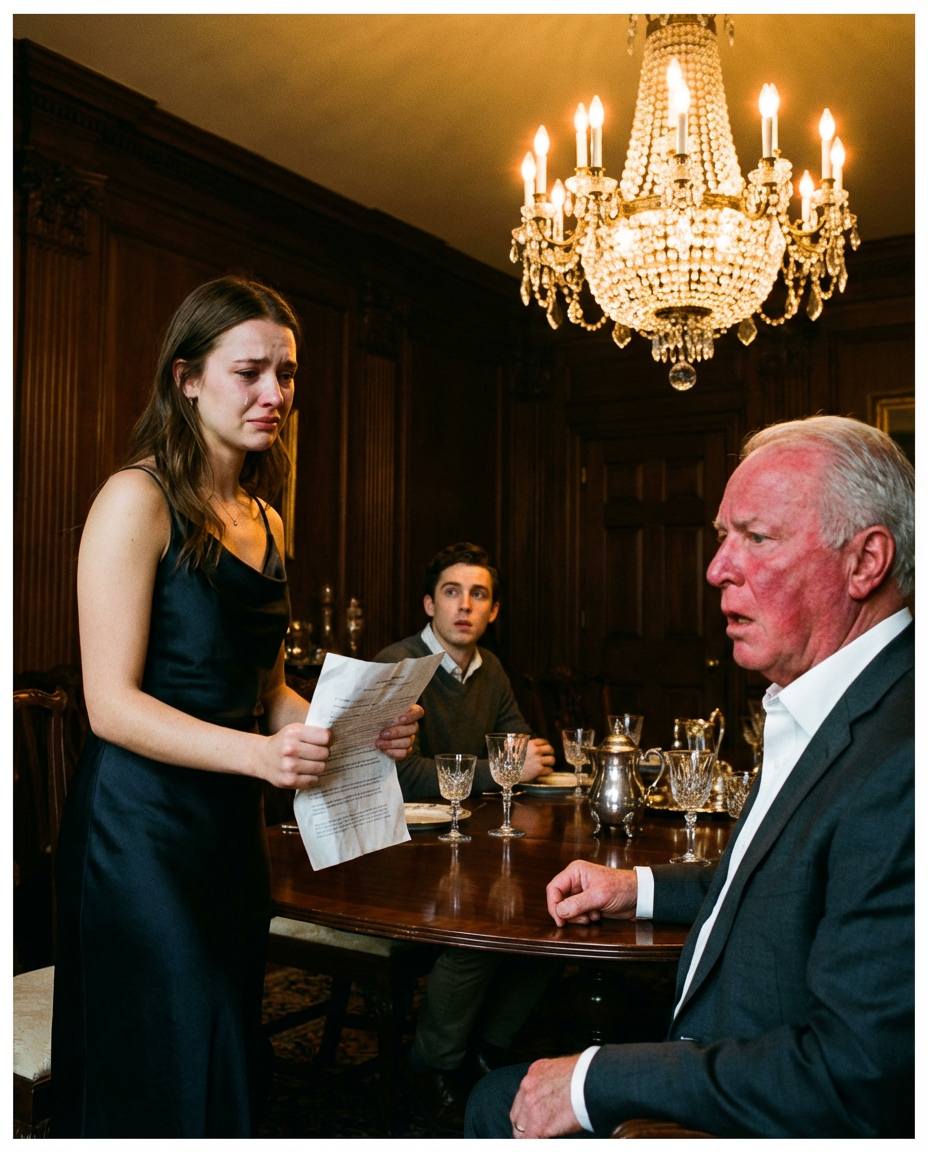
To everyone on the outside, my life looked like a curated Pinterest board. I was the daughter who never missed the Dean’s List. I was the one who landed the six-figure tech job at twenty-two. I was the one who bought my parents a luxury cruise for their 30th anniversary. In our family’s narrative, I was the “Success,” and my brother, Ethan, was the “Warning.”
But being the Golden Child isn’t about being the best. It’s about being a shield. You are the trophy the parents hold up so high that no one sees the rot in the foundation of the house.
For twenty-eight years, I played the part. I smiled through the passive-aggressive comments directed at Ethan. I stayed silent when my father credited my hard work to his “strict discipline” rather than my own sleepless nights. I was the pride of the family, but that pride was a cage.
The cracks started showing six months ago.
It began with a box of old legal documents I found in the attic while helping my mom “declutter”—which is her code for throwing away anything that reminds her of a time she wasn’t in control. Tucked inside a folder labeled “Tax Returns 2014” was a series of bank statements I was never meant to see.
Ten years ago, when Ethan was eighteen, he was arrested for a “hit and run.” The story my parents told everyone—the story I believed—was that Ethan had been drinking, stolen the car, and ruined a family’s life. My parents “sacrificed everything” to pay for his legal fees, and Ethan was essentially exiled, working dead-end jobs to “pay them back.” He became the family pariah, the reason we “couldn’t afford” certain luxuries, the dark cloud over every holiday.
But the bank statements told a different story.
The payments weren’t for legal fees. They were “settlements” paid out to a private party, signed by my father. And the date of the accident? That was the night of the Firm’s Annual Gala—a night Ethan wasn’t even in town. He was at a debate tournament four states away.
I remember that night. I remember my father coming home late, smelling of expensive scotch and panic. I remember my mother whispering in the kitchen for hours. The next morning, the car was gone, and Ethan was being screamed at in the driveway.
I realized, with a sickening jolt, that my father had been the one driving. They didn’t save Ethan; they framed him. They used his “rebellious” reputation as a teenage boy to cover my father’s tracks. They stole ten years of my brother’s life to protect my father’s “reputation” and, by extension, my status as the perfect daughter of a perfect man.
For months, I carried this. I looked at Ethan during Sunday dinners—quiet, withdrawn, eyes downcast while my father lectured him on “responsibility”—and I felt like I was suffocating.
The breaking point was my promotion party.
The house was full of my parents’ friends. My father stood up, clinking his glass, ready to give another speech about how his “parenting philosophy” had produced a leader in the industry. He looked at me with that beaming, proprietary glow. Then he looked at Ethan, who was standing by the drinks, and said, “If only your brother had half your integrity, we’d truly have something to celebrate.”
The room chuckled. It was a practiced, comfortable laugh.
I felt the “Golden Child” mask shatter.
“He does have integrity,” I said. The room went silent. “More than you’ll ever have, Dad.”
I didn’t just tell them I knew. I produced the copies of the bank statements I’d hidden in my purse. I explained, in front of their entire social circle, exactly whose ‘integrity’ had been bought with hush money and a son’s future.
The fallout was nuclear. My mother collapsed into hysterics, accusing me of “betraying the family.” My father turned a shade of purple I didn’t know was biologically possible, demanding I leave “his” house.
I did leave. But I didn’t go alone. For the first time in a decade, Ethan walked out with me.
Being the Golden Child meant I had the resources to fight back. I had the money for a real lawyer. I had the reputation that people actually believed. I used every ounce of that “Golden” status to burn the pedestal down.
Today, I am no longer the pride of the family. I am the “traitor.” I am blocked on all social media, written out of the will, and spoken of in hushed, shameful tones at those same Sunday brunches.
But for the first time in my life, I can look at my brother in the eye. And for the first time, he isn’t looking at the floor. He’s looking at the horizon.
The truth didn’t set my family free—it tore us apart. But some things are built so poorly they deserve to be demolished.