I thought I was buying my dream retirement property. What I found hiding in the barn changed everything.
Look, I’m not the kind of guy who shares his life story on the internet. Twelve years as a Navy SEAL taught me to keep my head down and my business private. But after what happened last month, I can’t sleep. My therapist says writing this out might help, and honestly, I need someone to tell me if I did the right thing. So here goes.
My name’s Marcus (changing some details for privacy), and I’m 38 years old. After multiple deployments and more close calls than I care to remember, I took my discharge papers and my savings and decided to disappear into rural Montana. No more orders, no more watching friends die, no more nightmares—just me, some land, and peace and quiet.
I found the perfect property online: 40 acres with an old farmhouse, a barn, and mountains in every direction. The listing said “fixer-upper” which in real estate speak means “basically condemned,” but I’ve rebuilt insurgent-damaged buildings with less. The price was almost too good to be true—$85,000 for the whole property. The photos showed a sagging porch, broken windows, and waist-high grass, but I saw potential.
The real estate agent, Linda, was a chatty woman in her sixties who seemed nervous when we pulled up to the property. “Now, Marcus, I have to be honest with you,” she said, clutching her clipboard. “This place has been empty for seven years. Old man Patterson died, and his kids just wanted to sell it as-is. There’s no electricity, no running water, and I can’t promise the roof doesn’t leak.”
“Perfect,” I told her. I meant it. After years of sleeping in combat zones, a leaky roof was nothing.
We walked through the house—creaky floors, peeling wallpaper, a kitchen straight out of 1970. The barn was even worse, listing to one side like it might collapse any second. But the land was gorgeous. Rolling hills, a creek cutting through the property, absolute silence except for birds and wind. I signed the papers that afternoon.
I spent the first week clearing brush and setting up a camper trailer on the property. My plan was to live in the trailer while I renovated the house, taking my time, doing it right. No rush. That was the whole point of this new life—no more rushing.
It was a Tuesday morning, about nine days after I’d moved onto the property, when everything changed.
I was working on the barn, trying to assess if I could save it or if I needed to tear it down and start over. The main doors were stuck shut, so I’d been working on prying them open. When they finally gave way with a shriek of rusty hinges, I wasn’t prepared for what I saw.
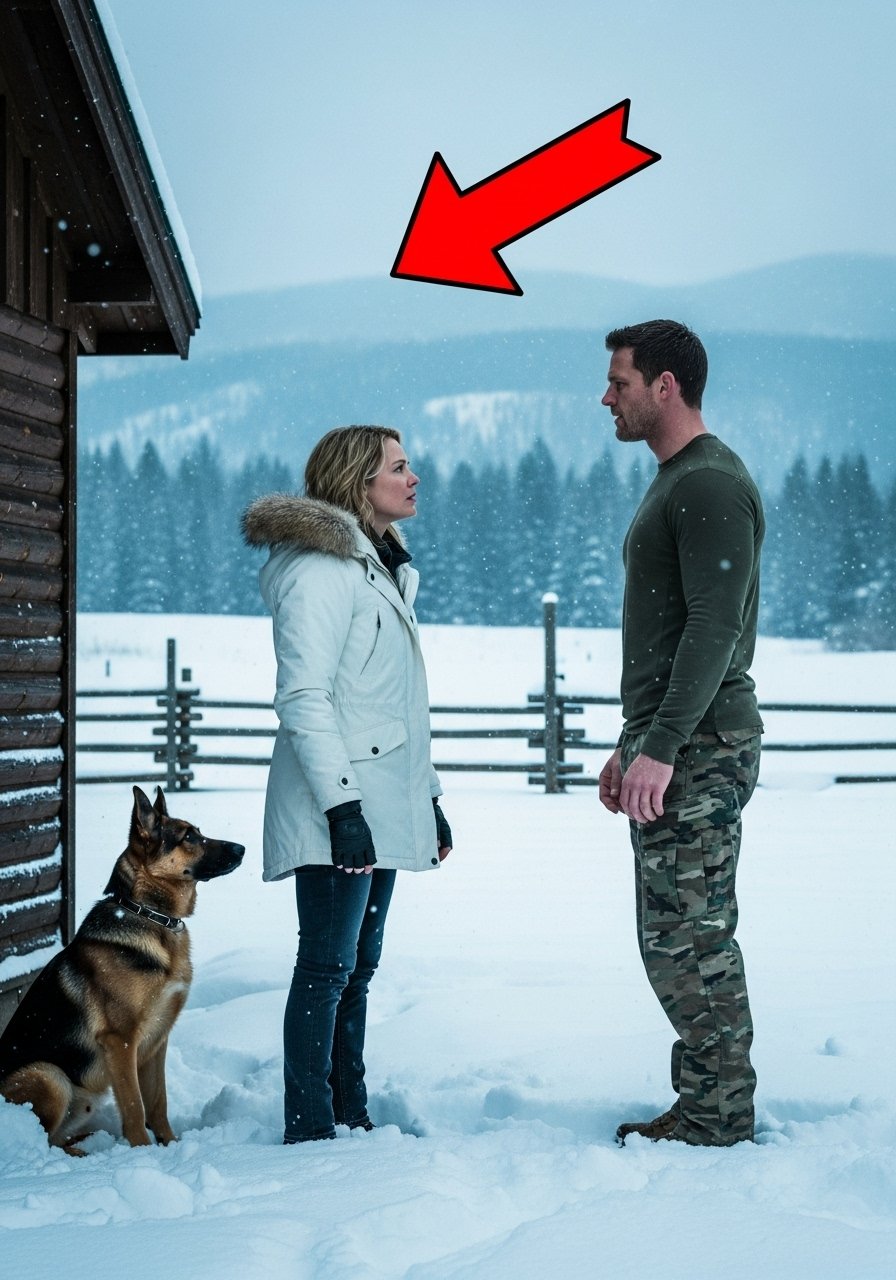
In the far corner of the barn, hidden behind old farm equipment and moldy hay bales, was a makeshift shelter. Blankets hung from beams creating a small enclosed space. And sitting in that space, staring at me with the widest, most terrified eyes I’d ever seen, was a girl. Maybe sixteen, seventeen years old. Blonde hair in a tangled mess, dirt-smudged face, wearing clothes that were way too big for her thin frame.
And next to her, growling low in his throat, was the scruffiest German Shepherd mix I’d ever seen.
My training kicked in immediately. I raised my hands, took two steps back, made myself small and non-threatening. “Hey,” I said, keeping my voice calm and even. “I’m not going to hurt you. My name is Marcus. I just bought this property.”
The girl didn’t say anything. She just clutched the dog’s collar, and the dog kept growling. I could see she was shaking.
“How long have you been here?” I asked.
Still nothing. But I noticed details now—a backpack, some granola bar wrappers, a water bottle collection. A sleeping bag that looked relatively new. This wasn’t some overnight squat. She’d been living here.
“Are you hungry? I have food in my trailer. Good food, not just granola bars.”
The dog’s growl got louder. The girl’s eyes darted toward the barn door—she was calculating if she could run.
“I’m not calling the cops,” I said quickly. “I just want to help. Are you safe? Are you hurt?”
That’s when she finally spoke, and her voice was barely a whisper. “Please don’t make me go back.”
Those five words punched me in the gut harder than any combat experience ever had.
I kept my hands raised. “Go back where?”
She shook her head, tears starting to stream down her face. “Please. I’ll leave. We’ll leave. Just give us an hour head start before you call anyone. Please.”
I’m not proud of what I did next. Legally, I know I should have called the authorities immediately. A minor hiding on my property, clearly in distress—that’s a situation that needs professionals. But I looked at this terrified kid and her loyal dog, and I thought about all the times in the military when following protocol meant someone got hurt.
“I’m not calling anyone,” I said. “And you don’t have to leave. Not yet. Not until we figure this out. But I need you to tell me—are you in immediate danger? Is someone looking for you who might hurt you?”
She hesitated, then shook her head. “Not anymore. They don’t know where I am.”
“Okay. Okay, that’s good.” I sat down right there in the barn doorway, making sure I wasn’t blocking her exit. “I’m going to sit here for a minute. You don’t have to come out. But I want you to know—I meant what I said about food. And it’s getting cold at night. I have a space heater in my trailer.”
We sat like that for maybe ten minutes. Me in the doorway, her in her blanket fort, the dog watching me like he was deciding whether to rip my throat out. Finally, she spoke again.
“What branch?”
“What?”
“You said you were military. What branch?”
“Navy. SEAL teams.”
She nodded slowly. “My dad was Army. Infantry.”
“Was?”
“Died. Afghanistan. Four years ago.”
And just like that, pieces started clicking into place. Military kid. Father killed in action. Something had gone wrong after that.
“I’m sorry,” I said, and meant it. “That’s rough.”
“Mom remarried,” she said quietly. “Mark seemed nice at first. But after the wedding…” She trailed off, but I didn’t need her to finish. I’d heard these stories before, seen the signs. “Did he hurt you?”
She pulled up her sleeve, and even from fifteen feet away, I could see the bruises. Old ones, yellowing. Newer ones, still purple-blue. The dog—who I’d learn was named Sergeant, because of course he was—licked her hand protectively.
“I tried to tell Mom, but she didn’t believe me. Said I was acting out, being dramatic. When I threatened to tell my school counselor, Mark said if I told anyone, he’d make sure Sergeant ended up at the pound. He was my dad’s dog. He’s all I have left of him.”
“So you ran.”
“Three weeks ago. I took some cash Mom had hidden, and Sergeant, and I just… left. I remembered Dad talking about Montana, how beautiful it was. I hitchhiked until I ran out of money, then I saw this place. It looked empty, so we came here. I thought I could figure out what to do next, but…” She wiped her eyes. “I don’t know what to do.”
Here’s where I need you internet strangers to weigh in, because I still don’t know if I made the right call.
I stood up slowly. “Here’s what’s going to happen. You and Sergeant are going to come to my trailer. You’re going to eat a real meal, take a hot shower, and sleep in an actual bed. Tomorrow, we’ll figure out next steps. But tonight, you’re safe. Deal?”
She stared at me for a long moment. “Why would you help me? You don’t know me.”
“Because someone should,” I said simply. “And because I have a feeling your dad would have done the same for someone else’s kid.”
That broke her. She started sobbing, and the dog whined and pressed against her. I waited until she composed herself, then she grabbed her backpack and followed me to the trailer, Sergeant glued to her side.
Her name was Lexi. She was seventeen, two months from her eighteenth birthday. She’d been an honors student before everything fell apart. She loved reading, wanted to study veterinary medicine. She’d been surviving on granola bars, creek water she boiled on a camping stove, and whatever she could shoplift from gas stations when she got desperate.
That first night, she ate three bowls of the chili I’d made, took the longest shower in history, and fell asleep on my trailer couch with Sergeant sprawled across her legs. I sat in my truck outside, trying to figure out what the hell I was supposed to do.
The legal thing was clear: call Child Protective Services, report the situation, hand her over to the system. But I’d seen what the system did to kids sometimes. She was two months from legal adulthood. Two months from being able to make her own choices. And if her stepdad was what she said he was, putting her back in that situation—even temporarily—could be dangerous.
I spent that whole night researching, reading forums, trying to figure out options. By sunrise, I had a plan. Maybe not a good plan, but a plan.
The next morning, I sat Lexi down. “Here’s the situation. I can’t harbor a runaway—that’s a crime, and I’d go to jail. But I also can’t in good conscience send you back to a place where you’re being hurt. So we’re going to do this by the book, but smart.”
I drove her to the nearest town (an hour away) and we went to the police station together. I stayed with her while she filed a report about the abuse, showed them her bruises, gave them details. It was the hardest thing I’ve ever watched someone do. She was shaking the whole time, convinced they wouldn’t believe her, convinced they’d send her right back.
But here’s the thing about small-town cops in Montana—they actually gave a damn. The officer who took her report, Sarah Kensington, was a mom herself. She saw what I saw. She made calls, got CPS involved, but did it smart. They opened an investigation into Mark. They contacted Lexi’s mom. And while all that was being sorted out, they asked me if I’d be willing to be a temporary foster placement.
I’d never considered being a foster parent. I was a single guy living in a trailer on an abandoned farm. But Officer Kensington explained that for short-term emergency placements, they had more flexibility, especially since Lexi was nearly eighteen. I went through a rapid background check (which, given my military record, was extensive but clean), and they approved me as a temporary placement for sixty days while the investigation proceeded.
The next eight weeks were the strangest of my life. I’m a guy who planned to live alone, work alone, die alone. Suddenly I had a teenage girl and a dog depending on me. We established routines. I worked on the house; she did online schoolwork (the school agreed to let her finish her senior year remotely given the circumstances). We cooked dinner together. She helped with renovations—turned out she was pretty handy with a hammer. Sergeant appointed himself supervisor of all projects.
The investigation moved faster than expected. When CPS interviewed Lexi’s mom with the allegations, she broke down. Turned out she had suspected something was wrong but had been in denial, choosing her new husband over her daughter’s safety. The guilt hit her all at once. She kicked Mark out, filed for divorce, and cooperated fully with the investigation. Mark was arrested on assault charges.
Lexi’s mom wanted her to come home. Lexi didn’t want to go.
That’s where we are now. Lexi turned eighteen last week. Legally, she’s an adult and can make her own choices. Her mom has been calling daily, begging for forgiveness, wanting a chance to rebuild their relationship. Lexi isn’t sure what she wants.
What she does know is that she wants to finish high school, apply to colleges, and keep working on this farm. She asked if she could stay here, at least until she figures things out. Not as my foster kid—she’s an adult now—but as… I don’t know what. A tenant? A friend? A weird pseudo-family situation?
I said yes. I’m having the barn converted into a small apartment for her—proper walls, insulation, electricity, plumbing. It’ll be done by Christmas. She’s already picked out paint colors.
But here’s what’s eating at me: Did I do the right thing? Her mom is destroyed by guilt and wants her daughter back. Family therapists say reconciliation is possible with work. Lexi’s school counselor thinks she should try to repair the relationship with her mom. But Lexi feels safest here, and I’ve gotten used to having her around. She makes the coffee better than I do, she’s teaching me to cook things that aren’t chili or MREs, and Sergeant has decided I’m acceptable pack member.
Am I enabling her to run from problems instead of facing them? Am I overstepping by offering her a place to stay? Should I push her harder to reconcile with her mom, or is that not my place?
My therapist says I’m projecting—that I’m trying to save her the way I couldn’t save some of my team members. Maybe she’s right. But also, maybe this kid just needs someone to be in her corner, no questions, no conditions.
I don’t know. I really don’t know.
What I do know is that yesterday, I came back from town with lumber supplies, and Lexi had made dinner. Just spaghetti and salad, nothing fancy. But she’d set two places at the fold-out table in the trailer, and when I walked in, she looked up and smiled and said, “Hey, Marcus. How was town?”
And it was so normal. So simple. So much like what a home is supposed to feel like.
So internet strangers, tell me: Did I do the right thing? Should she go back to her mom? Should I push for family therapy? Or is it okay that a broken-down SEAL and a runaway kid and a dog are building something new on an abandoned farm in Montana?
Because I’m honestly not sure anymore.
Update: Wow. I did not expect this response. Thank you all for the comments, the advice, the support. A few people asked for an update, so here it is: Lexi and I talked last night. We read through a lot of the comments together (she knows about this post—I asked her permission before posting). She cried a lot. Then she made a decision.
She’s going to stay here for now, but she agreed to start family therapy sessions with her mom via video call. Baby steps. No pressure to move back, but a chance to see if they can rebuild trust. Her mom is in therapy too, working through her own issues.
As for me? I guess I’m an accidental landlord and mentor now. The barn apartment is coming along nicely. Lexi picked out curtains last week, which led to a hilarious trip to a home goods store where I had no idea what “blackout” vs “light filtering” meant.
We’re figuring it out, one day at a time. And honestly? For a guy who thought he wanted to be alone, this weird little makeshift family doesn’t feel so bad.
Thanks for listening, Reddit. And for those who said I did good—I hope you’re right.
(Final note from Marcus: If you’re a young person in an abusive situation, please reach out to someone. National Child Abuse Hotline: 1-800-422-4453. You deserve to be safe.)