I didn’t think much of it at the time.
That’s the part everyone gets wrong when they hear this story. They imagine some big, heroic moment—slow motion, dramatic music, a clear sense that something important is happening.
But that’s not how it felt.
It just felt like a Tuesday.
I’m a single dad to a seven-year-old girl named Lily. I work nights as a waiter at a small family restaurant just off the highway. It’s not glamorous, but it pays the bills, and the owner lets me swap shifts when Lily gets sick or has school events.
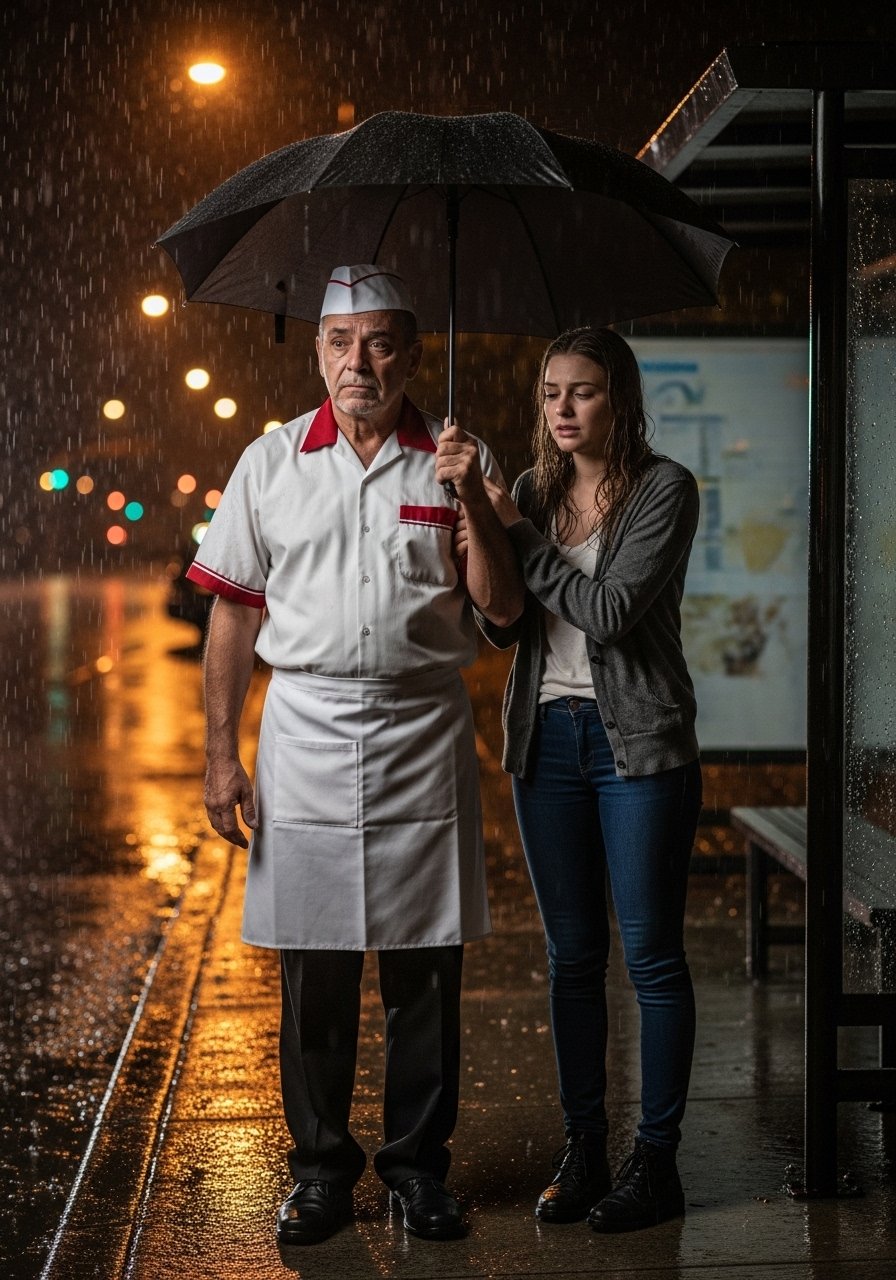
That night, it was raining hard. The kind of rain that soaks your shoes in seconds and turns headlights into blurry halos. We’d just closed. I was exhausted, thinking about whether I had enough energy left to help Lily with her spelling test in the morning.
I stepped outside to lock the door when I saw her.
She was standing near the bus stop across the street, completely drenched. No umbrella. No jacket thick enough for that kind of weather. She kept pacing, checking her phone, then looking up and down the road like she was waiting for something—or someone—that wasn’t coming.
Something about her made me pause.
Maybe it was the way she kept rubbing her arms, or how she flinched every time a car drove by too fast and sprayed water onto the curb. Or maybe it was just instinct—the kind you develop after years of watching out for someone smaller than you.
I crossed the street.
“Hey,” I said, keeping my distance. “You okay?”
She startled, clearly on edge. Then she shook her head.
“My phone died,” she said. “And the bus isn’t coming. I think they stopped running because of the storm.”
Her voice cracked on the last word.
I glanced back at the restaurant. The lights were still on. Warm. Safe.
“Do you want to come inside for a minute?” I asked. “Just until the rain lets up.”
She hesitated. I could see the calculation happening behind her eyes—the risk assessment every woman makes when a stranger offers help.
Finally, she nodded.
Inside, I grabbed a towel from the back and handed it to her. She apologized about a dozen times for dripping on the floor. I made her some tea using the staff kettle.
We didn’t talk much at first.
Eventually, she told me she was a student. That she’d had a job interview earlier that day that hadn’t gone well. That she was trying not to cry because she was “so tired of crying lately.”
I didn’t pry.
When the rain didn’t slow down after twenty minutes, I offered to drive her home. She gave me the address—only ten minutes out of my way.
In the car, she stared out the window the whole time, arms wrapped around herself like she was holding everything together by force.
When we reached her building, she paused before opening the door.
“Thank you,” she said. “I don’t think you realize how much this helped.”
I shrugged. “Get home safe.”
That was it.
Or so I thought.
A few days later, Lily and I were eating dinner on the couch, watching the evening news. She was half-paying attention, more focused on her mashed potatoes.
Then a story came on.
It was about a young woman who had gone missing for several hours during a severe storm. The screen showed her photo.
Lily froze.
“That’s her,” she said.
I looked up. My stomach dropped.
It was the woman from the bus stop.
The news anchor explained that she’d been found safe, but that police were investigating what they described as a “potentially dangerous situation.” They mentioned she’d been followed earlier that night and believed she might have been targeted.
Lily looked at me, eyes wide.
“Daddy,” she said. “That’s the lady you helped.”
I felt something cold settle in my chest.
I watched the rest of the segment in silence.
Later, after Lily went to bed, I sat alone and replayed that night over and over in my head. The pacing. The glances down the street. The way she’d jumped at every sound.
What if I hadn’t stopped?
What if I’d just gone home?
The next day, a reporter showed up at the restaurant.
She asked if anyone had helped a young woman during the storm a few nights earlier. My boss pointed at me before I could stop him.
I didn’t want attention. I didn’t want praise.
But the woman—Emily—had asked them to find me.
She wanted to say thank you.
We met briefly. She told me she’d realized later that someone had been following her for several blocks before she reached the bus stop. That the rain, the dead phone, and the empty street had terrified her.
“You gave me a place to breathe,” she said. “I don’t think I would’ve made it home otherwise.”
The story aired that night.
They called me a hero.
My daughter thought it was the coolest thing that had ever happened.
But the truth is simpler than that.
I didn’t save someone because I’m brave.
I did it because I’m a dad—and I hope that if Lily is ever standing alone in the rain, someone will stop and ask if she’s okay.