The snow had stopped falling hours ago, but the cold didn’t get the memo.
It pressed into everything—bones, breath, hope. The kind of cold that doesn’t just hurt, but warns you. The kind that whispers, You don’t have long.
I stood outside a closed gas station on the edge of town, my back pressed against brick that offered no warmth, only the illusion of shelter. My hands were numb, my lips cracked, my boots soaked through from trudging slush all day. The cardboard sign beside me was smeared and unreadable now, ink bleeding from melted snow.
I hadn’t always been here.
That’s the part people never believe.
Two winters ago, I had a house. A mailbox with our last name on it. A kitchen where my husband used to dance badly while making pancakes for our kids every Saturday morning. We weren’t rich. We weren’t struggling. We were just… normal.
Then my husband died.
Heart attack. Forty-two years old. No warning. No goodbye.
And everything unraveled faster than grief could keep up.
The hospital bills came first. Then the missed workdays. Then the rent notices. Friends said, “Let us know if you need anything.” But they had their own lives, their own limits. Family helped until they couldn’t. I helped myself until there was nothing left to give.
Eventually, the kids went to stay with my sister “temporarily.”
Temporarily became months.
Months became silence.
And somehow, I became the woman people crossed the street to avoid.
That night, the blizzard hit without mercy.
The news had warned everyone to stay indoors. Schools closed. Roads shut down. Emergency alerts buzzed phones I no longer owned. Shelters were full by sundown. I tried three. Each time, the same answer:
“We’re at capacity.”
So I walked.
I walked until my legs shook and my chest burned. Until the wind sliced through my jacket like it was paper. Until I couldn’t tell if my tears were freezing or already frozen.
That’s when I dropped to my knees in the snow.
I didn’t plan to beg.
But survival has a way of stripping pride clean off you.
“I just need help,” I whispered into the empty street. “Please. I just need help getting back to my kids.”
No one answered.
Cars passed. Tires hissed on ice. Headlights slowed, then sped up. I could feel myself fading, not dramatically, not suddenly—but quietly. Like a phone battery slipping from 5% to 1% without warning.
I remember thinking, This is how it ends. Not with a scream. Just cold.
Then I heard paws.
Not footsteps—paws.
A low, controlled growl cut through the wind.
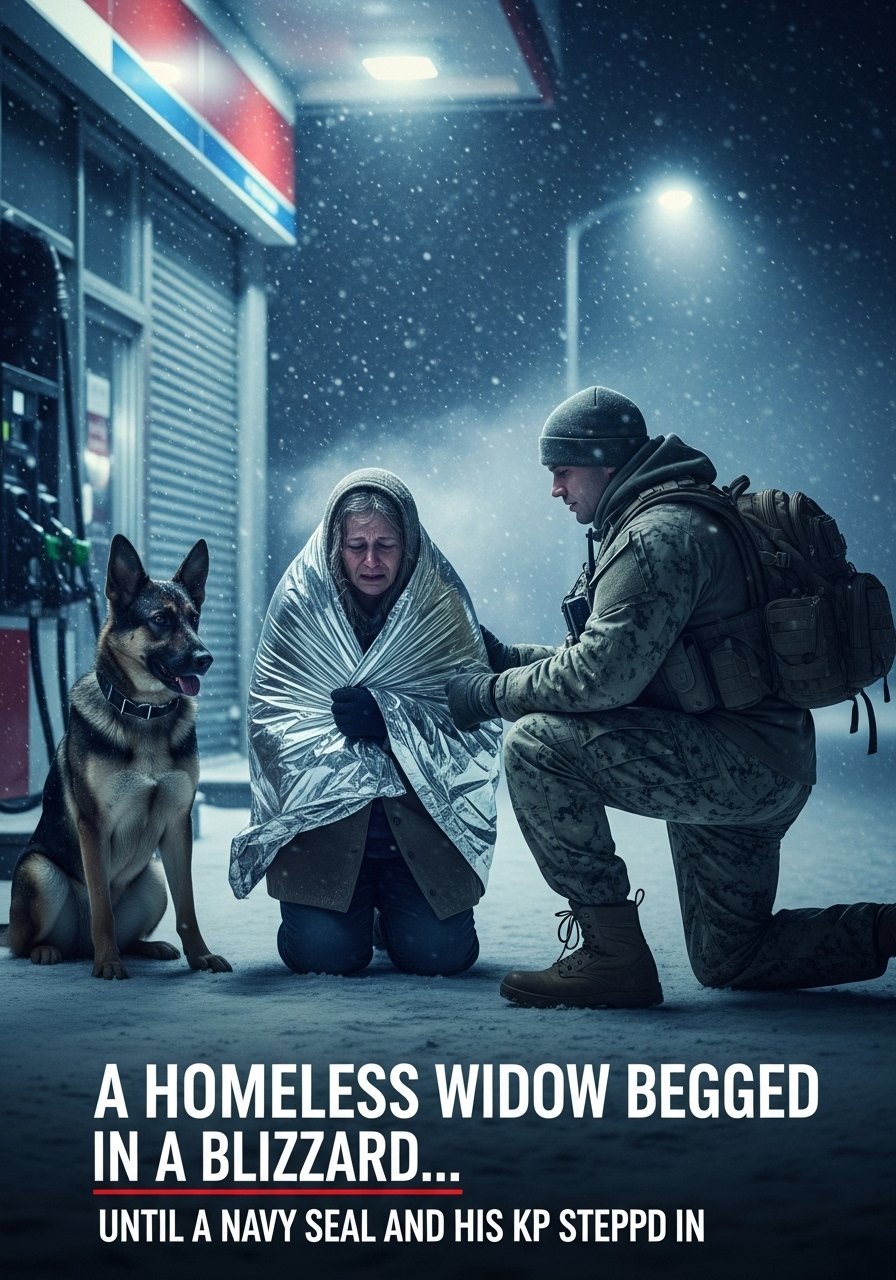
I looked up, barely able to focus, and saw a shape moving toward me through the snow. Big. Solid. A German Shepherd, ears sharp, eyes locked on me—not aggressive, but alert.
Behind the dog, a man emerged from the whiteout.
He was tall, broad-shouldered, moving like someone who knew exactly where his body was in space. He wore a heavy jacket with no visible logos, a beanie pulled low, and gloves that looked military-issued. There was something about him—calm, deliberate—that made the chaos around him feel smaller.
He knelt in front of me without hesitation.
“Ma’am,” he said, voice steady. “You’re not okay.”
I tried to answer, but my jaw wouldn’t cooperate.
The dog pressed closer, warm and solid, like an anchor. I realized then how violently I was shaking.
The man didn’t ask for my story. He didn’t lecture. He didn’t look uncomfortable.
He pulled a thermal blanket from his pack, wrapped it around me, and tucked it in tight like he’d done it a thousand times before.
“I’m going to get you somewhere warm,” he said. “But I need you to stay with me, alright?”
I nodded, or at least I think I did.
As he helped me to my feet, I noticed a patch on his backpack—faded, stitched carefully.
A trident.
I didn’t need to ask.
Navy SEAL.
He led me to a truck parked just beyond the gas station. The heater blasted like salvation. The dog—his K9—jumped into the back seat, watching me closely, as if making sure I didn’t disappear.
I cried then.
Not pretty crying. Not quiet crying.
The kind that comes from somewhere deep and ancient, when your body finally believes you might live.
On the drive, he asked gentle questions. My name. Whether I had family. If I was injured.
When I told him about my kids, his jaw tightened—not in anger, but in resolve.
“They’re safe?” he asked.
“With my sister,” I said. “I just… I can’t get back to them.”
He nodded once. “We’ll figure something out.”
He didn’t promise miracles.
He promised action.
Instead of taking me to an overcrowded shelter, he drove me to a small church I didn’t even know existed. He knew the pastor. Knew the back entrance. Knew exactly who to call.
Within an hour, I had a bed. Dry clothes. Soup so hot it made my hands ache. A phone to call my sister.
The SEAL didn’t stay long.
Before he left, I asked him why he stopped.
He shrugged, uncomfortable. “I don’t walk past people who need help,” he said. “Not overseas. Not here.”
Then he clipped a leash onto his dog, gave him a command in a language I didn’t recognize, and disappeared back into the storm.
I thought that was the end of it.
I was wrong.
Over the next weeks, things moved in ways I still don’t fully understand.
A social worker connected me to emergency housing. A veterans’ charity—his charity—covered a security deposit. Someone paid off my past-due storage unit so I could get our photos, our clothes, our memories back.
Three months later, I stood in a small apartment kitchen, watching my kids argue over cereal like nothing had ever happened.
I still cry sometimes.
I still carry the shame, the fear, the knowledge of how close I came to vanishing.
But every winter, when the snow starts falling, I remember that night.
I remember the sound of paws in the dark.
I remember a man who had seen war, who had trained for violence, choosing instead to kneel in the snow for a stranger.
And I remember this:
Sometimes, survival doesn’t come from being strong.
Sometimes, it comes from being seen.