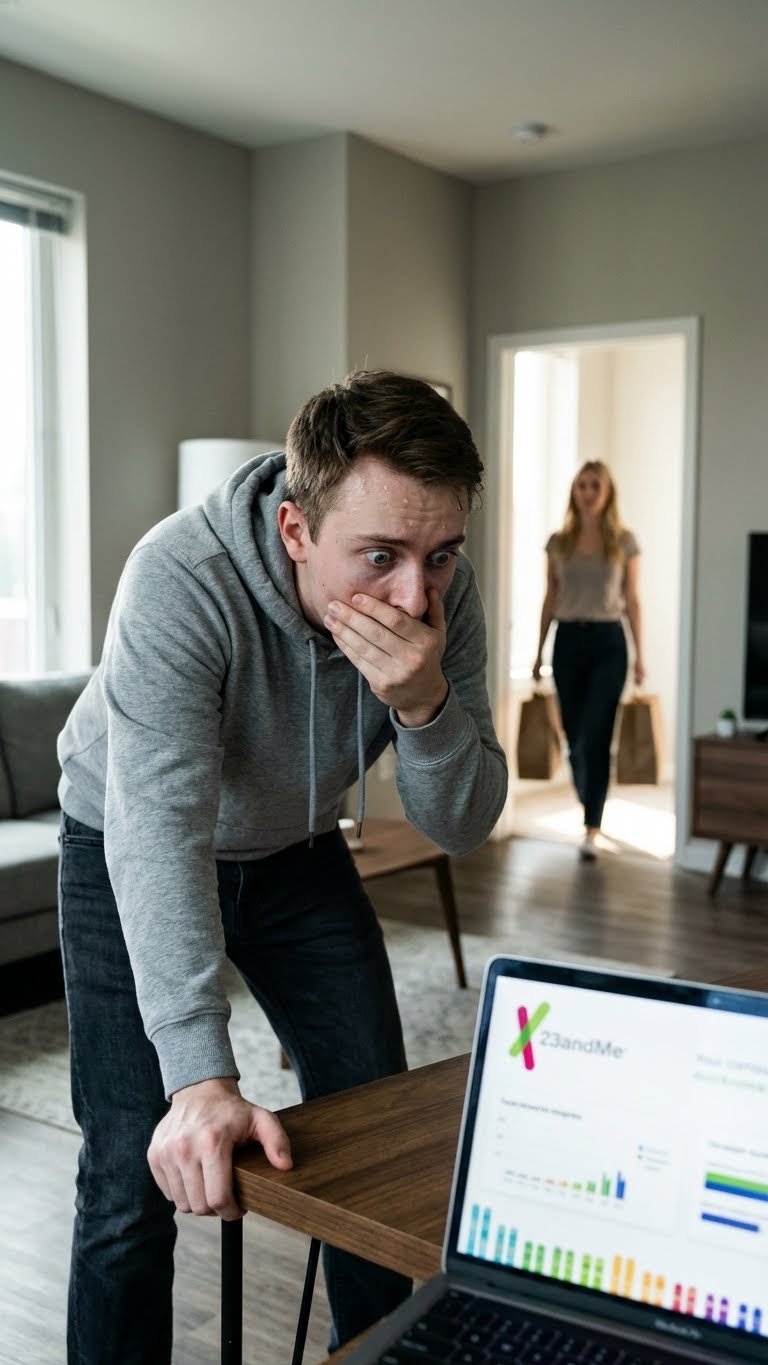
I stared at my laptop screen, reading the same line over and over until the words stopped making sense.
“You and your father share 0% DNA.”
My hands were trembling so badly I could barely click the mouse. This had to be a mistake. 23andMe made mistakes all the time, right? I’d read about it online. Lab errors. Mixed up samples. Database glitches.
But then I saw the next notification: “Close Family Match Found – Uncle Tom (predicted relationship: Father).”
Uncle Tom. My dad’s younger brother. The one who’d moved to Australia fifteen years ago and never came back. The one whose name made my mother’s face go pale whenever someone mentioned him at family gatherings. The one my dad refused to talk about, ever.
I was supposed to be doing this for fun. My girlfriend Emma had gotten us both 23andMe kits for Christmas. “Let’s see if you’re secretly royalty or something,” she’d joked while we spit into the tubes on New Year’s Eve. We’d sent them off together, laughing about how we’d probably both be “boring European mutts.”
Three weeks later, my entire life exploded.
The Phone Call
I called my mom. She didn’t answer. I called again. And again. On the fourth try, she picked up, her voice tight.
“Jake, I’m at work. Can this wait?”
“Did you sleep with Uncle Tom?”
The silence on the other end lasted so long I thought the call had dropped. Then I heard her breathing, quick and shallow, like she was trying not to cry or scream or both.
“How did you—” she started, then stopped. “Did your father tell you?”
“Dad doesn’t know, does he?” My voice cracked. “The 23andMe results just came back. Uncle Tom is my biological father. You’ve been lying to everyone for fifteen years.”
I heard something crash in the background. My mother was crying now, full sobs that she wasn’t even trying to hide.
“Jake, please. You don’t understand. It was complicated. It was one time, and Tom left, and your father—he loves you so much, and I couldn’t—”
“Does Tom know?”
Another long silence.
“He suspected. That’s why he left the country. That’s why he’s never come back. We agreed never to tell anyone. Ever. And now you’ve—” Her voice turned sharp, almost angry. “Why did you take that stupid test?”
I hung up. My phone immediately started buzzing with calls from her, but I couldn’t answer. I just sat there, staring at the genetic breakdown on my screen, watching my entire identity dissolve into percentages and chromosome matches.
Then my phone buzzed with a text. But it wasn’t from my mom.
It was from a number with an Australian country code.
“Jake? It’s Tom. Your mum just called me. I know you know. I’ve been waiting 15 years for this conversation. Can we talk?”
The Backstory I Never Knew
I didn’t respond to Tom’s text immediately. Instead, I sat in my apartment for hours, trying to process what this meant.
I was twenty-two years old. I’d grown up as Jake Morrison, son of David and Rachel Morrison. I had my dad’s last name, his old baseball glove, his spot on the family tree that hung in my grandmother’s hallway. We’d bonded over basketball games and terrible action movies. He’d taught me to drive, helped me move into my college dorm, gave me advice about girls and jobs and life.
And none of it was real. Not biologically, anyway.
I thought about Uncle Tom—or, I guess, my biological father. I barely remembered him. He’d been around when I was a kid, showing up at family barbecues and holidays, but always seeming uncomfortable, like he didn’t quite fit. When I was seven, he announced he was moving to Australia for work. Everyone was surprised by how sudden it was. One month he was there, the next he was gone.
I’d asked my dad about it once, maybe a year after Tom left. Dad’s face had gone hard, and he’d said simply, “Sometimes people make choices that hurt the people who love them. Tom made his choice.”
Now I understood what he’d meant. Or thought I did.
Emma came home around seven that evening and found me still sitting in the same spot, laptop open, phone buzzing nonstop with calls from my mother.
“Babe? What’s wrong?” She set down her bag, concern flooding her face when she saw my expression.
I showed her the screen.
“Oh my God,” she whispered, sinking onto the couch next to me. “Jake, I’m so sorry. I thought these tests were just fun. I didn’t think—”
“It’s not your fault,” I said automatically. But part of me wondered: if she hadn’t bought those kits, would I still be living in ignorant bliss?
Confronting My Mother
My mother showed up at my apartment an hour later. I hadn’t answered any of her calls, but I’d finally texted: “Come over. We need to talk face to face.”
She looked terrible—eyes red and swollen, makeup smeared, still wearing her work clothes but looking like she’d been through a war. She stood in my doorway, and for the first time in my life, I saw her as a stranger. Someone capable of deception on a massive scale.
“Can I come in?” Her voice was small.
I stepped aside. Emma quietly excused herself to our bedroom, leaving us alone in the living room that suddenly felt too small for the weight of what we needed to discuss.
Mom sat on the edge of the couch, hands twisting in her lap. She didn’t look at me.
“Tell me everything,” I said. “The truth. All of it.”
She took a shaky breath. “Your dad and I were going through a rough patch. This was before you were born—we’d been trying to get pregnant for two years and nothing was working. The doctors said everything was fine, that we just needed to keep trying, but it was putting so much strain on our marriage. We were fighting all the time.”
I stayed silent, letting her continue.
“Tom was staying with us for a few months between jobs. He’d always been… there was always something between us, even before I married David. But I chose David. He was stable, responsible, the obvious choice.” She laughed bitterly. “Tom was the wild one. The one who couldn’t settle down, who chased dreams instead of security.”
“So you slept with him.” My voice was flat.
“It was one night. One stupid, terrible night when David and I had a huge fight and he left to stay at his friend’s place to cool off. Tom and I got drunk, and I was so angry and hurt, and—” She stopped, wiping her eyes. “It was the biggest mistake of my life.”
“But you got pregnant.”
“I did. And I genuinely didn’t know whose baby you were. David and I had reconciled a few days after… after it happened with Tom. We were trying to make things work. When I found out I was pregnant, I just assumed—I hoped—it was David’s.”
“When did you know it wasn’t?”
She was quiet for a long moment. “You were about six months old. You started looking more like Tom than David. Same eyes, same smile. Tom noticed too. He came to me one day when David was at work and said, ‘Rachel, I think he’s mine.’ We just stared at each other, and I knew he was right.”
“You could have done a paternity test.”
“I couldn’t. Don’t you understand?” Her voice rose desperately. “David loved you so much. You were his son. Doing a test would have destroyed everything—our marriage, our family, David’s relationship with his brother. And for what? To confirm what Tom and I already knew?”
“For the truth,” I shot back. “You don’t think I deserved the truth? Dad deserved the truth? “
“You were a baby,” she said, tears streaming down her face now. “You needed a stable home with two parents who loved you. Tom couldn’t offer that. He was barely employed, living couch to couch. David was an incredible father—is an incredible father. I made a choice to protect you.”
“You made a choice to protect yourself,” I corrected coldly. “And you forced Tom to leave the country to keep your secret.”
She flinched. “He agreed to go. I didn’t force him. We both knew that if he stayed, eventually David would figure it out. Someone would say something about how much you looked like Tom, or Tom would slip up, or—” She shook her head. “It was killing him, watching you grow up knowing he was your father but couldn’t claim you. So he left.”
The Truth About Tom
After my mother left—our conversation ending in bitter silence rather than resolution—I finally responded to Tom’s text.
“Yes. Let’s talk.”
He called me immediately. It was early morning in Australia, and I could hear birds in the background when he answered.
“Jake.” His voice was thick with emotion. “I’ve imagined this conversation a thousand times.”
“Why didn’t you ever reach out?” I asked, surprising myself with how much anger was in my voice. “Fifteen years. You could have told me.”
“I couldn’t,” he said simply. “Your mum and I made an agreement. David couldn’t know. And you… you were happy. I saw photos on Facebook over the years—Rachel couldn’t completely block me because it would look suspicious. I watched you grow up in pictures. Every birthday, every school photo, every achievement. I was so proud of you, and I had no right to be.”
“You’re my biological father. You had every right.”
“No,” he said firmly. “Biology doesn’t make you a father. David is your father in every way that matters. He raised you, loved you, taught you, supported you. I just… I contributed DNA. That’s all.”
His words should have made me feel better, but they made me angrier. “Don’t you think that choice should have been mine? Maybe I would have wanted to know you. Maybe I deserved to have both of you in my life instead of this fifteen-year lie.”
Tom was quiet for a long time. “You’re right. You deserved better than what we gave you. We were cowards, Rachel and I. We chose what was easiest for us and told ourselves it was for your benefit.”
The honesty was startling. “Why did you really leave?”
“Because I was in love with your mother,” he said quietly. “I had been for years, long before she married my brother. And every time I saw you, I saw both of us in your face, and it destroyed me. I couldn’t stay in that house, watching her raise my son with my brother, pretending everything was normal. So I ran to the other side of the world and tried to build a different life.”
“Did it work?”
“No.” He laughed sadly. “I got married, divorced. Had relationships that never went anywhere because I couldn’t stop thinking about the family I’d left behind. About the son I’d abandoned. Moving away didn’t erase you, Jake. It just meant I grieved you from a distance.”
Telling My Dad
The hardest conversation was still ahead of me. For three days, I avoided my dad’s calls and texts asking if I wanted to come over for our usual Sunday dinner. Finally, I agreed to meet him at his house—the house I’d grown up in, that still had my high school baseball photos on the wall and my height marks on the doorframe.
He greeted me with his usual bear hug, completely oblivious to the bomb I was about to drop.
“You look tired, kid. Everything okay at work?”
“Dad, sit down. We need to talk.”
His smile faded. He sank into his recliner—the same one he’d sat in a thousand times before, watching games, reading the paper, falling asleep during movies—and looked at me with growing concern.
“What’s going on?”
I pulled up the 23andMe results on my phone and handed it to him. “Emma got us DNA test kits for Christmas. The results came back.”
He stared at the screen, his face slowly draining of color as he read. I watched his eyes move across the words, saw the exact moment he understood what he was seeing. The phone trembled in his hand.
“This is a mistake,” he said finally, his voice hoarse. “These things make mistakes all the time—”
“It’s not a mistake, Dad. I talked to Mom. I talked to Tom. It’s real.”
He dropped the phone like it had burned him. “Tom.” The name came out strangled. “My brother. My brother and my wife.”
“It was one time, fifteen years ago. Before I was born, obviously. They said you and Mom were going through a rough patch—”
“A rough patch?” He stood abruptly, his face flushing red. “We were struggling to get pregnant, so she slept with my brother? And then let me raise his child for fifteen years thinking he was mine?”
“You ARE my dad,” I said desperately. “Biology doesn’t change that. You raised me. You taught me everything I know. You’re my father in every way that matters—”
“Don’t.” He held up a hand, and I saw tears in his eyes for the first time since his own father’s funeral. “Don’t patronize me with that ‘biology doesn’t matter’ speech. You’re right that I’m your father in every real sense. But that doesn’t erase the fact that my wife and my brother betrayed me in the worst possible way and then lied to me for fifteen years.”
“I know. I’m so sorry. I didn’t know whether to tell you or keep the secret, but I couldn’t—I couldn’t look at you knowing the truth and not say anything.”
He sank back into his chair, suddenly looking ten years older. “Does Tom know?”
“He suspected. That’s why he left for Australia. To keep the secret.”
Dad laughed, a bitter sound. “How noble of him. Abandon his son and his brother to avoid an uncomfortable conversation.” He looked at me with devastated eyes. “Did your mother know for sure, or was she just guessing?”
“She said she suspected when I was six months old. Tom confronted her about it, and they agreed it was probably his, but they never did a paternity test. They just… decided to never tell anyone and hope it went away.”
“Jesus Christ.” He put his head in his hands. “Fifteen years. I’ve been living a lie for fifteen years.”
The Fallout
The explosion was spectacular and devastating.
My dad filed for divorce within a week. My mother begged, cried, explained, apologized—none of it mattered. The foundation of their marriage had been built on a lie, and now that the truth was exposed, there was no rebuilding.
“I could have forgiven the affair,” he told me during one of our increasingly frequent phone calls. “People make mistakes, marriages go through hell. But the lying, Jake. Fifteen years of looking me in the eye every single day and lying. Watching me raise another man’s child—my own brother’s child—and never saying a word. That’s not a mistake. That’s a choice she made every day for fifteen years.”
The extended family fractured along fault lines. Dad’s parents—my grandparents, who’d always been a huge part of my life—didn’t know what to do with me. Was I still their grandson? Legally yes, biologically no. Some relatives sided with my mother, saying she’d made an impossible choice in an impossible situation. Others were furious at the betrayal and the years of deception.
Tom flew back to the States for the first time in fifteen years. He and my dad met once, at a coffee shop, without me. Dad told me later that it lasted ten minutes before he walked out. “He tried to apologize. Tried to explain. I told him he was dead to me and I never wanted to see him again.”
But Tom stayed. He got an apartment in the city, forty minutes from where I lived. He texted me occasionally, always careful, always leaving the door open but never pushing.
Meeting My Biological Father
Three months after the DNA results destroyed my family, I agreed to meet Tom for lunch.
He looked older than I remembered, grayer, with lines around his eyes that hadn’t been there fifteen years ago. But I could see it now—the resemblance. The same eyes, same nose, same gesture of running his hand through his hair when nervous.
“Thanks for agreeing to see me,” he said as we sat down at a quiet restaurant. “I wasn’t sure you would.”
“I’m not sure why I did,” I admitted. “Part of me wants to hate you for abandoning me. Part of me wants to get to know you. Mostly I’m just confused.”
“That’s fair.” He smiled sadly. “For what it’s worth, I never abandoned you by choice. I wanted to be in your life more than anything. But Rachel and I agreed it was impossible.”
“You could have fought for me.”
“And destroyed your family in the process? Torn you between two fathers? Exposed the lie and watched your parents’ marriage implode when you were seven years old?” He shook his head. “Maybe that would have been more honest, but I don’t think it would have been better. Not for you.”
We talked for two hours. He told me about his life in Australia, his failed marriage, his career as a wildlife photographer. He showed me photos of the Outback, of kangaroos and sunsets and the life he’d built half a world away from the son he couldn’t claim.
“I named my photography business after you,” he said quietly, pulling up a website on his phone. “Jake’s Eye Photography. Everyone assumed Jake was a friend or mentor. But it was you. My way of keeping you close even though you were an ocean away.”
I didn’t know what to say to that.
The Resolution
A year has passed since that 23andMe notification destroyed my family’s fifteen-year lie. The dust has settled into a new, strange normal.
My dad and I are still close—closer, in some ways, because we’ve been forced to confront what fatherhood really means. He’s dating someone new, a kind woman named Patricia who makes him laugh again. He told me once, late at night after a few beers, “You’re my son. That DNA test didn’t change that. But knowing the truth… it hurts less now. Like lancing a wound I didn’t know was infected.”
My mother and I have a strained relationship. I see her for holidays, we text occasionally, but the easy closeness we once had is gone. She made choices that protected her but wounded everyone else, and I’m still working through my anger about that in therapy.
Tom and I meet for lunch once a month. It’s awkward and sometimes painful, but we’re building something. Not a father-son relationship exactly—that role is filled. But a connection. He’s teaching me photography, showing me how to see the world the way he does. Last month he invited me to visit Australia with him, and I said yes.
The extended family is still fractured, probably permanently. Some relationships survived the revelation, others didn’t. That’s the thing about DNA tests and family secrets—the truth might set you free, but it also burns everything in its path.
Emma and I are still together, though she jokes that she’s never buying anyone a DNA test as a gift ever again. “I was trying to find out if you were secretly Viking royalty,” she said once. “Instead I accidentally destroyed your entire family tree.”
“You didn’t destroy it,” I corrected. “You revealed it was built on lies. There’s a difference.”
Recently, my dad asked me an interesting question: “If you could go back and not take that test, would you?”
I thought about it for a long time. The easy answer is yes—ignorance was simpler, less painful, didn’t blow up my family. But the honest answer is more complicated.
“No,” I finally said. “Because now I know the truth. And the truth, even when it hurts, is better than living a lie.”
He nodded slowly. “Yeah. I think I agree. It just took me a while to get there.”
The 23andMe kit sits in my closet now, empty, its purpose served. Sometimes I think about all the families like mine—sitting on secrets, hoping they stay buried, not realizing that DNA doesn’t keep secrets anymore. That saliva and science will eventually expose what silence tried to hide.
Would I recommend DNA tests to others? I honestly don’t know. They can connect you to lost relatives, reveal fascinating ancestry, solve medical mysteries. But they can also tear apart the fundamental stories families tell themselves about who they are and where they came from.
All I know is this: my name is Jake Morrison. My dad is David Morrison, the man who raised me and loved me and taught me how to be a man. My biological father is Tom Morrison, who made mistakes and carried secrets and is trying, fifteen years late, to be part of my life.
And the truth, messy and painful as it is, beats the lie.
Even when it costs everything.