I shouldn’t have looked. But Sarah’s laptop was facing me, screen fully lit, and I saw my name. Not just my name—my full name, my address, and a folder labeled “Evidence – Michael Chen.” My hands went cold. Sarah had left her desk three minutes ago for a bathroom break, and I was just dropping off the quarterly reports she’d asked for.
The screen was still unlocked. I could see at least eight open tabs and what looked like a spreadsheet with dates, times, and dollar amounts. Next to my name were the words “Primary Target.”
I should have walked away. I should have set the reports down and left. But my name was right there, and my brain couldn’t make sense of what “Primary Target” meant. Was this some kind of project? A joke? My legs felt disconnected from my body as I moved closer to her desk.
The spreadsheet had at least forty rows. I recognized some of the names—people from our department, people who’d left the company in the past year, people I’d worked with. Each row had dates going back six months. Some had red highlights. Mine was highlighted in red.
I heard footsteps in the hallway. My heart slammed against my chest. I backed away from the desk so fast I almost tripped over the trash can. By the time Sarah walked back in, I was standing near the door, reports in hand, trying to look normal. She smiled at me, that same friendly smile she’d given me every morning for the past two years.
“Thanks for bringing these by,” she said, reaching for the reports. Her voice was light, casual. “You okay? You look pale.”
“Fine,” I said. “Just tired.”
She nodded and turned toward her computer. I watched her glance at the screen. Something shifted in her expression—so quick I almost missed it. Her hand moved to the mouse, and she clicked something. When she looked back at me, that smile was still there, but it felt different now. Tighter.
“Well, don’t work too hard,” she said.
I left her office and walked straight to the bathroom. My hands were shaking. I ran cold water over my wrists and tried to think clearly. Sarah Mitchell had worked at Westfield Analytics for four years. She was senior HR coordinator. She’d interviewed me when I first applied. She’d helped me navigate the company insurance system when my mom got sick last year. She’d brought cookies to the office on my birthday.
And she had a file on me labeled “Evidence.”
I couldn’t go to anyone. Going to HR meant going to Sarah’s department. Going to my manager meant it would probably filter back to HR anyway. I didn’t even know what I’d say. “I saw something on her computer that scared me” sounded paranoid. “She has a file with my name on it” sounded like I’d been snooping. Which I had been, technically.
For the rest of that day, I couldn’t focus. Every time someone walked past my cubicle, I tensed. I kept replaying what I’d seen. The spreadsheet. The dates. My address. That folder name.
When I got home that night, I did something I’d never done before. I went through my email history with Sarah. Every single exchange we’d had in two years. There were hundreds of emails. Most were routine—meeting confirmations, policy updates, benefit questions. But as I read them again, I started noticing things.
Three months ago, she’d asked me detailed questions about my previous employer. I’d thought she was just making conversation. She wanted to know why I left, who my manager was, whether I’d signed a non-compete agreement. I’d answered everything. I’d been friendly.
Two months ago, she’d asked if I’d be willing to share my salary history for a “compensation benchmarking study.” I’d declined, said I preferred to keep that private. She’d said no problem, totally understood. But now I remembered how she’d followed up the next day with a different angle—asking about my education loans, whether the company’s tuition reimbursement program would be useful for me.
I’d told her I had about forty thousand in student debt. I’d told her I was considering going back for an MBA. I’d told her everything.
My phone buzzed. A text from an unknown number: “Hey Michael, this is Sarah. I got your personal number from the directory. Can we talk tomorrow? Nothing bad, just want to catch up.”
I stared at the message. She’d never texted me before. We didn’t have that kind of relationship. And why would she emphasize “nothing bad”? People only say that when something is bad.
I didn’t respond. I barely slept that night. Every time I closed my eyes, I saw that spreadsheet. Primary Target. Evidence.
The next morning, Sarah wasn’t at her desk. I asked around casually—had anyone seen Sarah? Janet from accounting said she’d taken a personal day. That’s when I noticed something else. Three people from that spreadsheet I’d seen—people whose names I recognized—weren’t at their desks either. One had quit last month. One had been fired for “policy violations” that nobody would explain. One had transferred to the Boston office suddenly, mid-project.
I started checking LinkedIn. Five people who’d left the company in the past year had worked in my department. Four of them had left under strange circumstances. One had posted something cryptic: “Sometimes you find out who people really are too late.”
I wanted to message them. I wanted to ask what happened. But what would I say?
That afternoon, I got called into a meeting with my manager, Tom. He seemed uncomfortable. He asked me questions about my recent work, my relationship with other team members, my satisfaction with the company. It felt like a performance review, except we’d had one just six weeks ago and everything had been fine.
“Is something wrong?” I finally asked.
Tom hesitated. “We’ve had some concerns raised about potential policy violations. It’s probably nothing, but HR needs to do a standard inquiry.”
“What kind of violations?”
“I’m not at liberty to discuss that yet. Sarah will reach out to schedule a time to talk.”
My stomach dropped. “Sarah Mitchell?”
“Yes. Is there a problem with that?”
I couldn’t tell him. If I told him what I’d seen, it would confirm I’d been looking at her computer without permission. It would make me look guilty of something. I shook my head.
“No problem.”
That evening, I got an email from Sarah. Subject line: “Required Meeting – Compliance Matter.” The email was professional, formal. It requested my presence at an HR meeting Friday morning at nine. It listed Sarah and someone named Patricia Volkov from Legal as attendees.
Legal.
I forwarded the email to my personal account. I started documenting everything—every interaction I’d had with Sarah, every weird question she’d asked, every date I could remember. I took screenshots of my work emails. I backed up my files. I didn’t know what I was preparing for, but I knew something was wrong.
Thursday morning, I came in early. Sarah’s office door was closed, but I could see her through the glass. She was on the phone, and she was looking at her computer screen with an intensity I’d never seen before. She was taking notes, nodding. When she glanced up and saw me, she didn’t wave or smile. She just held eye contact for three seconds, then looked back at her screen.
I thought about that folder. Evidence. Evidence of what? What had I supposedly done? Or what was she doing?
Friday morning arrived. I put on my best shirt, like I was going to court. I got to the office at eight-thirty, thirty minutes before the meeting. I sat at my desk and tried to breathe normally.
At eight fifty-five, my phone rang. It was Sarah.
“Michael? Could you come up a few minutes early?”
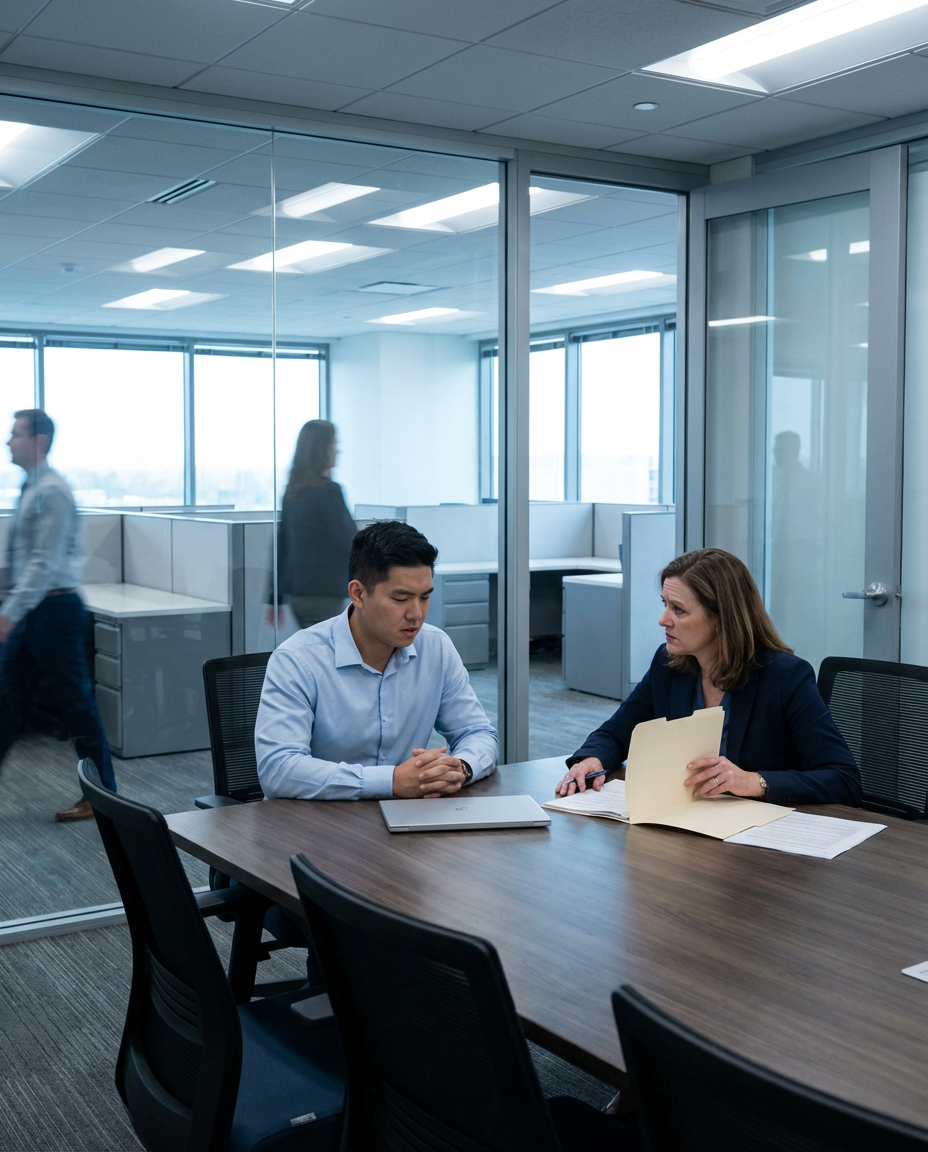
I walked to the HR conference room. Sarah was there. Patricia Volkov was not. It was just Sarah, a closed laptop, and a folder. A physical folder. Thick.
She gestured to a chair. I sat.
“Patricia is running late,” Sarah said. “But I wanted to talk to you first. Privately.”
She opened the folder. I could see papers, printed emails, highlighted sections. My name was on the first page.
“Michael, I need to ask you something, and I need you to be completely honest with me.”
My mouth was dry. “Okay.”
She looked at me for a long moment, and I realized something. She looked scared. Not angry, not professional—scared.
“Did you look at my computer last Tuesday?”
The room felt smaller. I could hear the clock on the wall ticking. I could hear my own heartbeat.
“Yes,” I said.
She closed her eyes. When she opened them again, she looked like she might cry.
“Then you know.”