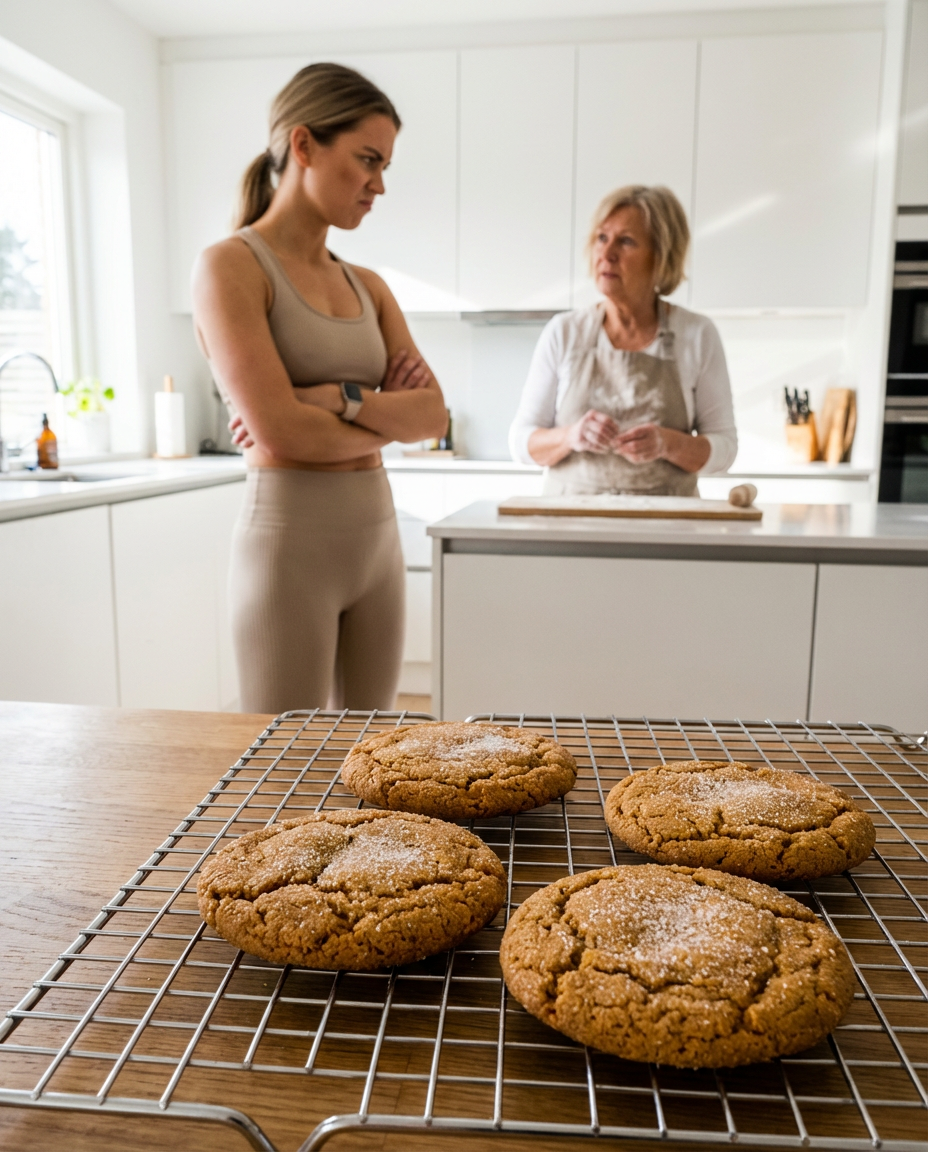
I am 62 years old, and until last Tuesday, I considered myself a “cool” grandmother. I have a career, I travel, and I’ve always made it a point to respect my son’s marriage. I know the horror stories of overbearing mothers-in-law, and I swore I would never be one. But apparently, in the eyes of my daughter-in-law, Brooke, I am not just overbearing—I am a “toxic presence” and a “biological threat.”
The conflict centers around a recipe that has been in my family for four generations: My grandmother’s molasses ginger cookies. They are soft, spicy, and, in my opinion, a hug in food form.
My son, David, married Brooke five years ago. Brooke is what people online call an “Almond Mom,” but on steroids. She is an influencer in the “wellness” space. Her house is a temple of beige linen, organic kale, and zero-sugar living. My grandkids, Leo (4) and Mia (6), have never tasted a drop of Red 40 or a grain of processed white sugar in their lives.
I’ve tried to be respectful. When they come over, I stock the fridge with organic berries and unsweetened almond butter. I’ve sat through Brooke’s hour-long lectures on how “glucose spikes lead to childhood inflammation.” I nodded. I smiled. I kept my mouth shut.
But last week, David had a late meeting, and Brooke had a “wellness retreat” (which turned out to be a spa weekend). They asked if the kids could stay with me for two nights. I was thrilled.
On the second night, Leo was crying. He’s a sensitive boy, and he was missing his mom. He looked at the photo of my grandmother on the mantle and asked what she was holding in the picture.
“Those are her ‘Magic Cookies,’ Leo,” I said, without thinking. “She used to make them whenever I felt sad.”
Mia’s eyes lit up. “Can we make magic cookies?”
Now, looking back, this was my moment of failure. I knew Brooke’s rules. But I looked at my grandkids—children who think a “treat” is a freeze-dried piece of seaweed—and I felt a wave of pity. I thought, One cookie won’t kill them. It’s a family tradition.
We spent the evening baking. The kitchen smelled like cinnamon and ginger. The kids were covered in flour, laughing, and for the first time in months, they weren’t acting like little robots who only talk about “gut health.” They each had two cookies with a small glass of actual whole milk. They were in heaven. They went to sleep without a single complaint, their bellies full and their hearts happy.
The disaster happened the next afternoon when Brooke came to pick them up.
I had cleaned the kitchen, but I forgot one thing: the cooling rack. It was sitting on the back of the stove with three leftover cookies.
Brooke walked in, glowing from her retreat. She hugged the kids, and then she smelled it. She literally stopped in her tracks, her nose wrinkled like she’d smelled a dead animal.
“What is that smell?” she asked, her voice dropping an octave.
“We made cookies!” Leo shouted, his face beaming. “Grandma’s magic cookies! They were so yummy!”
The silence that followed was deafening. Brooke turned to me, her face pale. “You gave them… gluten? And sugar?”
“Brooke, it was just two cookies,” I said, trying to keep my voice light. “They had a wonderful time. We talked about their great-great-grandmother—”
“You poisoned them,” she interrupted. She wasn’t yelling. She was whispering, which was somehow worse. “You intentionally introduced neurotoxins into their developing systems after I explicitly told you our dietary boundaries. This is a violation of their bodily autonomy.”
“Brooke, don’t you think ‘poison’ is a bit of a strong word? It’s a cookie. Millions of children eat them every day.”
“And millions of children have metabolic disorders!” she snapped. She grabbed the kids’ bags. “Leo, Mia, get in the car. We need to go home and start a charcoal detox immediately.”
I thought that was the end of it. A dramatic exit, a few weeks of “the cold shoulder,” and eventually a forced apology from me. I was wrong.
An hour later, I heard a knock at the door. I opened it to find two police officers.
“Ma’am, we received a call regarding a potential child endangerment and ‘intentional ingestion of harmful substances,'” the officer said, looking incredibly embarrassed to even be standing there.
Brooke had called the non-emergency line and then the emergency line when they didn’t respond fast enough, claiming I had “drugged” the children with “unregulated substances.” When the police realized the “substance” was a ginger snap, they basically rolled their eyes and left, but the damage was done.
The next morning, I received a 3,000-word email from Brooke. She CC’d my son and my ex-husband. In it, she outlined a “Safety Plan” for if I ever wanted to see the kids again.
The requirements were insane:
- I must attend a “Nutrition Awareness” course.
- I must pay for a full blood-panel for both children to check for “sugar-induced inflammation.”
- All future visits must be supervised by a third-party “wellness coach.”
- I am banned from my own kitchen when the children are in the house.
The worst part? David isn’t standing up to her. He called me, sounding exhausted. “Mom, just do the course. You know how she is about her brand. She thinks this could ruin her reputation if her followers found out her kids were eating processed flour. Just apologize so I can have some peace.”
I told him no. I told him I wouldn’t apologize for giving my grandchildren a piece of their heritage. I told him that the only person “poisoning” those kids is the mother who is teaching them to be afraid of food.
Now, Brooke has blocked my number, and she’s posted a “vague-blog” on her Instagram about “toxic family members who don’t respect boundaries” and “protecting your children’s vessels from outside interference.” Her followers are calling me a “generational trauma-inflictor.”
I’m sitting in my quiet house with a tin of ginger cookies, wondering if I’m the one who is crazy. Is a cookie worth losing my grandchildren? Or is this where I finally draw the line against a daughter-in-law who has lost touch with reality?