I have spent the last fifteen years of my life believing I was a hypochondriac. I have spent thousands of dollars on specialists, allergists, and gastroenterologists. I have missed my own anniversary trips, spent nights curled up on bathroom floors, and endured the subtle, pitying eye-rolls of my husband’s entire family.
And all of it—every single second of pain—was a calculated experiment by my mother-in-law, Evelyn.
To understand the depth of this betrayal, you have to understand Evelyn’s “Secret Ingredient.” In the small, tight-knit town where my husband, Mark, grew up, Evelyn is a culinary local legend. She doesn’t just cook; she performs. Her Sunday Roasts are mandatory. Her Thanksgiving spreads are talked about for months. But the crown jewel of her repertoire is her “Harvest Stew.”
It’s a rich, earthy, incredibly complex dish that she makes every time the family gathers. For fifteen years, I’ve been told that if I didn’t eat the stew, I wasn’t “really part of the family.”
The problem started the very first time I met her. I told her, as politely as possible, that I have a severe intolerance to mushrooms. It’s not a “call an ambulance” allergy, but it’s a “my body will reject my existence for 48 hours” level of sickness. It’s painful, it’s exhausting, and it’s very real.
Evelyn’s response back then was a thin, tight smile. “Oh, dear. How modern. In my day, we just called that being a picky eater.”
For fifteen years, every time she served the stew, I would ask, “Evelyn, does this have mushrooms in it? You know I can’t have them.”
And for fifteen years, she would look me dead in the eye and say, “Of course not, darling. I made this batch specifically without them just for you. The ‘Secret Ingredient’ is something else entirely. It’s a family trade secret.”
I trusted her. Why wouldn’t I? She was my husband’s mother. She was a pillar of the community. So, I would eat. And about three hours later, the cramps would start. The cold sweats. The agonizing trips to the bathroom.
When I would mention it the next day, the gaslighting would begin.
Mark would sigh and say, “Honey, Mom said there were no mushrooms. Are you sure it’s not just stress? You always get so worked up before we visit her.”
Evelyn would chime in with a performative pout. “It breaks my heart that my cooking makes you feel this way. Maybe it’s the wine you’re drinking? Or perhaps it’s… well, you’ve always been a bit delicate, haven’t you?”
She managed to convince my husband, my sister-in-law, and eventually me, that my symptoms were psychosomatic. I started seeing a therapist for “somatic symptom disorder.” I thought I was losing my mind. I thought my own body was lying to me to get out of spending time with my in-laws.
The truth came out last Sunday during Evelyn’s 70th Birthday Party.
The house was packed. Most of the town was there. Evelyn was in her element, presiding over a massive pot of the Harvest Stew. I had been feeling particularly run-down that week, and I told Mark I was going to skip the stew this time.
“Don’t be difficult, please,” Mark whispered. “It’s her 70th. She’s been in the kitchen for two days. If you don’t eat, she’ll think you’re snubbing her. Just have a small bowl. She swore to me there’s nothing in there but beef and root vegetables.”
I caved. I had a small bowl. Within an hour, I felt the familiar, dreaded tightening in my gut. I excused myself to the kitchen to get some water and try to find some antacids.
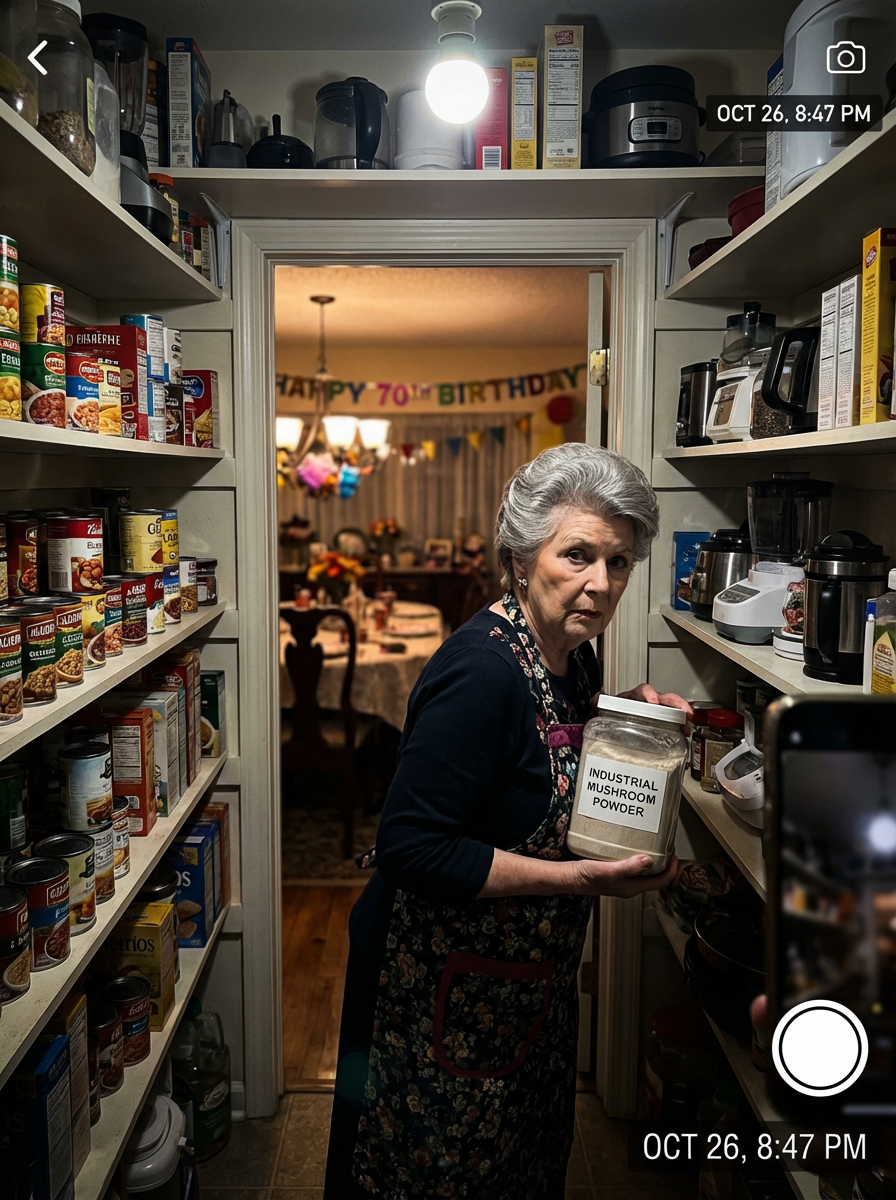
Evelyn was in the pantry, her back to me. She didn’t hear me come in. She was humming a little tune, and she was holding a large, industrial-sized jar of porcini mushroom powder—the kind that’s incredibly concentrated.
I watched, frozen, as she took a tablespoon of the powder and stirred it into a small Tupperware container of leftovers.
“Evelyn?” I whispered.
She jumped, nearly dropping the jar. Her face went through a terrifying sequence of expressions: shock, guilt, and finally, a cold, hard mask of indifference.
“Oh,” she said, smoothing her apron. “You startled me.”
“Is that… is that mushroom powder?” my voice was shaking. “The jar says ‘Concentrated Porcini.’ You just put that in the stew?”
Evelyn didn’t even try to deny it. She leaned against the pantry shelf and looked at me with a smirk that I will see in my nightmares.
“I’ve been putting it in every single batch for fifteen years, dear,” she said, her voice calm and conversational. “It’s the ‘Secret Ingredient.’ It gives it that ‘umami’ everyone raves about.”
I felt the room tilt. “But I told you. I told you every single time. I’ve been sick for fifteen years, Evelyn. I’ve been to the hospital. I’ve been in therapy because I thought I was crazy!”
Evelyn stepped closer, her eyes narrowing. “And yet, you’re still standing here. You didn’t die, did you? I knew you were lying from the start. I wanted to prove that it was all in your head. That you were just looking for a reason to be ‘special’ and ‘difficult.’ And I proved it. You ate it for fifteen years and you’re fine. A little stomach ache? That’s just your guilty conscience for being such a liar.”
I realized then that she wasn’t just a bad cook or a forgetful woman. She was a predator. She had used my own body as a laboratory to prove her dominance over me. She had watched me suffer, watched me cry, watched me doubt my own sanity—and she had enjoyed it.
I didn’t scream. I didn’t cry. I felt a cold, sharp clarity take over.
I walked out of the pantry and into the dining room, where forty people were eating. I walked straight to the head of the table where Mark was sitting.
“Mark,” I said loudly. The room went quiet. “I need you to listen to me very carefully. Your mother just admitted that she has been intentionally putting mushrooms into my food for fifteen years. She’s been doing it to ‘prove’ I’m a liar.”
Mark started to do his usual routine. “Honey, come on, you’re making a scene—”
“I’m not making a scene, Mark. I’m giving you a choice.” I looked at Evelyn, who had followed me out of the kitchen, looking like a victim.
“Evelyn,” I said, turning to her. “Tell them. Tell them what the ‘Secret Ingredient’ is.”
She tried to play it off. “It’s just a spice blend, everyone! She’s just had a bit too much to drink—”
“It’s porcini powder,” I shouted. “The jar is on the second shelf of the pantry. Mark, go look. Go look right now or I am calling the police and filing a report for food tampering.”
Mark saw the look in my eyes and realized I wasn’t backing down. He went into the kitchen. The silence in the room was deafening. A minute later, he came out holding the heavy jar. His face was white.
“Mom?” he asked, his voice breaking. “The labels say this is pure mushroom. Why is this in the pantry? You told me you never used this.”
Evelyn’s mask finally broke. She didn’t apologize. She screamed. She screamed about how I had ruined the family, how I was a “weak, fragile girl” who didn’t deserve her son, and how she was the one who kept this family together.
I didn’t stay to hear the end of it. I walked out, got in my car, and drove to a hotel.
It’s been three days. Mark has been calling me non-stop. He’s caught in the middle. He says what she did was “wrong,” but he also says she’s “elderly” and “from a different generation” where they didn’t understand allergies. He wants me to come home so we can “talk it out” as a family.
He doesn’t get it. This wasn’t a mistake. This was fifteen years of biological warfare. This was fifteen years of her watching me get sick and smiling about it.
I told Mark this morning that I am filing for divorce. Not because of his mother, but because he spent fifteen years helping her gaslight me. I’m done being “delicate.” I’m done being the “picky eater.”
I’m moving to a city where nobody knows Evelyn, and I’m going to have a giant, mushroom-free pizza for dinner.