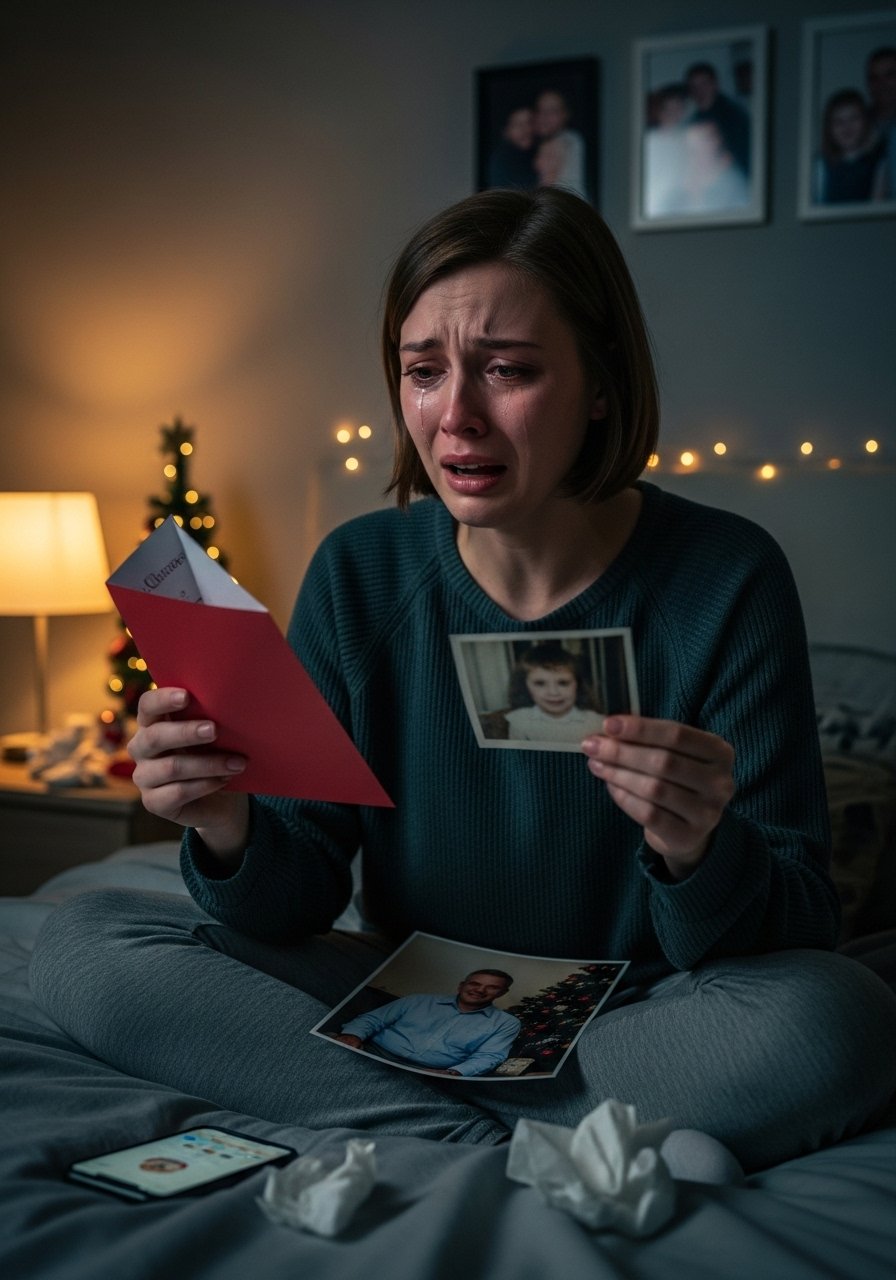
I’m 23 years old, and until last week, I believed my father died in a car accident when I was eight. I have vague memories of him—mostly just feelings and impressions rather than concrete details. I remember his laugh. I remember feeling safe when he picked me up. I remember my mom crying a lot after he “died.”
For fifteen years, I’ve carried the weight of being fatherless. I’ve gone to therapy to process the grief. I’ve cried on Father’s Day. I’ve wondered what kind of man he was, what he would think of me, whether I inherited any of his traits or talents.
And it was all a lie. Every single bit of it.
My father isn’t dead. He’s alive, living about 200 miles away, and apparently has been trying to contact me for years. I only know this because of a Christmas card that was accidentally delivered to our house—a card meant for our neighbor with an almost identical address.
The truth has destroyed everything I thought I knew about my life, my mother, and my own identity. And I’m sitting here, nine days before Christmas, trying to figure out what the hell I’m supposed to do with this information.
The Discovery
It started so innocuously. Last Tuesday, I was home from college for winter break, sorting through the mail while my mom was at work. Most of it was the usual holiday stuff—cards from relatives, catalogs, charity solicitations.
Then I saw a red envelope addressed to “Michael Peterson, 4 Rosewood Lane.” Our address is 4 Rosewood Court. The streets run parallel to each other, and the post office mixes them up constantly. It happens probably once a month.
Usually, I just walk misdelivered mail over to the correct house. But this time, something made me look at the return address more carefully.
The envelope was from “David Morrison, 2547 Maple Street, Riverside.”
Morrison. My last name is Morrison. My mother’s name is Jennifer Morrison. And according to everything I’ve been told my entire life, my father’s name was David Morrison.
My hands started shaking. This had to be a coincidence. Morrison is a common name. There are probably thousands of David Morrisons in our state alone.
But something in my gut told me this wasn’t a coincidence.
I know I shouldn’t have opened mail addressed to someone else. I know it’s technically a federal crime. But I was holding an envelope from someone with my dead father’s name, and I physically could not stop myself from carefully opening it.
Inside was a Christmas card. Generic holiday scene on the front—snowman, winter landscape, “Season’s Greetings” in gold script. But it was the handwritten message inside that made my world stop:
“Mike, hope this finds you well. Been thinking about you this holiday season as always. Would love to connect if you’re ever willing. My number’s still the same. Take care of yourself. —David”
That was it. Simple, casual, like they were old friends who’d lost touch.
But tucked inside the card was a small photo. A picture of a man who looked to be in his early fifties, standing next to a Christmas tree, holding what appeared to be a recent issue of a newspaper—the date clearly visible as November 2024.
And the man in the photo looked exactly like the few pictures I have of my father. Older, yes. Grayer. More lines around his eyes. But unmistakably the same person.
I stared at that photo for probably twenty minutes, my brain refusing to process what I was seeing. This couldn’t be real. My father was dead. He died fifteen years ago. My mother told me. We went to his funeral. I have a memory—vague and dreamlike—of standing in a church, people in black, someone telling me Daddy was in heaven now.
Except apparently, none of that was true.
The Confrontation
I didn’t know what to do. I sat on the couch holding that card and photo, completely paralyzed, until I heard my mom’s car in the driveway.
When she walked in, I was still sitting there, the card in my lap.
“Hey honey, how was your—” She stopped mid-sentence when she saw my face. “What’s wrong?”
I held up the card. “This was delivered to our house by mistake. It’s addressed to someone on Rosewood Lane, but I opened it because of the return address.”
My mom went pale. Actually pale, like all the blood drained from her face in an instant.
“Who is David Morrison?” I asked, my voice surprisingly steady. “And why does he look exactly like my dead father?”
“Where did you get that?” Her voice was barely a whisper.
“I told you. It was misdelivered. Mom, what the hell is going on? Is this… is this Dad?”
She closed her eyes. Opened them. Closed them again. Then slowly nodded.
“He’s alive?” I stood up, the card falling to the floor. “My father is ALIVE?”
“Sweetheart, please let me explain—”
“EXPLAIN? You told me he was DEAD! We went to his FUNERAL!”
“We didn’t,” she said quietly. “We went to a memorial service. For you. To help you process the separation. But there was no body. No actual funeral.”
I couldn’t breathe. The room was spinning. “How long have you been lying to me?”
“Since you were eight. Since the divorce.”
“DIVORCE?” I was shouting now. “You weren’t even divorced! He DIED! That’s what you told me!”
My mom sat down heavily on the chair, tears streaming down her face. “I’m so sorry. I thought I was protecting you. You were so young, and things were so complicated—”
“Protecting me FROM WHAT? From having a father?”
And then she told me everything. And somehow, the truth was even worse than the lie.
The Truth
According to my mother, here’s what actually happened when I was eight:
My parents’ marriage had been deteriorating for years. My father struggled with depression and unemployment. My mother was working two jobs to keep us afloat. They fought constantly. Money was always tight. The stress was crushing both of them.
When I was seven, my father started disappearing for days at a time. He’d leave without explanation and come back disheveled and uncommunicative. My mother suspected he was having an affair, but it turned out he was actually staying at a homeless shelter, too ashamed to admit he couldn’t handle the pressure of providing for his family.
Eventually, when I was eight, my parents separated. My father moved out, moved to a different city, got help for his depression, and tried to rebuild his life. They agreed to divorce.
But here’s where my mother made the decision that would shape the next fifteen years of my life: she decided I was too young to understand divorce, too young to handle the complexity of a father who was alive but absent. She was worried about the back-and-forth of custody, worried my father wasn’t stable enough for visitation, worried about the effect on me.
So she told me he died.
She staged a memorial service at our church. Just close family and friends—people she’d sworn to secrecy. No body, but she told me it was because of the “accident.” She took down most of his pictures, packed away his belongings, and created a fiction that, in her mind, was kinder than the truth.
“I thought it would be easier for you,” she said through tears. “One clean break instead of years of confusion and disappointment. Your father was in such a bad place then. I didn’t know if he’d ever get better. I didn’t want you to spend your childhood waiting for a father who might never be able to show up consistently.”
“So you decided he was just… DEAD?” I couldn’t wrap my mind around it. “You didn’t think I deserved to know the truth?”
“You were eight years old!”
“What about when I was ten? Twelve? Fifteen? When was the right time to tell me you’d been lying to me my entire conscious life?”
She didn’t have an answer for that. Because there is no good answer.
The Hidden History
Over the next several hours—between crying and shouting and long, awful silences—my mother revealed more details that made everything even more surreal.
My father had tried to contact me. Multiple times over the years.
When I was nine, he sent birthday cards. My mother intercepted them and threw them away.
When I was eleven, he hired a lawyer to request visitation rights. My mother fought it, arguing that I believed he was dead and that revealing the truth would be psychologically damaging. The court apparently agreed that disrupting my life at that point would do more harm than good.
When I was thirteen, he tried to friend request me on social media. My mother had set up my accounts with her email address and monitored them closely. She blocked him before I ever saw the request.
When I was sixteen, he wrote me a letter—a long, heartfelt letter explaining everything, apologizing, expressing his love for me. My mother found it in the mailbox and destroyed it.
“He never stopped trying,” she admitted. “He’s been sober for twelve years. He has a stable job. He’s remarried. He’s built a good life. And he’s never stopped asking about you, trying to reach you.”
“And you kept me from him,” I said flatly. “For fifteen years, you kept me from my own father.”
“I was protecting you!”
“From WHAT? From having a parent who loved me? From knowing the truth? From making my own decisions about my own relationships?”
“From being abandoned again!” she shouted. “From getting your hopes up that he’d be there for you and then being disappointed when he wasn’t! From the confusion and pain of having a father who was alive but absent!”
“But he wasn’t absent! He was TRYING! You just wouldn’t let him!”
The realization was crushing. My father hadn’t abandoned me. My mother had stolen him from me.
The Man in the Photo
I spent the rest of that evening in my room, staring at the photo from the Christmas card. Really looking at it for the first time.
My father—because that’s who he was, undeniably—looked healthy. Happy, even. He was standing in what appeared to be a nice home, next to a decorated Christmas tree, smiling at the camera. In the background, I could see picture frames on the mantel, though the photo wasn’t clear enough to see who was in them.
He looked like someone who had his life together. Someone stable and content. Nothing like the broken, unstable person my mother had described.
I found myself searching for similarities between us. He had my nose, or I had his. The same slightly crooked smile. The same dark hair, though his was graying now. We had the same build—tall and lean.
I’d spent my whole life wondering who I looked like, where certain traits came from. And here he was, alive, a 200-mile drive away, and I’d never known.
I pulled out my laptop and did something I probably should have done years ago: I googled “David Morrison Riverside.”
He popped up immediately. A LinkedIn profile for a David Morrison who worked as an accountant at a mid-size firm in Riverside. The profile picture matched the man in the photo. The bio said he’d been with the company for eleven years.
I clicked through to his Facebook profile. It was mostly private, but I could see his profile picture and cover photo. The profile picture was him with a woman around his age, both smiling. The cover photo was a landscape shot of mountains.
I found his address on a people-search website. 2547 Maple Street. The same address from the return label on the Christmas card.
My father was real. He was alive. He had a life, a job, possibly a whole new family. And he apparently sent Christmas cards to someone named Michael Peterson every year.
Michael Peterson
That thought stopped me. Who was Michael Peterson, and why was my father sending him Christmas cards?
I walked the card over to the correct address the next morning. A man in his fifties answered the door.
“Sorry, this was delivered to my house by mistake,” I said, handing him the card. “I think it’s yours.”
“Oh, thanks!” He looked at the envelope and smiled. “From Dave! He never forgets.”
I couldn’t help myself. “How do you know David Morrison?”
“Dave? He’s my sponsor. Well, was my sponsor. We’re more like friends now. Met him in AA about ten years ago. Good guy. One of the best.”
“His sponsor?” I repeated numbly.
“Yeah, we both went through the program together. He’s been sober twelve years now. Actually, I think his twelve-year anniversary was just last month. He’s helped a lot of guys get through it.”
My father was a sponsor in AA. He’d been sober for twelve years. He was helping other people overcome addiction.
“Is he… does he have a family?” I asked, knowing I was overstepping but unable to stop.
Michael smiled. “Oh yeah. He’s remarried. Nice lady named Patricia. No kids together, but I know he had a daughter from his first marriage. He talks about her sometimes. Always wondered if they’d reconnect someday.”
He talks about me. He’s been sober for twelve years and he talks about me.
I thanked Michael and walked back home in a daze.
The Decision
For the past week, I’ve been completely paralyzed, unable to decide what to do with this information.
Part of me wants to contact my father immediately. To call the number he left, to drive to Riverside, to meet him and demand answers and make up for fifteen years of lost time.
Part of me is terrified. What if he’s not what I’m hoping for? What if the reality of having a relationship with him is disappointing? What if my mother was right about something, and I’m better off not knowing him?
Part of me is furious with my mother beyond words. She stole fifteen years from me. She lied to my face every single day. She let me grieve a parent who wasn’t dead. She intercepted his attempts to reach me and never told me. How do I forgive that? Can I forgive that?
But part of me also understands, in a twisted way, what she thought she was doing. She was protecting eight-year-old me from a complicated, painful situation. She thought she was making my life simpler, easier, less traumatic. She was wrong—devastatingly, unforgivably wrong—but her intentions came from a place of love, however misguided.
I’ve barely spoken to my mother since the truth came out. She’s tried to apologize, tried to explain further, tried to tell me she understands if I hate her. I don’t hate her. But I don’t know how to be in the same room with her either.
The Contact
Yesterday, I made a decision. I found my father’s phone number—the one he’d mentioned in the card to Michael Peterson (“my number’s still the same”).
I sat on my bed for two hours with my phone in my hand, the number typed in but not called. My thumb hovered over the dial button approximately a thousand times.
Finally, I sent a text instead: “Is this David Morrison?”
The response came within minutes: “Yes, who is this?”
I stared at those three words for a long time. Then I typed: “This is your daughter. My name is Sarah.”
Three dots appeared, disappeared, appeared again. Then: “Sarah? Is this really you?”
“Yes.”
My phone immediately rang. My father was calling me. After fifteen years of thinking he was dead, my father was calling me.
I let it ring four times before I answered.
“Hello?” My voice was shaking.
“Sarah?” His voice was exactly like I remembered and also completely different. Deeper. Older. But unmistakably him. “Is this really you? How did you get my number?”
“Long story. Involves a misdelivered Christmas card.”
He laughed—a shocked, emotional laugh. “Of course it does. Sarah, I… I don’t even know what to say. I’ve been trying to reach you for so long.”
“I know,” I said quietly. “I found out everything. About the divorce. About Mom telling me you were dead. About you trying to contact me.”
“I’m so sorry,” he said, and his voice cracked. “I’m so sorry for everything. For leaving. For not fighting harder. For not being there.”
“You tried to be there. Mom wouldn’t let you.”
“Still. I should have… I don’t know. Done something different. Been stronger. I failed you.”
We talked for three hours. He told me about his battle with depression, his journey to sobriety, his new life. He told me about all the birthdays he’d celebrated alone, thinking of me, hoping I was happy. He told me about the letters he wrote but never sent, the calls he wanted to make but wasn’t legally allowed to, the photos he had of me as a child that he looked at every day.
He told me he got married five years ago to a woman named Patricia who knows all about me, who’s been encouraging him to keep trying to make contact even when it seemed hopeless.
He told me he never stopped being my father, even when I didn’t know he existed.
And he cried. My father, this man I don’t really know but am somehow connected to on the deepest level, cried because his daughter was talking to him for the first time in fifteen years.
I cried too.
The Invitation
Before we hung up, my father said something that’s been haunting me ever since:
“I know this is incredibly sudden, and I don’t want to pressure you at all. But Patricia and I celebrate Christmas on the 25th, and if you wanted to… I mean, you’d be more than welcome to come. To meet us. To spend the holiday here. No pressure at all if it’s too soon. I just want you to know the invitation is there.”
Christmas. With my father. With this man who’s been alive all along, who has a whole life I know nothing about, who I’ve been grieving for fifteen years.
The thought terrifies me. But it also fills me with a longing I didn’t know I could feel.
I told him I’d think about it.
The Impossible Choice
So now I’m here, eight days before Christmas, with an impossible choice to make.
Option one: Go to my father’s house for Christmas. Meet him. Meet Patricia. Start building a relationship with this man who should have been in my life all along. Begin the process of recovering the fifteen years that were stolen from us.
But that means not spending Christmas with my mother. The woman who raised me alone, who worked multiple jobs to provide for me, who was there for every school play and soccer game and nightmare and triumph. The woman who also lied to me every single day for fifteen years and robbed me of knowing my father.
Option two: Stay home. Pretend everything’s normal. Celebrate Christmas with my mother like we always do, except now there’s this massive lie sitting between us that can never be unspoken. Maintain the status quo while internally falling apart.
Option three: Spend Christmas alone. Refuse to reward either parent for the mess they’ve created. Take time to process everything without the pressure of performing normalcy for anyone.
None of these options feels right.
The Bigger Questions
But beyond the immediate Christmas decision, I’m struggling with so many bigger questions:
Can I forgive my mother? Should I? She genuinely thought she was protecting me, but the result was fifteen years of unnecessary grief and a fractured relationship with my father that can never be fully repaired.
Can I build a relationship with my father after all this time? We’re essentially strangers. I was eight when I last saw him. I’m 23 now. We’ve both become completely different people.
What about Patricia? How do I feel about my father having a new wife, a whole new life that doesn’t include me? Rationally, I want him to be happy. Emotionally, there’s this weird jealousy that she got to be part of his recovery and his life when I didn’t.
What about extended family? Does my maternal grandmother know the truth? My aunts and uncles? Who else has been lying to me?
And what about my own identity? I’ve spent fifteen years as “the girl whose father died.” That’s been part of my story, part of how I understand myself. Who am I now that the story has changed?
The Therapy Session
I had an emergency session with my therapist yesterday—the same therapist I’ve been seeing for years to process grief over my “dead” father. That conversation was surreal.
“So,” she said carefully, “your father isn’t actually dead.”
“Nope. Very much alive. Sending Christmas cards to his AA sponsor and living a nice life in Riverside.”
“How are you feeling about this?”
I laughed. It wasn’t a happy laugh. “I have no idea. Every emotion at once? None of them? I’m furious. I’m relieved. I’m excited. I’m terrified. I’m grieving, except now I’m not sure what I’m grieving. The father I thought I lost? The fifteen years I can’t get back? The mother-daughter relationship that’s never going to be the same?”
She nodded thoughtfully. “All of those things are worth grieving. The loss of your father wasn’t real, but the grief you felt was. That matters. And now you’re dealing with a different kind of loss—the loss of the narrative you’ve built your life around.”
“So what do I do?”
“What do you want to do?”
That’s the question, isn’t it? What do I want?
I want the last fifteen years back. I want to know my father. I want my mother to have never lied to me. I want a time machine and a different childhood and parents who made better choices.
But I can’t have any of that. All I can have is what happens next.
Where I Am Now
It’s eight days until Christmas. I still haven’t decided what I’m doing.
My father texts me every day—not pushy, just checking in. “Good morning, Sarah.” “Hope you’re having a good day.” “No pressure on Christmas. Whatever you decide is okay.”
My mother is giving me space but I can feel her desperation. She wants to fix this, but there’s no fixing it. There’s only living with it.
I’ve been looking at plane tickets to Riverside. Then closing the tab. Then opening it again. The flight is only an hour. I could go for Christmas Day and be back by the 26th. Or I could stay longer. There’s a guest room, my father says. Patricia would love to meet me.
Patricia sent me a friend request on Facebook. I looked at her profile for an hour—pictures of her and my father hiking, at restaurants, with friends. She looks kind. Happy. Normal. In several pictures, I can see photos of me as a child in the background of their home. She knows who I am. She’s been living with my ghost in their house.
I accepted the friend request but haven’t messaged her. What do you even say? “Hi, sorry my existence is weird for you”?
The Question I’m Asking
So here I am, internet strangers, completely lost and looking for perspective:
What would you do in my situation?
Do I spend Christmas with the father who’s been alive all along, who’s been sober for twelve years, who never stopped trying to reach me? Do I give him a chance to explain, to be part of my life, to make up for lost time?
Or do I stay with the mother who raised me but also lied to me every single day for fifteen years? The woman who thought she was protecting me but actually robbed me of knowing my father?
Can I forgive either of them? Should I?
And how do I even begin to process the fact that I’ve spent half my life grieving someone who wasn’t actually dead?
People keep telling me there’s no right answer, but that’s not helpful. I need to make a decision. I need to choose how to spend Christmas. I need to figure out how to move forward.
Some part of me wants to be angry at everyone—my mother for lying, my father for leaving in the first place (even if he had good reasons), the universe for creating this impossible situation.
Another part of me just wants to curl up and cry for all the years we lost.
And another part—maybe the most honest part—just wants to meet my dad. To hug him. To hear him tell me in person that he loves me, that he never stopped loving me, that he’s sorry for everything.
But I’m terrified. What if it’s awkward? What if we don’t connect? What if the reality can never live up to what I’m hoping for?
And what if going to see him permanently damages my relationship with my mother? As angry as I am with her, she’s still my mother. She’s the one who was there for everything. She raised me alone. How do I balance acknowledging the good she did with the unforgivable thing she also did?
The Clock Is Ticking
Eight days. That’s all I have to decide.
Eight days to figure out if I’m ready to meet the father I thought was dead.
Eight days to decide if I can sit across from my mother at Christmas dinner and pretend everything’s okay.
Eight days to somehow process fifteen years of lies and figure out what kind of person I want to be in response to them.
The only thing I know for sure is this: whatever I decide, someone’s going to be hurt. Including me.
So please, if you’ve been through anything even remotely similar—or even if you haven’t—tell me what you think I should do. Because right now, I genuinely have no idea.
And Christmas is coming whether I’m ready or not.