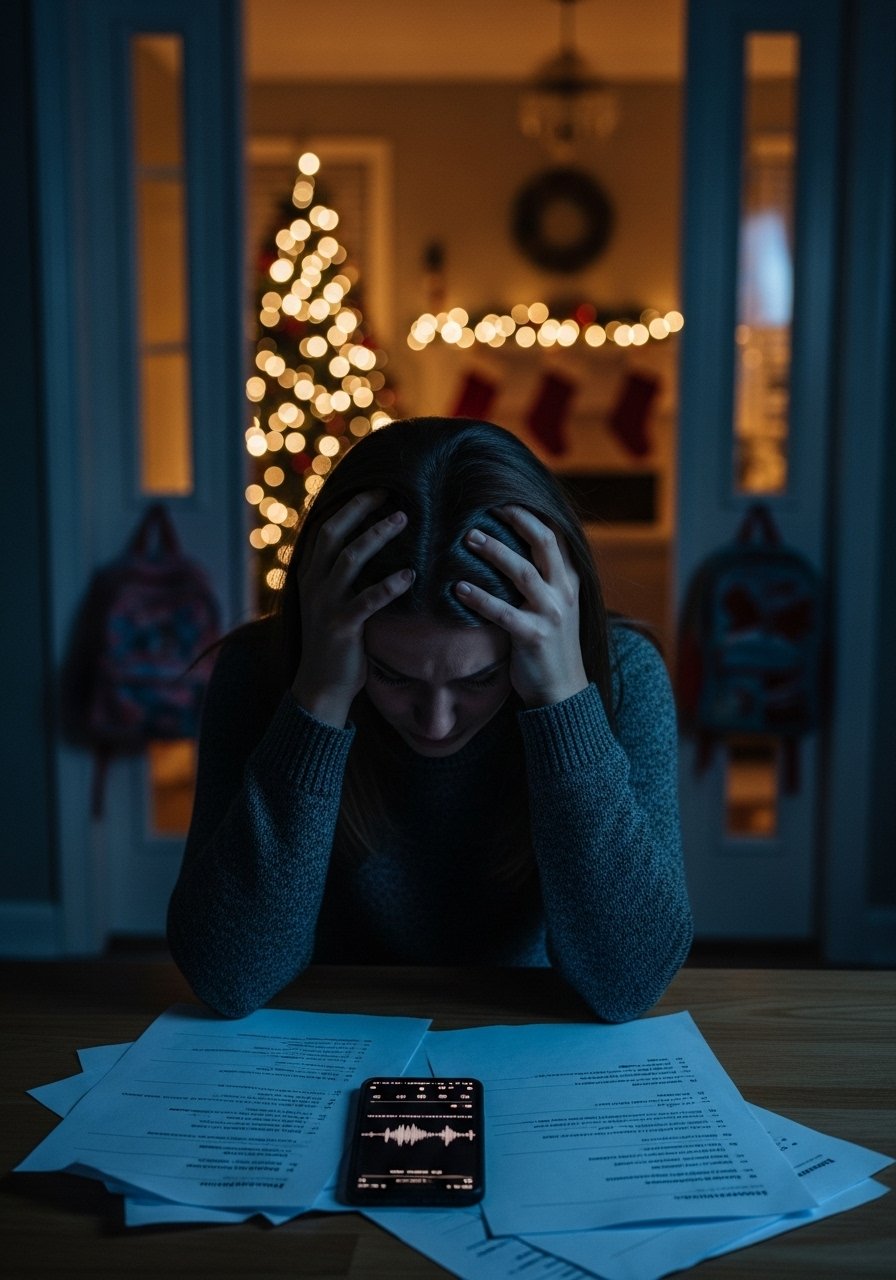
I never thought I’d be the person to ban a grandparent from seeing their grandchildren during the holidays, but here we are. Christmas is in three days, and my mother-in-law is officially uninvited from our home. My husband is caught in the middle, half my family thinks I’m overreacting, and I’m sitting here listening to audio recordings that make me want to throw up.
Yes, audio recordings. Because if I didn’t have proof of what’s been happening behind my back for God knows how long, I’d probably be questioning my own sanity right now. But I do have proof. Hours of it. And what I discovered has shattered any illusions I had about my relationship with my MIL and made me question everything about the past three years.
So let me tell you the whole story, because I genuinely need outside perspective on whether I’m doing the right thing or if I’ve completely lost it.
The Background
My mother-in-law, Linda, has always been… involved. That’s the polite way to put it. From the moment my husband Mark and I got engaged seven years ago, she’s had opinions about everything—our wedding, our house, our careers, our parenting style, even what we name our kids.
We have two children: Emma, who just turned 7, and Lucas, who’s 5. Linda lives about fifteen minutes away and has been extremely present in their lives since they were born. She babysits once or twice a week, comes to every school event, and has the kids sleep over at her house at least once a month.
I always thought this was wonderful. I have a complicated relationship with my own mother, so I was genuinely happy that my kids had such an involved grandmother. Sure, Linda could be a bit overbearing and old-fashioned in her views, but I chalked it up to generational differences and tried to let things slide.
Mark is an only child, and Linda has been a widow for twelve years. I understood that our kids were basically the center of her world, and I didn’t want to be the daughter-in-law who restricted grandparent access. So I bit my tongue when she’d make little comments about my parenting choices, rolled my eyes when she’d “forget” the boundaries we’d set, and tried to maintain the peace.
Looking back now, I realize I was way too accommodating. I was so focused on being the “cool” daughter-in-law and making sure my kids had a relationship with their grandmother that I ignored about a thousand red flags.
The Incident That Started Everything
Three weeks ago, my daughter Emma came home from school and asked me a question that made my blood run cold.
“Mommy, why do you not love us as much as Grandma Linda does?”
I was standing at the kitchen counter making after-school snacks, and I literally dropped the knife I was holding.
“What? Baby, what are you talking about? Of course I love you. I love you more than anything in the world.”
Emma looked confused and a little upset. “But Grandma Linda said that mommies who work don’t love their kids as much as mommies who stay home. And you work a lot, so…”
My heart started pounding. I teach high school English—I’m home by 4 PM most days and have summers off. I’m hardly an absentee parent. But more importantly, who the hell tells a seven-year-old something like that?
I took a deep breath and knelt down to Emma’s level. “Emma, sweetheart, that’s not true at all. Mommies show love in lots of different ways. Some mommies stay home, some mommies work, but that doesn’t mean one loves their kids more than the other. I work because I love teaching, and I also love spending time with you and Lucas. Both things can be true.”
Emma seemed somewhat reassured, but I could tell Linda’s words had planted a seed of doubt. After Emma went upstairs to play, I immediately texted Mark: “We need to talk about your mother. Call me when you can.”
When Mark called during his lunch break, I told him what Emma had said. His response was disappointing but not surprising: “Mom probably didn’t mean it that way. You know she’s from a different generation. She thinks staying home is what’s best for kids because that’s what she did.”
“But she told our daughter that I don’t love her as much because I work,” I said, trying to keep my voice steady. “That’s not a generational difference. That’s poisoning our child against me.”
Mark sighed. “I’ll talk to her. I’m sure she didn’t realize how it would sound to Emma.”
He did talk to her, apparently. Linda called me that evening, and her apology was one of those non-apologies that makes everything worse: “I’m sorry if Emma misunderstood what I said. I was just trying to explain why I’m always available for the kids when you’re at work. I didn’t mean anything by it.”
If Emma misunderstood? I wanted to scream. But I thanked her for calling, said I appreciated the apology, and tried to move on.
Except I couldn’t move on. Because once you see one crack in the foundation, you start noticing others.
The Pattern Emerges
Over the next week, I started paying closer attention to things my kids would say after spending time with Linda. Little comments that I’d previously dismissed as typical kid stuff suddenly seemed more sinister.
Lucas mentioned that Grandma Linda told him that I get “too angry” and that’s why she’s teaching him to keep secrets from me about things that happen at her house. “Secrets are how we protect the people we love,” she’d apparently said.
Emma casually mentioned that Grandma Linda said the reason I don’t bake cookies with them very often is because I “don’t have the patience” like a real mother should.
Lucas said Grandma Linda told him that someday he’d understand why Daddy works so hard—because he has to make up for Mommy not being a better homemaker.
Each comment was small on its own. Easily explained away as a misunderstanding or an overreaction on my part. But together, they formed a clear pattern: Linda was systematically undermining me to my own children.
I brought it up to Mark again. He was more concerned this time but still hesitant to fully confront his mother. “Maybe we should just reduce the babysitting for a while,” he suggested. “Give everyone some space.”
But I wanted answers. I wanted to know exactly what Linda was saying when I wasn’t around. I needed proof that I wasn’t being paranoid or oversensitive.
That’s when I made a decision that some people will probably judge me for: I put a recording device in Emma’s backpack.
The Recordings
Before anyone comes for me—yes, I know this is legally and ethically complicated. I did my research. In our state, it’s legal to record conversations as long as one party consents, and since Emma is my minor child, I legally had the authority to do this. I also made sure the device was only active during the times she was with Linda, and I told Emma there was a “special button” in her backpack that she could press if she ever felt unsafe (which activated the recording).
I wasn’t trying to spy on my child. I was trying to protect her from someone I suspected was psychologically manipulating her.
The first recording was from a Saturday when Linda took both kids to her house for the afternoon. I sat in my car in a parking lot two blocks from our house and listened to the audio in real-time on my phone, and what I heard made me feel physically ill.
It started innocuously enough—Linda was making lunch, asking the kids about school, normal grandmother stuff. But then Emma mentioned that I’d helped her with a school project the night before.
Linda’s response: “Oh, well, I’m glad Mommy finally had time for you. She’s so busy with her job that she doesn’t always make you girls her priority, does she?”
“What’s a priority?” Emma asked.
“It means what’s most important to you. For me, you and Lucas are my number one priority. That’s why I’m always here for you, no matter what. Some people put other things first, like their jobs or their friends. But not me. You two are the most important thing in my whole world.”
My hands were shaking. The implication was crystal clear: I didn’t prioritize my children. Linda did.
But it got worse.
Lucas said something about how I’d been tired lately (I’d been fighting a cold), and Linda responded: “Mommy gets tired a lot because she tries to do too much. That’s what happens when you don’t focus on what really matters. When I was raising your daddy, I made sure I had energy for him because being a mother was my job. My only job. And look how wonderful he turned out!”
Emma, bless her perceptive little heart, said: “But Mommy’s job is important too. She teaches kids.”
Linda’s laugh was condescending. “Oh sweetheart, anyone can teach kids. But only one person can be YOUR mommy. And the best mommies make their children the center of their universe. They don’t split their attention between their kids and a career.”
I had to pull over because I was crying so hard I couldn’t see the road.
More Disturbing Revelations
I kept recording over the next two weeks. Every time Linda babysat or took the kids somewhere, I made sure Emma had the device with her. And every single recording contained something that ranged from subtly undermining to outright cruel.
Some highlights, if you can call them that:
On my parenting style: “Grandma, why does Mommy have so many rules?” Lucas asked during one recording. “Because Mommy gets stressed easily, honey. She doesn’t know how to just relax and let kids be kids like I do. That’s why you have more fun here, right? Because Grandma understands what children need.”
On my relationship with Mark: “Do Mommy and Daddy fight a lot?” Emma asked (we’d had a minor disagreement about dishes the night before). “All couples fight sometimes, sweetie. But they fight more when one person isn’t pulling their weight. Daddy works so hard, and Mommy works too, but she also expects Daddy to do lots of housework when he gets home. That’s not really fair to him, is it? When I was married to Grandpa, I made sure everything was taken care of so he could relax when he got home from work.”
On my appearance: This one was particularly cruel. Emma mentioned that I’d gotten my hair cut shorter, and Linda said: “Oh dear. Well, your mommy makes interesting choices sometimes. Short hair isn’t very feminine, is it? When you grow up, you’ll want to keep your hair long and pretty so you can attract a good husband. Not all women understand how to do that.”
On food and health: I’ve been trying to feed my kids healthier meals and limit sugar. Linda apparently had thoughts about this too: “I know Mommy doesn’t like you having treats, but that’s because she’s worried about being skinny. Some mommies care more about how they look than about letting their children enjoy childhood. When Daddy was little, I let him have dessert whenever he wanted, and he turned out just fine!”
And the worst one—on my worth as a mother: Lucas was apparently upset about something (the recording captured him crying), and Linda comforted him: “It’s okay, baby. You know what? If Mommy ever decides that her job is more important than you and Emma, you can always come live with Grandma. I would take such good care of you. Better care than you get now because I would be here all the time, not just when it’s convenient. You’d never feel lonely or ignored here. You’d always be the most important thing to me.”
I listened to that one three times to make sure I’d heard it correctly. My mother-in-law was literally telling my five-year-old that he’d be better off living with her instead of with his own parents.
The Confrontation
I made Mark listen to every single recording. All of them. We sat together in our bedroom after the kids were asleep, and I watched his face change from skeptical to shocked to horrified as he heard his mother’s words.
“I can’t believe this,” he kept saying. “This isn’t… I don’t understand why she would…”
“She’s trying to turn our children against me,” I said flatly. “She’s been doing it for God knows how long, and it’s only going to get worse. She needs to be confronted, and there need to be serious consequences.”
To his credit, Mark didn’t try to defend her this time. He was angry—really angry—in a way I’d rarely seen. “I’ll call her tomorrow,” he said. “This has to stop immediately.”
The next morning, Mark called Linda and told her we needed to have a family meeting that evening. She showed up at our house at 6 PM, clearly confused about why both of us looked so serious.
We sat her down in the living room. Mark had printed out transcripts of some of the worst recordings (I’d gone through and transcribed the most damaging parts).
“Mom, we need to talk about what you’ve been saying to Emma and Lucas,” Mark started.
Linda immediately went defensive. “What are you talking about? I don’t say anything wrong to those children. I love them more than anything.”
“We know exactly what you’ve been saying,” I said, keeping my voice as calm as possible. “We have recordings.”
Her face went white. “Recordings? You’ve been recording me?”
“We’ve been recording what you say to our children when we’re not around,” Mark said. “And what we’ve heard is completely unacceptable.”
He started reading from the transcripts. With each quote, Linda’s expression shifted from shock to defensiveness to anger.
“You’re taking things out of context,” she said. “I was just trying to help them understand—”
“Understand what?” I interrupted. “That their mother doesn’t love them? That I’m a bad parent because I work? That they’d be better off living with you?”
“I never said you don’t love them!”
“Yes, you did,” Mark said firmly, pointing to the transcript. “Right here. You told Emma that mothers who work don’t love their kids as much. You’ve been consistently undermining my wife to our children, and it needs to stop.”
Linda stood up, her face flushed with anger. “I’ve been a mother a lot longer than either of you! I know what children need! And yes, I do think they’d be better off with someone who puts them first instead of worrying about a career! Is that so wrong?”
“Yes!” I said, my voice rising despite my efforts to stay calm. “Yes, it is wrong! You don’t get to undermine my parenting. You don’t get to make my children doubt my love for them. And you absolutely don’t get to suggest they’d be better off living with you!”
“I give those children everything!” Linda shouted. “I’m there for them constantly! More than you are! Someone has to make up for what they’re not getting at home!”
The implication was clear and devastating. She genuinely believed I was an inadequate mother.
Mark stepped between us. “Mom, you need to leave. Now. We’ll contact you when we’re ready to discuss what happens next.”
Linda looked at her son with absolute betrayal in her eyes. “You’re choosing her over me? I’m your mother. I raised you. And this is how you repay me?”
“You’ve been damaging my children’s relationship with their mother,” Mark said quietly. “This isn’t about choosing sides. This is about protecting our kids from something toxic.”
Linda grabbed her purse and headed for the door. Before she left, she turned back with tears streaming down her face. “You’ll regret this. Both of you. Those children need me.”
Then she was gone.
The Aftermath
That confrontation was ten days ago. Since then, things have been absolute chaos.
Linda has sent approximately fifty text messages ranging from apologetic (“I’m sorry if I hurt your feelings”) to angry (“You’re poisoning my son against me”) to manipulative (“Please don’t keep me from my grandchildren during Christmas. It’ll break their hearts”).
She’s called Mark’s phone so many times he had to block her number temporarily. She showed up at our house twice before we told her if she came again, we’d get a restraining order.
She’s contacted other family members, playing the victim. I’ve gotten texts from Mark’s aunt, his cousins, and even some family friends, all telling us we’re being too harsh, that we should forgive her, that banning her from Christmas is cruel and unnecessary.
“She’s just old-fashioned,” one text read. “She doesn’t mean any harm. You’re going to regret destroying this family over some hurt feelings.”
Some hurt feelings. As if systematically undermining a mother to her own children is just “hurt feelings.”
Mark has been incredible through all of this. He’s stood by my decision to uninvite Linda from Christmas, even though I know it’s killing him. She’s his mother, and despite everything, he still loves her. But he agrees that what she did was unforgivable and that our children’s wellbeing has to come first.
The kids have asked about Grandma Linda several times. “Why hasn’t Grandma come to visit?” “Is Grandma Linda coming for Christmas?”
We’ve tried to explain in age-appropriate terms: “Grandma said some things that weren’t kind, and we need to take a break from spending time with her while we figure things out.”
Emma, perceptive as always, asked: “Is it because of what she said about you, Mommy?”
My heart broke. “Yes, sweetie. Grandma said some things that weren’t true and weren’t nice. Grown-ups need to take responsibility for their words, just like kids do.”
The Christmas Decision
So now it’s three days before Christmas, and I’m standing firm on my decision: Linda is not welcome in our home for the holidays.
Some people think this is too harsh. “It’s Christmas,” they say. “It’s a time for family and forgiveness. Can’t you just let it go for the kids’ sake?”
But here’s the thing: I am doing this for the kids’ sake.
My children need to grow up knowing that their mother loves them unconditionally. They need to know that I will always protect them, even from people who are supposed to love them. They need to understand that actions have consequences, even for grandparents.
And honestly, I need to model healthy boundaries. If I let Linda get away with this behavior just because it’s Christmas, what am I teaching my daughter? That women should accept being undermined and disrespected to keep the peace? That we should tolerate toxic behavior from family members just because they’re family?
No. I won’t teach my daughter that. I won’t teach my son that either.
Linda has offered a half-hearted apology via text: “I’m sorry you were offended by my comments. I only want what’s best for the children. Can we please move past this and celebrate Christmas together as a family?”
But I don’t accept that apology. “I’m sorry you were offended” is not an apology. It doesn’t acknowledge what she did wrong. It doesn’t take responsibility. It doesn’t include any promise to change her behavior.
Until Linda can offer a genuine apology—one that acknowledges the specific harm she caused and outlines how she plans to do better—she doesn’t get access to my children.
And honestly, even with a genuine apology, I don’t know if I can ever trust her alone with them again. How do I know she won’t go right back to poisoning them against me the moment I’m not around?
The Guilt and the Doubt
I’d be lying if I said I was 100% confident in my decision. I feel guilty every single day.
Guilty that my kids won’t have their grandmother at Christmas. Guilty that Mark is caught in the middle. Guilty that I’m causing family drama during what’s supposed to be a happy time of year.
I also wonder if I’m being too harsh. Maybe Linda really doesn’t understand what she did wrong. Maybe she genuinely believes she was helping the kids. Maybe I should be more forgiving.
But then I listen to those recordings again, and I remember: she told my five-year-old that he should live with her instead of with us. She systematically tried to make my children doubt my love for them. She spent months, maybe years, undermining my role as their mother.
That’s not a mistake. That’s not a misunderstanding. That’s deliberate psychological manipulation of young children.
And I refuse to expose my kids to that anymore, even if it means they don’t see their grandmother for Christmas.
Where We Go From Here
I don’t know what the future holds for our relationship with Linda. Maybe eventually, with therapy and genuine accountability, we can rebuild some kind of relationship. Maybe she’ll never acknowledge what she did, and we’ll be estranged permanently.
Right now, I’m focused on my kids. On reassuring them that they are loved, that they are my priority, that nothing Linda said was true.
I’m focused on my marriage, on supporting Mark through this even though it’s his mother we’re dealing with.
And I’m focused on setting an example for my children about boundaries, self-respect, and what it means to protect the people you love.
Christmas will be different this year. Smaller. Quieter. But it will also be drama-free, which honestly sounds pretty good right now.
So yes, I uninvited my mother-in-law from Christmas. Some people think that makes me cruel. Some think it makes me strong.
All I know is that I’m doing what I believe is right for my family, even though it’s one of the hardest things I’ve ever done.
The Question I’m Left With
I’m putting this out there for everyone to weigh in on: Am I wrong?
Should I have given Linda another chance? Should I have let her come to Christmas and just monitored the situation more closely? Am I overreacting to what some people see as “typical grandparent behavior”?
Or am I justified in drawing this hard line and protecting my children from someone who, despite claiming to love them, was actively damaging their relationship with their mother?
Because despite all my conviction, I still have moments where I wonder if I’m doing the right thing. If I’m being too unforgiving. If I’m going to regret this decision.
But then I think about Emma asking me if I don’t love her as much because I work. I think about Lucas being told to keep secrets from me. I think about both of them being told they’d be better off living with their grandmother.
And I know—even with all the guilt and doubt—that I made the right choice.
My children deserve better than a grandmother who tears their mother down. They deserve to grow up secure in the knowledge that both their parents love them completely. And they deserve to see their mother stand up for herself and for them, even when it’s hard.
So this Christmas, Linda won’t be at our table. And I’m okay with that.
Even if everyone else thinks I’m wrong.