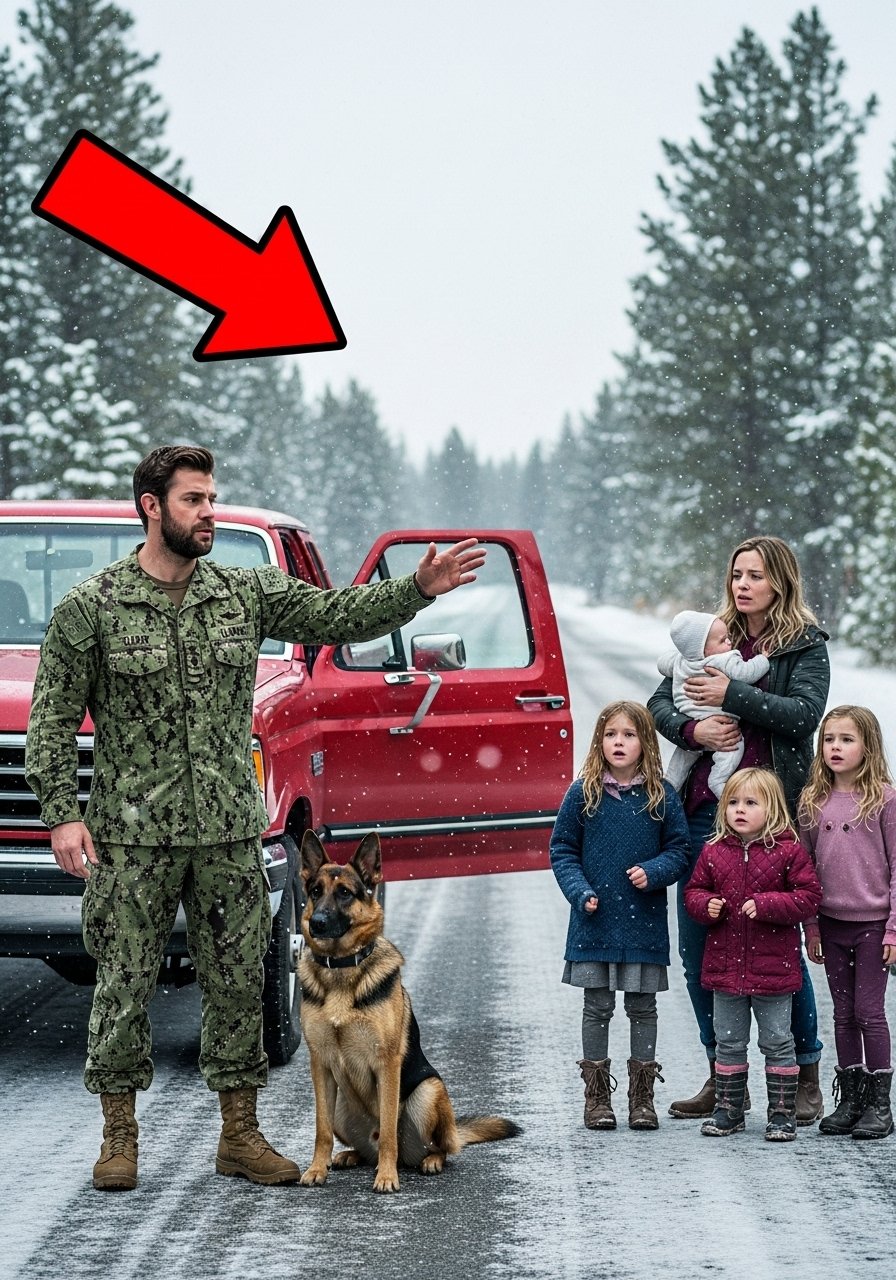
The whiteout in northern Maine isn’t a weather event; it’s a wall. When the sky turns that bruised shade of purple and the wind starts to scream at sixty miles per hour, the locals call it “The Eraser.” It erases roads, it erases landmarks, and if you’re not careful, it erases lives.
My name is Marcus. I spent twelve years in the Teams. I’ve survived sub-zero extractions and mountain skirmishes where the air was too thin to breathe. I retired to this quiet corner of the world to escape the noise, but the training never really leaves you. Your eyes stay on a swivel. You notice the things other people ignore.
That’s why, when I was navigating my modified truck through the worst blizzard of the decade, I saw the flash of red. It was a tiny scrap of fabric, fluttering near a snowbank three miles from the nearest house.
I slammed on the brakes. My 4×4 skidded, the tires clawing for grip. I stepped out, and the cold hit me like a physical blow—a dry, lethal $-15^\circ \text{F}$ without the wind chill.
There, huddled in a shallow ditch, was a woman. She was shielding two small children with her own body. They weren’t dressed for a blizzard. They were dressed for a quick trip to the grocery store.
“Ma’am!” I roared over the gale.
She looked up. Her eyelashes were matted with ice. Her eyes were glazed—the early stages of Stage II hypothermia. She didn’t scream for help. She just tightened her grip on the kids.
I didn’t ask for permission. I scooped up the girl, grabbed the boy by the hand, and hauled the woman toward the idling warmth of my truck.
The Shivering Truth
Once the cabin air hit $75^\circ \text{F}$ and their breathing began to steady, the story spilled out. Her name was Sarah. Her husband, David, had been a Marine sergeant. He didn’t come home from his last tour two years ago.
Sarah was a “Gold Star” widow, trying to make it on a shoe-string budget. That morning, her furnace had given out. With the storm rolling in, she panicked. She called the only family she had left: her husband’s brother, Greg, who lived only ten minutes away in a sprawling, climate-controlled mansion.
“He told me he couldn’t come,” Sarah whispered, her voice cracking as she held a steaming mug of coffee I’d kept in my thermos. “He said the roads were too dangerous for his new luxury SUV. He told me to ‘call a professional’ and hung up. I tried to drive to my mom’s, but the car slid… and the phone died.”
She had been walking for nearly forty minutes. In those temperatures, forty minutes is a death sentence.
The SEAL Instinct
As a Navy SEAL, you’re taught to compartmentalize. But hearing that a man would let his brother’s widow and children freeze to death because he didn’t want to salt-stain his leather seats? That triggered a different kind of mission.
“Come with me,” I told her.
“Where? To the hospital?”
“Eventually,” I said, my voice dropping into that low, tactical register. “But first, we’re going to make sure this never happens again.”
I drove them to my place—a reinforced cabin with a surplus generator and enough cordwood to last a nuclear winter. I called my neighbor, a retired nurse, to check their vitals. Once I knew they were safe, fed, and warm, I walked back out to my truck.
I had a GPS, a heavy-duty winch, and a very specific destination.
The Confrontation
Greg’s driveway was plowed. The lights in his house were warm and inviting. When I hammered on the door, he opened it wearing a cashmere sweater, a glass of scotch in his hand.
“Can I help you?” he asked, looking annoyed.
“I’m the guy who just pulled your brother’s kids out of a snowbank three miles from here,” I said. I stepped into the foyer. I’m 6’4″, 230 pounds of concentrated muscle. Greg took a very fast step back.
“Look, I told Sarah it wasn’t safe—”
“Safe for who, Greg? The SUV? Or your conscience?” I didn’t raise my voice. I didn’t have to. I leaned in close enough for him to see the “quiet professional” look in my eyes—the one that usually precedes a very bad day.
“Your brother died for people he didn’t even know,” I said. “And you wouldn’t drive ten minutes for the people he loved most. Here’s what’s going to happen. You’re going to write a check right now for Sarah’s furnace. Not a repair—a replacement. And then, you’re going to set up an education fund for those kids.”
“You can’t threaten me,” he stammered.
“I’m not threatening you. I’m offering you a chance at redemption before I tell every veteran organization in this state exactly what kind of ‘man’ you are. Small towns have long memories, Greg. Do you want to be the man who left a widow to die, or the man who fixed it?”
The Aftermath
The check was written. The furnace was replaced the next day by a local contractor who, after hearing the story from me, refused to charge for labor.
I spent the rest of the week chopping wood for Sarah’s back porch. Am I the jerk for using my “SEAL persona” to intimidate a civilian? Some might say so. They might call it “toxic” or “overstepping.”
But in the Teams, we have a saying: The only easy day was yesterday. For Sarah, yesterday was the hardest day of her life. My job was to make sure her tomorrow was a little bit brighter.
What would you have done? Would you have walked away, or would you have forced a “family man” to actually act like one?