The last time I saw my brother, Mark, truly happy was at our grandmother’s 80th birthday. He was laughing, a genuine, booming sound that filled the room, as he tried to teach our stoic German Shepard, Max, how to dance the polka. Max, naturally, just sat there, looking bewildered, while Mark spun around him, red-faced and joyful. That was five years ago. Now, when I see him, the laughter is gone, replaced by a vacant stare, a forced smile, and a rhetoric that chills me to the bone.
Part 1: The Cracks Begin to Show
Mark and I were always close. He was three years older, my protector, my confidant. Growing up in a small town in Ohio, we were inseparable. We built forts in the woods, navigated the terrifying labyrinth of high school together, and shared dreams over late-night pizza. He was the pragmatic one, the one who always had a plan, while I was the dreamer. He went to college, got a good job in engineering, and seemed set for a comfortable, conventional life.
The first sign that something was off was subtle. It started with him pulling away from our family vacations. First, it was a vague excuse about work, then a more pointed “I’ve got other commitments.” He stopped calling Mom as often. When he did, his conversations became strangely clipped, almost formal.
Then came the emails. Not from Mark, but from a new address: “The Beacon of Truth.” They were long, rambling diatribes about societal decay, the impending collapse of civilization, and the urgent need for spiritual purification. I dismissed them as spam, but a cold knot formed in my stomach when I saw Mark’s name listed as a “founding member” at the bottom.
I confronted him about it over Thanksgiving dinner, a meal that quickly devolved into a scene straight out of a reality TV show.
“Mark, what is this ‘Beacon of Truth’ stuff?” I asked, trying to keep my voice level. Our parents were across the table, pretending not to listen, but their hushed conversation had died.
He stiffened. “It’s a community, Sarah. A way to find true purpose in a world lost to materialism.”
“It sounds like a cult,” I blurted out.
His eyes, once full of warmth, turned cold. “You don’t understand. You’re still trapped in the illusion.”
That was the night the chasm opened between us.
Part 2: The Deepening Abyss
Over the next year, Mark became a ghost. He moved out of his apartment, quit his stable engineering job, and severed ties with most of his old friends. His phone number changed, and the only way to reach him was through the “Beacon of Truth” community email. Even then, the replies were always from a collective address, filled with jargon and evasive answers.
My parents were devastated. My mother, usually so resilient, started losing weight. My father, a man who rarely showed emotion, walked around with a perpetual shadow in his eyes. We tried everything. We called, we wrote letters, we even drove to the remote compound he now lived in, nestled deep in the mountains of Colorado.
The compound looked like something out of a bad movie. A high fence, security cameras, and stern-faced “volunteers” who politely but firmly turned us away. They spoke in the same unsettling, calm tones as Mark’s emails, about “seekers” and “the Great Awakening.”
My heart ached with a physical pain. This wasn’t my brother. The Mark I knew loved practical jokes, bad action movies, and long philosophical debates that usually ended with him conceding he was wrong, but only after a valiant argument. This new Mark was a stranger, hollowed out, his personality replaced by an ideology.
I spent countless nights researching cults, reading survivor stories, devouring books on mind control and psychological manipulation. I learned about the tactics: love bombing, isolation, thought reform, fear mongering. Every article was a punch to the gut, detailing the exact slow, insidious process that had consumed my brother.
I even tried to understand why Mark would be drawn to this. He was intelligent, grounded. But he’d also been quietly struggling with an existential crisis after a bad breakup and a period of feeling unfulfilled at work. They had preyed on that vulnerability, offering him purpose, belonging, and answers to questions he didn’t even know he was asking.
Part 3: A Desperate Plan
My parents wanted to hire a deprogrammer. I researched them, but the cost was astronomical, and the success rates were far from guaranteed. Plus, I worried about the trauma it might inflict. I couldn’t bear the thought of my brother hating me even more.
I decided I had to try something different. Something that felt more like me. I had to fight fire with fire, or rather, fight manipulation with genuine connection.
I started sending him packages. Not just letters, but things that evoked our shared past. A copy of his favorite childhood comic book. A ridiculous photo of us from a terrible school picture day. A playlist of all the cheesy 80s songs we used to sing at the top of our lungs on road trips. I knew the cult likely screened his mail, but I figured if enough innocuous, nostalgic items got through, they might trigger something.
I also created a fake social media profile. It was an elaborate charade. I posed as a “seeker” genuinely interested in “The Beacon of Truth.” I spent weeks studying their online forums, learning their jargon, their beliefs, their internal power structures. I knew it was risky, morally ambiguous even, but I was desperate.
I started posting innocent questions, expressing doubts about the “outside world,” and praising the “wisdom of the Elders.” Slowly, carefully, I started engaging with others in the community, building a persona that would eventually get me noticed by Mark.
Part 4: The Glimmer of Hope
It took nearly a year of this digital masquerade. A year of carefully crafted posts, of feigned spiritual yearning, of biting my tongue when I wanted to scream.
Then, one day, I received a private message.
From Mark.
“Your questions show genuine insight,” he wrote. “The Elders have noticed your sincerity.”
My heart pounded. It was a formal message, completely devoid of personality, but it was him. Or at least, his avatar in the cult.
I continued the charade, letting him guide me, asking for “spiritual guidance.” I learned about their daily routines: endless chores, communal meals, hours of “meditation” (which sounded suspiciously like indoctrination sessions), and nightly “gatherings” where the Elder preached their doctrine.
One of their core tenets was the rejection of “material possessions” and “earthly attachments.” This, I realized, was their way of severing ties with family, careers, and personal identity.
I subtly started introducing concepts of “true spiritual connection” that didn’t require isolation. I talked about finding divinity in nature, in art, in human connection. I even started sharing “personal anecdotes” that were actually disguised memories of Mark and me, framed as profound spiritual lessons.
It was a slow, agonizing process. Two steps forward, one step back. Sometimes, he’d respond with a canned cult message. Other times, I’d get a flicker of something more. A slightly less formal tone, a fleeting reference to something from our past that he quickly retracted.
The turning point came during one of our “private discussions” about the importance of “shedding earthly burdens.”
“Sometimes,” I wrote, “I miss the simple joy of an old photograph. It’s not about the paper or the ink, but the memory, the shared light within it. Is there not divinity in shared memory?”
His reply was brief. “Memories can be anchors.”
But then, an hour later, a second message: “Do you remember the photo of Max trying to dance?”
My breath hitched. It was a tiny thing, almost imperceptible. But it was his memory, unprompted by me. It was a crack in the wall, a single ray of light in the darkness.
Part 5: The Rescue Mission
I knew I had to seize the moment. I started talking about a “pilgrimage.” I framed it as a journey to a sacred natural site, a place where “seekers” could experience unfiltered divine energy, away from the structured environment of the compound. I chose a national park a few hours away from the compound, a place we used to hike together as kids.
I convinced him that I needed a “guide,” someone with his level of “spiritual understanding,” to join me. I made it sound like a personal mission, blessed by the Elders (I even forged an email from a fake Elder account for plausible deniability, a desperate act I don’t regret).
He agreed. It was a miracle.
The day I drove to pick him up, my hands were shaking so badly I almost had to pull over. I saw him standing by the road, dressed in the simple, shapeless robes the cult members wore. His face was thin, his eyes hollow, but for the first time in years, he was alone.
“Sarah,” he said, his voice flat.
“Mark,” I replied, my voice thick with unshed tears.
I didn’t hug him. I knew that would overwhelm him. I just opened the passenger door.
The drive was agonizingly quiet. I put on the old 80s playlist, low. He didn’t react. I kept my conversation neutral, talking about the “spiritual journey” and the beauty of the landscape.
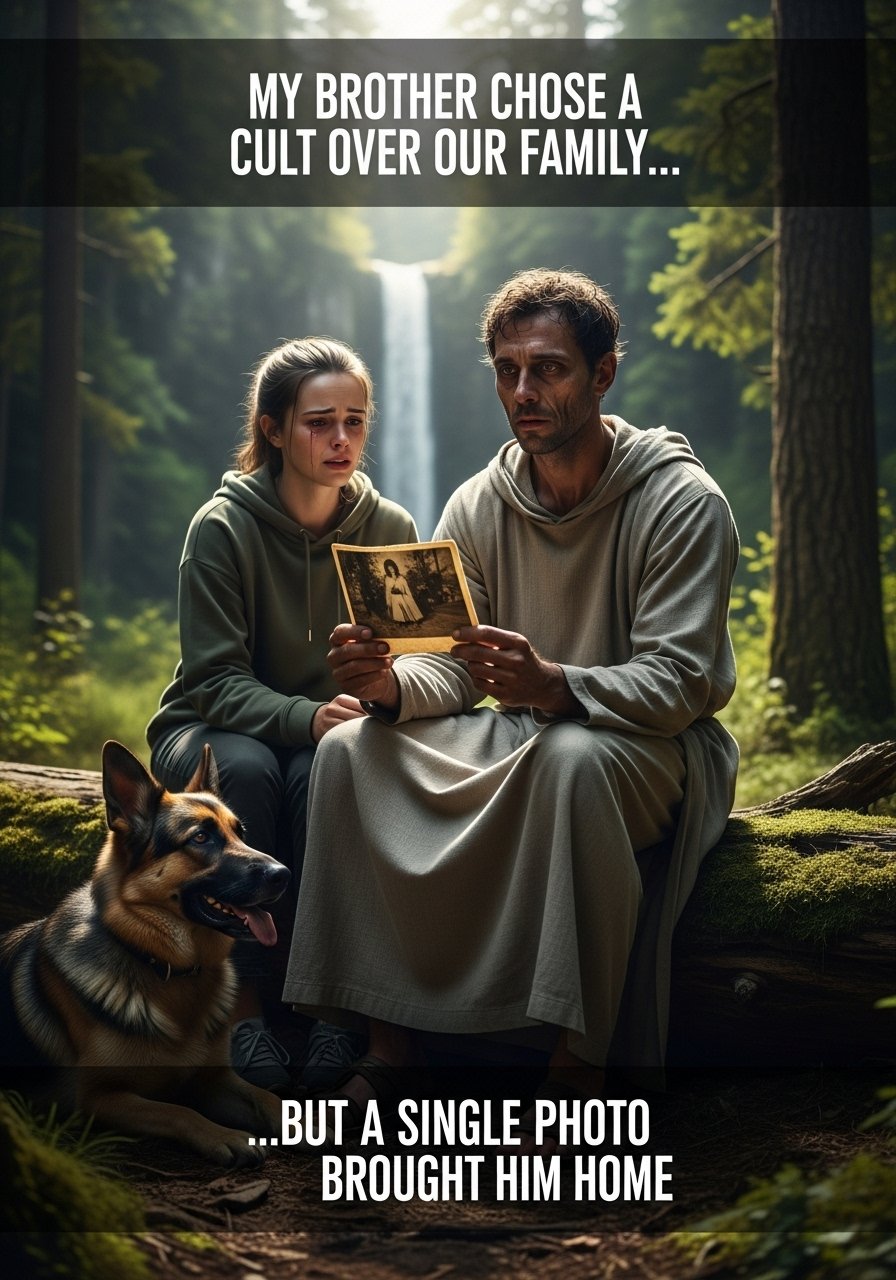
When we finally arrived at the national park, I led him to a clearing near a waterfall, a spot we used to call “our secret place.” I pulled out a small backpack.
“I packed some provisions for our pilgrimage,” I said, trying to sound casual.
Inside, I had placed our old photo albums. The one with Max dancing. The one with our parents, young and laughing. Pictures of our childhood home.
He looked at the albums with a detached curiosity, as if they were ancient artifacts. I didn’t push. I just sat beside him, and for the next few hours, I quietly flipped through the pages. I pointed to pictures, telling stories in a calm, even voice, stories that evoked laughter, mischief, and the unconditional love of our family.
I told him about the time he accidentally dyed his hair green trying to be a punk rocker. I reminded him of the summer we tried to build a raft and almost drowned in the creek. I spoke of Mom’s legendary apple pie and Dad’s terrible dad jokes.
At first, he just stared blankly. But slowly, imperceptibly, something began to shift. A muscle in his jaw twitched. His gaze lingered on a photo of our grandmother.
Then, he reached out, his hand trembling slightly, and pointed to a picture of him and me as toddlers, covered in mud, grinning maniacally.
“We were… we were always getting into trouble, weren’t we?” he whispered, his voice hoarse, like he hadn’t used it for personal thoughts in years.
Tears streamed down my face, but I kept my voice steady. “Always.”
Part 6: The Long Road Back
That was the first crack. It wasn’t an instant cure. The deprogramming was long and painful. It involved therapists, support groups, and a slow, agonizing process of him rebuilding his sense of self. The cult had stripped him of his identity, replaced his memories with theirs, and filled his mind with fear and paranoia.
There were relapses, moments where he’d retreat, muttering cult slogans, his eyes vacant once more. There were times I almost gave up, overwhelmed by the sheer magnitude of what had been done to him.
But our family never gave up. My parents moved closer, creating a stable, loving environment. We surrounded him with the unconditional love he’d been starved of. We listened without judgment, letting him process the trauma at his own pace.
It’s been two years since that day at the waterfall. Mark isn’t entirely “back” to who he was before. The experience has left its scars. He’s quieter, more introspective. He struggles with trust, and the trauma of having been manipulated still haunts him.
But he laughs now. Sometimes, when he thinks no one is looking, I catch him humming an old 80s tune. He’s working again, in a job he enjoys, and he volunteers at a local animal shelter, spending hours with the abandoned dogs, finding solace in their uncomplicated affection.
He even bought a new dog, a scruffy terrier mix he named Max, after our childhood companion.
We still talk about it, sometimes. The cult. The darkness. He’ll share fragments of what he remembers, the fear, the isolation, the insidious way they twisted his perception of reality. And I listen, offering empathy and understanding.
Our bond is different now. It’s forged in fire, deepened by a shared battle. He knows he almost lost everything, and he knows I fought for him when he couldn’t fight for himself.
It was the hardest thing I’ve ever done. It took everything I had, emotionally, mentally, financially. But when I see him now, truly present, truly there, I know it was worth every single moment.
To anyone out there with a loved one trapped in a cult: don’t give up. The path is long, harrowing, and heartbreaking. But sometimes, a little bit of shared memory, a glimmer of the past, can be enough to light the way back home.